10-K: Annual report [Section 13 and 15(d), not S-K Item 405]
Published on June 10, 2026
UNITED STATES
SECURITIES AND EXCHANGE COMMISSION
WASHINGTON, D.C. 20549
FORM
For the fiscal year ended
OR
For the transition period from ________ to __________
COMMISSION FILE NUMBER
Aethlon Medical, Inc.
(Exact name of registrant as specified in its charter)
| (State or other jurisdiction of incorporation or organization) | (I.R.S. Employer Identification No.) |
| (Address of principal executive office) | (Zip Code) |
REGISTRANT’S TELEPHONE NUMBER, INCLUDING AREA
CODE: (
SECURITIES REGISTERED PURSUANT TO SECTION 12(b) OF THE EXCHANGE ACT:
|
TITLE OF EACH CLASS |
TRADING SYMBOL |
NAME OF EACH EXCHANGE ON WHICH REGISTERED |
SECURITIES REGISTERED UNDER SECTION 12(g) OF THE EXCHANGE ACT:
NONE
(TITLE OF CLASS)
Indicate by check mark if the registrant is a well-known seasoned issuer,
as defined in Rule 405 of the Securities Act. Yes ☐
Indicate by check mark if the registrant is not required to file reports
pursuant to Section 13 or 15(d) of the Act. Yes ☐
Indicate by check mark whether the registrant (1)
has filed all reports required to be filed by Section 13 or 15(d) of the Securities Exchange Act of 1934 during the preceding 12 months
(or for such shorter period that the registrant was required to file such reports), and (2) has been subject to such filing requirements
for the past 90 days.
Indicate by check mark whether the registrant has
submitted electronically every Interactive Data File required to be submitted pursuant to Rule 405 of Regulation S-T (§ 232.405 of
this chapter) during the preceding 12 months (or for such shorter period that the registrant was required to submit such files).
Indicate by check mark whether the registrant is a large accelerated filer, an accelerated filer, a non-accelerated filer, a smaller reporting company, or an emerging growth company. See the definitions of “large accelerated filer,” “accelerated filer”, “smaller reporting company”, and “emerging growth company” in Rule 12b-2 of the Exchange Act. (Check one)
| Large accelerated filer ☐ | Accelerated filer ☐ | |
| Smaller reporting company | ||
| Emerging growth company |
If an emerging growth company, indicate by check mark if the registrant has elected not to use the extended transition period for complying with any new or revised financial accounting standards provided pursuant to Section 13(a) of the Exchange Act. ☐
Indicate by check mark whether the registrant has
filed a report on and attestation to its management’s assessment of the effectiveness of its internal control over financial reporting
under Section 404(b) of the Sarbanes-Oxley Act (15 U.S.C. 7262(b)) by the registered public accounting firm that prepared or issued its
audit report.
If securities are registered pursuant to Section 12(b)
of the Act, indicate by check mark whether the financial statements of the registrant included in the filing reflect the correction of
an error to previously issued financial statements.
Indicate by check mark whether any of those error corrections are restatements that required a recovery analysis of incentive-based compensation received by any of the registrant’s executive officers during the relevant recovery period pursuant to § 240.10D-1(b). ☐
Indicate by check mark whether the registrant is a
shell company (as defined in Rule 12b-2 of the Exchange Act). Yes ☐ No
The aggregate market value of the common stock held
by non-affiliates of the registrant as of September 30, 2025 (the last trading day of the registrant’s most recently completed second
quarter) was approximately $
The number of shares of the common stock of the registrant outstanding as of June 8, 2026 was .
TABLE OF CONTENTS
| i |
CAUTIONARY NOTICE REGARDING FORWARD LOOKING STATEMENTS
This Annual Report on Form 10-K, or Annual Report, contains “forward-looking statements” within the meaning of Section 27A of the Securities Act of 1933, as amended, or Securities Act, and Section 21E of the Securities Exchange Act of 1934, as amended, or the Exchange Act, which are subject to the safe harbor created by those sections.
We may, in some cases, use words such as “anticipate,” “believe,” “could,” “estimate,” “expect,” “intend,” “may,” “plan,” “potential,” “predict,” “project,” “should,” “will,” “would” or the negative of these terms, and similar expressions that convey uncertainty of future events or outcomes to identify these forward-looking statements. Any statements contained herein that are not statements of historical facts may be deemed to be forward-looking statements and are based upon our current expectations, beliefs, estimates and projections, and various assumptions, many of which, by their nature, are inherently uncertain and beyond our control. Such statements, include, but are not limited to, statements contained in this Annual Report relating to our business, business strategy, products and services we may offer in the future, the timing and results of future regulatory filings, the timing and results of future clinical trials, and capital outlook. Forward-looking statements are based on our current expectations and assumptions regarding our business, the economy and other future conditions. Because forward looking statements relate to the future, they are subject to inherent uncertainties, risks and changes in circumstances that are difficult to predict. Our actual results may differ materially from those contemplated by the forward-looking statements. They are neither statements of historical fact nor guarantees of assurance of future performance. We caution you therefore against relying on any of these forward-looking statements. Important factors that could cause actual results to differ materially from those in the forward looking statements include, but are not limited to, a decline in general economic conditions nationally and internationally; the ability to protect our intellectual property rights; competition from other providers and products; risks in product development; inability to raise capital to fund continuing operations; changes in government regulation; the ability to complete capital raising transactions, and other factors (including the risks contained in Item 1A of this Annual Report under the heading “Risk Factors”) relating to our industry, our operations and results of operations and any businesses that may be acquired by us. Should one or more of these risks or uncertainties materialize, or should the underlying assumptions prove incorrect, actual results may differ significantly from those anticipated, believed, estimated, expected, intended or planned.
Factors or events that could cause our actual results to differ may emerge from time to time, and it is not possible for us to predict all of them, nor can we assess the impact of all factors on our business or the extent to which any factor, or combination of factors, may cause actual results to differ materially from those contained in any forward-looking statements we may make. Given these uncertainties, you should not place undue reliance on these forward-looking statements. We cannot guarantee future results, levels of activity, performance or achievements. Except as required by applicable law, we undertake no obligation to and do not intend to update any of the forward-looking statements to conform these statements to actual results.
| ii |
SUMMARY RISK FACTORS
Below is a summary of the principal factors that make an investment in our securities speculative or risky. This summary does not address all of the risks that we face. Additional discussion of the risks summarized in this risk factor summary, and other risks that we face, can be found below under the heading “Risk Factors” in Part I of this Annual Report and should be carefully considered, together with other information in this Annual Report and our other filings with the SEC before making investment decisions regarding our securities.
| · | We have incurred significant losses and expect to continue to incur losses for the foreseeable future. As a result, our financial statements for the fiscal year ended March 31, 2026 carry a going concern qualification by our independent auditors. | |
| · | We will require additional financing to sustain our operations, achieve our business objectives and satisfy our cash obligations, which may dilute the ownership of our existing stockholders. | |
| · | We have limited experience in identifying and working with large-scale contracts with medical device manufacturers; manufacture of our devices must comply with good manufacturing practices in the United States. | |
| · | Delays, interruptions or the cessation of production by our third-party suppliers of important materials or delays in qualifying new materials has and may continue to prevent or delay our ability to manufacture our Hemopurifier. | |
| · | Our Hemopurifier technology may become obsolete. | |
| · | If we fail to comply with extensive regulations of U.S. and foreign regulatory agencies, the commercialization of our products could be delayed or prevented entirely. | |
| · | If we are unable to maintain compliance with the listing requirements of the Nasdaq Capital Market, our common stock may be delisted from the Nasdaq Capital Market, which could have a material adverse effect on our financial condition and could make it more difficult for you to sell your shares. | |
| · |
As a public company with limited financial resources undertaking the launch of new medical technologies, we may have difficulty attracting and retaining executive management and directors.
| |
| · |
We plan to expand our operations, which may strain our resources; our inability to manage our growth could delay or derail implementation of our business objectives.
| |
| · |
Our success is dependent in part on our executive officers.
| |
| · | Delays in successfully commencing or completing our planned clinical trials could jeopardize our ability to obtain regulatory approval and sustain our operations. |
| iii |
PART I
ITEM 1. BUSINESS
Unless otherwise indicated or the context otherwise requires, references to the “Company”, “Aethlon”, “we”, “us” and “our” refer to Aethlon Medical, Inc.
Overview and Corporate History
Overview
We are a medical therapeutic company focused on developing the Hemopurifier® (HP), a clinical-stage investigational immunotherapeutic device designed to address unmet needs in oncology, life-threatening infectious diseases, organ transplantation and other disease states in which extracellular vesicles (EVs) contribute to disease progression. The Hemopurifier utilizes a proprietary lectin-based technology to bind and remove enveloped viruses and EVs from biological fluids. EVs have been associated with immune suppression, metastasis, and resistance to therapy in cancer, as well as progression of severe infectious diseases.
In pre-clinical studies, the Hemopurifier has also demonstrated the ability to bind disease-associated extracellular vesicles (“EVs”) and a panel of enveloped viruses. The Hemopurifier has been evaluated in human studies, involving 173 treatment sessions in 44 patients with either viral infections or cancer. The device has been well tolerated with an adverse event profile that is consistent with extracorporeal therapy. In certain human studies designed to evaluate viral clearance from biological fluids, findings demonstrated the removal of enveloped viruses. The U.S. Food and Drug Administration (“FDA”) has granted the Hemopurifier “Breakthrough Device” designation for two independent indications:
| · | the treatment of individuals with advanced or metastatic cancer unresponsive to or intolerant of standard-of-care therapy; and | |
| · | the treatment of life-threatening viruses not addressed with approved therapies. |
We are currently advancing clinical development activities for the Hemopurifier in oncology. We are also evaluating the Hemopurifier’s potential in additional applications based on its mechanism of action and preclinical studies.
We are evaluating the Hemopurifier as a potential treatment of patients with advanced and metastatic cancer through its ability to bind to and remove extracellular vesicles (“EVs”) particles that may promote tumor growth and metastasis. In October 2022, we formed a wholly-owned subsidiary in Australia to support oncology-related clinical research and pursue regulatory approval and potential regulatory and commercialization opportunities for the Hemopurifier.
We previously completed an in vitro binding study of utilizing cancer patient samples, to evaluate the Hemopurifier’s ability to remove EVs from plasma. Results from this translational study provided pre-clinical evidence supporting the design of our oncology clinical trial involving patients with solid tumors who have stable or progressive disease during anti-PD-1 monotherapy treatment, such as Keytruda® (pembrolizumab) or Opdivo® (nivolumab).
We are currently conducting a safety, feasibility and dose-finding clinical trial in Australia evaluating the Hemopurifier in patients with solid tumors who have stable or progressive disease during anti-PD-1 monotherapy treatment. The trial is designed to enroll approximately 9 to 18 participants. The primary endpoint of the trial is safety, while exploratory analyses will be conducted to explore the number of HP treatments required to produce sustained reductions of EVs as well as improve anti-tumor T cell activity.
| 1 |
Three clinical sites in Australia— Royal Adelaide Hospital in Adelaide, and Pindara Private Hospital on the Gold Coast and GenesisCare North Shore Hospital in Sydney— are currently open for patient enrollment. During fiscal year 2026, we completed enrollment and treatment of the first cohort of three participants, each of whom received a single 4-hour Hemopurifier treatment. Following review of the first cohort data, independent Data Safety Monitoring Board (DSMB) reported no safety concerns and recommended progression to the second cohort. Following the DSMB review of the first cohort, enrollment commenced in the second cohort, in which participants received two Hemopurifier treatments during a one-week treatment period. In March 2026, the Company completed the second cohort and the DSMB subsequently approved advancement to the third cohort of the study. To date, no serious adverse events (“SAEs”) or dose-limiting toxicities ((“DLTs”) related to the Hemopurifier have been reported.
We previously pursued approval of a similar oncology clinical trial in India and received formal approval from the Central Drugs Standard Control Organization (“CDSCO”) on July 7, 2025. Following evaluation of anticipated site activation timelines and trial execution requirements, the Company elected to not proceed with the India trial in order to conserve resources and focus efforts on the Australian oncology clinical trial.
Life-Threatening Viral Infections
We believe the Hemopurifier may be applicable in the treatment of life-threatening viral infections involving highly glycosylated, or carbohydrate coated, viruses for which no approved therapies exist. In small-scale or early feasibility human studies conducted under FDA and international regulatory frameworks, the Hemopurifier has been used to treat individuals infected with Ebola, human immunodeficiency virus, or HIV, and hepatitis-C and SARS-CoV-2.
In vitro studies have demonstrated the ability of the Hemopurifier to capture multiple enveloped viruses, including Ebola, Marburg virus, Zika, Lassa, MERS-CoV, Cytomegalovirus, Epstein-Barr, Herpes simplex, Chikungunya, Dengue, West Nile, H1N1 swine flu, H5N1 bird flu, and the reconstructed 1918 Spanish flu virus. In several cases, these studies were conducted in collaboration with leading government or non-government research institutes.
While we terminated our U.S. and India-based COVID-19 studies due to low ICU patient volume and shifting priorities, these programs provided clinical experience with the Hemopurifier in critically ill patients. We continue to maintain an open IDE for viral indications, preserving the ability to evaluate the Hemopurifier in response to future outbreaks or emergent pathogens.
Under this open IDE, in 2014, the Company filed an Expanded Access protocol with the FDA to treat Ebola virus infected patients in up to ten centers in the United States and a corresponding protocol was approved by Health Canada. These protocols remain open, allowing Hemopurifier treatment to be offered to patients presenting for care in both countries.
We have sufficient inventory of Hemopurifiers to support our ongoing oncology trial in Australia as well as any near-term expansion of that study. While we have received FDA approval to begin manufacturing at our San Diego facility under our IDE supplement, we are still awaiting FDA approval of a separate supplement to qualify an additional supplier of a key Hemopurifier component as a second source. We continue to work with the FDA on this process.
Pre-Clinical Exploration of Additional Clinical Uses for the Hemopurifier
The Aethlon R&D laboratory continues to explore potential new indications for the Hemopurifier. We have published in the peer-reviewed journal Transplant Immunology the ability of the device to remove extracellular vesicles and their microRNA cargo from acellular perfusates of discarded kidneys that had undergone normothermic machine perfusion.
On May 12, 2025, the results of our pre-clinical ex vivo study entitled “Ex Vivo Removal of CD41 positive platelet microparticles from Plasma by a Medical Device containing a Galanthus nivalis agglutinin (GNA) affinity resin” were published in the pre-print vehicle bioRxiv.
| 2 |
Platelet-derived extracellular vesicles (PD-EVs) are the most numerous EV population in the body and are released by platelets in response to a variety of stimuli. The cargo contained within these EVs have been noted to take part in damage to blood vessels, activation of immune cells and spread of tumor cells. Excessive levels of PD-EVs have been implicated in a myriad of diseases including cancer, lupus, systemic sclerosis, multiple sclerosis, Alzheimer’s disease, sepsis, acute COVID-19 and Long COVID.
In this study, donated healthy human plasma was circulated through the Hemopurifier (HP) to simulate a clinical HP session. The study demonstrated approximately 98.5% removal of platelet-derived EVs at a timepoint equivalent to a four-hour HP treatment. We believe the results support the ongoing Australian oncology clinical trial and may support investigation of the Hemopurifier in additional disease indications.
In November 2025, we publicly released a separate pre-clinical preprint entitled “Increased mannosylation of extracellular vesicles in Long COVID plasma provides a potential therapeutic target for Galanthus nivalis agglutinin (GNA) affinity resin,” describing exploratory ex vivo laboratory research conducted in collaboration with the University of California, San Francisco Long COVID Clinic examining extracellular vesicle characteristics in plasma samples from individuals with Long COVID. The findings described in these preprints have not been peer reviewed and are based on laboratory analyses rather than clinical studies. These activities are intended to inform potential future research directions and evaluate the broader applicability of the Hemopurifier platform and may not be indicative of clinical outcomes.
Successful clinical development and regulatory approvals will be required before the Hemopurifier may be marketed in the United States or foreign jurisdictions. Some of our patents may expire before regulatory approval is obtained; however, the Company believes that its existing patent portfolio and more recently issued patents and patent applications will continue to support protection of the proprietary nature of our Hemopurifier treatment technology.
We continue to monitor the impact of inflation, global economic conditions, geopolitical conflicts, capital market volatility and other macroeconomic factors on its business, operations, clinical development programs and future access to capital. The extent to which these factors may affect the Company’s business, financial condition and results of operations remains uncertain and will depend on future developments beyond the Company’s control.
Our executive offices are located in San Diego, California. Our telephone number is (619) 941-0360. Our website address is www.aethlonmedical.com. The information contained on, or that can be accessed through, our website is not part of, and is not incorporated into, this Annual Report.
The Mechanism of Action (MOA) of the Hemopurifier
The Hemopurifier is a lectin-affinity plasmapheresis extracorporeal device designed for the removal of harmful extracellular vesicles and life-threatening enveloped viruses from the plasma component of the bloodstream. In the United States, the Hemopurifier is classified as a combination product whose regulatory jurisdiction is the Center for Devices and Radiological Health, or CDRH, the branch of FDA responsible for the premarket approval of all medical devices.
In our current applications, our Hemopurifier can be used with approved dialysis machines serving as a blood pump. It could also potentially be developed as part of a proprietary closed system with its own pump and tubing set, negating the requirement for dialysis infrastructure.
| 3 |
The Hemopurifier - Clinical Experience
Hepatitis C and HIV
The initial clinical development of the Hemopurifier focused on the viral infections Hepatitis C and HIV. Clinical trials conducted in India and a safety trial demonstrated the removal of both viruses from the bloodstream with a benign safety profile. Prior to FDA approval of the IDE feasibility study, we conducted investigational HCV treatment studies at the Apollo Hospital, Fortis Hospital, and the Medanta Medicity Institute in India. In the Medanta Medicity Institute study, 12 HCV-infected individuals were enrolled to receive three six-hour Hemopurifier treatments during the first three days of a 48-week peginterferon+ribavirin treatment regimen. The study was conducted under the leadership of Dr. Vijay Kher. Dr. Kher’s staff reported that Hemopurifier therapy was well tolerated and without device-related adverse events in the 12 patients treated.
Of these 12 patients, ten completed the Hemopurifier-peginterferon+ribavirin treatment protocol, including eight genotype-1 patients and two genotype-3 patients. Eight of the ten patients achieved a sustained virologic response, which is the clinical definition of treatment cure and is defined as undetectable HCV in the blood 24 weeks after the completion of the 48-week peginterferon+ribavirin drug regimen. Both genotype-3 patients achieved a sustained virologic response, while six of the eight genotype-1 patients achieved a sustained virologic response, which defines a cure of the infection. Our IDE safety study in end stage renal disease patients on dialysis who were infected with HCV was conducted at DaVita MedCenter Dialysis in Houston, Texas. We reported that there were no device-related adverse events in enrolled subjects who met the study inclusion-exclusion criteria. We also reported that an average capture of 154 million copies of HCV (in International Units, I.U.) within the Hemopurifier during four-hour treatments.
In addition to treating Ebola and HCV-infected individuals, we also conducted a single proof-of-principle treatment study at the Sigma New Life Hospital in an AIDS patient who was not being administered HIV antiviral drugs. In the study, viral load was reduced by 93% as the result of 12 Hemopurifier treatments (each four hours in duration) that were administered over the course of one month.
With the advent of highly effective anti-retroviral drugs for HIV (HAART), and curative direct acting antivirals (DACs) for Hepatitis C, clinical development for these indications was abandoned.
Ebola Virus-Single Patient Emergency Use
Under Emergency use conditions a single patient with Ebola infection with multiple organ dysfunction was treated with the Hemopurifier at Frankfurt University Hospital in Germany. The patient tolerated a single 6.5-hour Hemopurifier treatment. Prior to treatment, the Ebola viral load was measured at 400,000 copies/ml. The post-treatment viral load was 1,000 copies/ml. Calculations by the treating physician indicated that 242 million copies of Ebola virus were captured within the Hemopurifier during treatment. The patient made a full recovery. Based on this experience, the Company filed an Expanded Access protocol with the FDA to treat Ebola virus infected patients in up to ten centers in the United States and a corresponding protocol was approved by Health Canada. These protocols remain open, allowing Hemopurifier treatment to be offered to patients presenting for care in both countries. In 2018, the FDA designated the Hemopurifier as a Breakthrough Device ” for the treatment of life-threatening viruses that are not addressed with approved therapies.”
Severe Acute SARS-CoV-2/COVID-19 Infection – Emergency Use and Clinical Trials
SARS-COV-2, the causative agent of COVID-19 is a member of the coronavirus family, which includes the original SARS virus, SARS-CoV, and the MERS virus. SARS-CoV-2, found to contain mannose on the envelope surface. This suggests that the Hemopurifier could potentially clear it from biological fluids, including blood.
| 4 |
Under Single Patient Emergency Use regulations, we have treated two patients with COVID-19 with the Hemopurifier. We published a manuscript reviewing case studies covering those two Single Patient Emergency Use treatments entitled “Removal of COVID-19 Spike Protein, Whole Virus, Exosomes and Exosomal microRNAs by the Hemopurifier® Lectin-Affinity Cartridge in Critically Ill Patients with COVID-19 Infection” in the peer-reviewed journal Frontiers in Medicine.
The manuscript described the use of the Hemopurifier for a total of nine sessions in two critically ill COVID-19 patients. The first case study demonstrated the improvement in the patient who was a SARS-COV-2 positive COVID-19 present at entry to the hospital, with associated coagulopathy, or CAC, lung injury, inflammation, and tissue injury despite the absence of demonstrable COVID-19 viremia at the start of treatment at Day 22. This patient received eight Hemopurifier treatments without complications and eventually was weaned from a ventilator and was discharged from the hospital. Plasma samples from this patient revealed a decrease in extracellular vesicle counts over the course of the eight treatments and decreases in exosomal microRNAs associated with the development of coagulopathy and acute lung injury.
The second patient case study demonstrated in vivo removal of SARS-CoV-2 virus from the blood stream of an infected patient. This patient completed a six-hour Hemopurifier treatment without complications and subsequently was placed on continuous renal replacement therapy, or CRRT. The patient ultimately expired three hours after being placed on CRRT because of the advanced stage of the patient’s disease.
On June 17, 2020, the FDA approved a supplement to our open IDE for the Hemopurifier in viral disease to allow for the testing of the Hemopurifier in patients with SARS-CoV-2/COVID-19 in a New Feasibility Study. That study was designed to enroll up to 40 subjects at up to 20 centers in the United States. Subjects had to have an established laboratory diagnosis of COVID-19, be admitted to an ICU, and have acute lung injury and/or severe or life-threatening disease, among other criteria. Endpoints for this study, in addition to safety, include reduction in circulating virus, as well as clinical outcomes (NCT # 04595903). In June 2022, the Company completed the treatment protocol for its first patient in this study.
In June 2022, the Company completed the treatment protocol of the only participant enrolled in the study. The patient received one HP treatment daily for 4 days. This patient died following cardiac arrest (not related to the HP treatment) as a consequence of severe COVID-19 pneumonia. Blood samples taken from the patient did not reveal any evidence of viremia. Plasma sent for cytokine analysis revealed a numeric decrease in the levels of IP-10, MCP-1, and IL-10.
A similarly designed trial was also conducted in India. One patient was enrolled on February 16, 2022, at Medanta Medicity Hospital, Gurugram, Haryana 12200, India. The patient tolerated one HP treatment daily for three days. On February 19, 2022, in the first 15 min during the 3rd treatment, one nonserious Grade 2 AE was reported (hemolysis and leaking of the filter). The filter was replaced, and therapy resumed without sequelae. On Day #4 the patient suffered asystole and died due to clinical deterioration unrelated to the device. During the first Hemopurifier treatment (T1) there was a gradual decrease in viral load from the baseline at 4923 copies/mL decreasing steadily to 1307 copies/mL over five hours, indicating a 73% reduction from baseline. At the beginning of the second Hemopurifier treatment (T2), the viral load was 850 copies/mL, dropped below the lower limit of quantification within an hour, and remained undetectable, suggesting rapid clearance. The viral load before the third treatment (T3) was below the quantification limit but unexpectedly rose at 3 hours (636 copies/mL), peaking at 4 hours (1583 copies/mL), and slightly decreasing at 5 hours (1104 copies/mL). This irregular pattern suggests possible delayed RNA release, sample variability, or another biological factor affecting detection. The cumulative data shows a reduced SARs-CoV-2 viral load during the first two Hemopurifier treatments but not during the third treatment.
Due to lack of eligible patients in the ICU the clinical trial was closed on November 22, 2022.
| 5 |
Oncology- U.S. Clinical Trial in Head and Neck Cancer
A single center clinical trial entitled “Depleting Exosomes to Improve Response to Immune Therapy in Head and Neck Squamous Cell Cancer: An Early Feasibility Phase I Clinical Trial” was conducted under a US IDE at the University of Pittsburgh. This was a single arm Phase 1 clinical trial designed to evaluate the safety and efficacy of the Hemopurifier plus pembrolizumab for the treatment of patients with recurrent or metastatic head and neck squamous cell cancer. All patients were treated with pembrolizumab every 21 days as standard of care. The patients were to receive a 4-hour Hemopurifier treatment before Pembrolizumab infusions 2 occasions 21 days apart. A total of 2 patients were enrolled in the study with the first occurring on Dec 14, 2020. The first patients received 2 HP treatments, and the second patient received one HP treatment. The second treatment in the second patient was terminated due to operator error.
The only exploratory efficacy laboratory analysis that was performed in this study was a determination of the total nanoparticle concentrations in the 1st patient prior to and for 14 days after the second HP treatment. Total nanoparticle concentrations decreased following each Hemopurifier treatment. Following Hemopurifier treatment, the total nanoparticle concentrations rose by about Day 7 but did not reach the baseline levels. Exosomes levels are a component of the total nanoparticle concentration but exosome levels over time were not specifically determined.
Research and Development Costs
A substantial portion of our operating budget is used for research and development activities. The cost of research and development, all of which has been charged to operations, amounted to approximately $1,912,000 and $2,212,000 in the fiscal years ended March 31, 2026 and 2025, respectively.
Recent Developments
Subsequent to March 31, 2026, the Company sold an aggregate of 800,111 shares of common stock under its ATM facility, resulting in gross proceeds of approximately $1,904,000. Net proceeds, after sales commissions of approximately $48,000 and SEC, settlement and delivery fees of approximately $6,000, were approximately $1,851,000. The Company has not reflected additional offering-related costs, including legal and accounting fees, in the net proceeds amount, as such costs will be recorded as a reduction of additional paid-in capital upon final determination. The Company intends to use the proceeds for working capital and general corporate purposes, including clinical development activities and research and development.
On June 4, 2026, the Company filed Amendment No. 1 to its prospectus supplement relating to its at-the-market offering program. The amendment updated the amount of securities eligible for sale pursuant to General Instruction I.B.6 of Form S-3. Following the filing of the amendment, the Company may offer and sell shares of its common stock having an aggregate offering price of up to approximately $542,716 pursuant to its ATM facility.
Intellectual Property
We rely on a combination of patents, trade secrets, know-how, trademarks, and confidentiality agreements to protect our proprietary technologies, including the Hemopurifier platform. As of March 31, 2026, we owned or exclusively licensed a portfolio of approximately 19 issued patents and approximately 18 pending patent applications worldwide, including the United States, certain European jurisdictions, Canada, Australia, Japan, India. The issued patents include European patents granted by the European Patent Office that are pending validation in designated jurisdictions. Our patent portfolio relates primarily to extracorporeal removal technologies, viral and exosome-related applications, and related therapeutic methods.
We also maintain trademark registrations for Hemopurifier and Aethlon Medical in the United States, trademark protection for Hemopurifier in India, and international trademark protection for SANSAGITTA in multiple jurisdictions, including Australia, Canada, the European Union, the United Kingdom, and India. We also use the marks Aethlon ADAPT™ and ELLSA™ in connection with our business and development activities.
| 6 |
Industry & Competition
The industry for treating infectious disease and cancer is extremely competitive, and companies developing new treatment procedures face significant capital and regulatory challenges. As our Hemopurifier is a clinical-stage device, we have the additional challenge of establishing medical industry support, which will be driven by treatment data resulting from human clinical studies. Should our device become market cleared by the FDA or the regulatory body of another country, we may face significant competition from well-funded pharmaceutical organizations. Additionally, we would likely need to establish large-scale production of our device in order to be competitive. Our competitors include blood filters produced by ExThera Medical Corporation.
Government Regulation
The Hemopurifier is subject to regulation by numerous regulatory bodies, primarily the FDA, and comparable international regulatory agencies. These agencies require manufacturers of medical devices to comply with applicable laws and regulations governing the development, testing, manufacturing, labeling, marketing, storage, distribution, advertising and promotion, and post-marketing surveillance reporting of medical devices. As the primary mode of action of the Hemopurifier is attributable to the device component of this combination product, the CDRH has primary jurisdiction over its premarket development, review and approval. Failure to comply with applicable requirements may subject a device and/or its manufacturer to a variety of administrative sanctions, such as issuance of warning letters, import detentions, civil monetary penalties and/or judicial sanctions, such as product seizures, injunctions and criminal prosecution.
FDA’s Pre-market Clearance and Approval Requirements
Each medical device we seek to commercially distribute in the United States will require either a prior 510(k) clearance, unless it is exempt, or a pre-market approval from the FDA. Generally, if a new device has a predicate that is already on the market under a 510(k) clearance, the FDA will allow that new device to be marketed under a 510(k) clearance; otherwise, a premarket approval, or PMA, is required. Medical devices are classified into one of three classes—Class I, Class II or Class III—depending on the degree of risk associated with each medical device and the extent of control needed to provide reasonable assurance of safety and effectiveness. Class I devices are deemed to be low risk and are subject to the general controls of the Federal Food, Drug and Cosmetic Act, such as provisions that relate to: adulteration; misbranding; registration and listing; notification, including repair, replacement, or refund; records and reports; and good manufacturing practices. Most Class I devices are classified as exempt from pre-market notification under section 510(k) of the FD&C Act, and therefore may be commercially distributed without obtaining 510(k) clearance from the FDA. Class II devices are subject to both general controls and special controls to provide reasonable assurance of safety and effectiveness. Special controls include performance standards, post market surveillance, patient registries and guidance documents. A manufacturer may be required to submit to the FDA a pre-market notification requesting permission to commercially distribute some Class II devices. Devices deemed by the FDA to pose the greatest risk, such as life-sustaining, life-supporting or implantable devices, or devices deemed not substantially equivalent to a previously cleared 510(k) device, are placed in Class III. A Class III device cannot be marketed in the United States unless the FDA approves the device after submission of a PMA. However, there are some Class III devices for which FDA has not yet called for a PMA. For these devices, the manufacturer must submit a pre-market notification and obtain 510(k) clearance in orders to commercially distribute these devices. The FDA can also impose sales, marketing or other restrictions on devices in order to assure that they are used in a safe and effective manner. We believe that the Hemopurifier will be classified as a Class III device and as such will be subject to PMA submission and approval.
Pre-market Approval Pathway
A pre-market approval application must be submitted to the FDA for Class III devices for which the FDA has required a PMA. The pre-market approval application process is much more demanding than the 510(k) pre-market notification process. A pre-market approval application must be supported by extensive data, including but not limited to technical, preclinical, clinical trials, manufacturing and labeling to demonstrate to the FDA’s satisfaction reasonable evidence of safety and effectiveness of the device.
| 7 |
After a pre-market approval application is submitted, the FDA has 45 days to determine whether the application is sufficiently complete to permit a substantive review and thus whether the FDA will file the application for review. The FDA has 180 days to review a filed pre-market approval application, although the review of an application generally occurs over a significantly longer period and can take up to several years. During this review period, the FDA may request additional information or clarification of the information already provided. Also, an advisory panel of experts from outside the FDA may be convened to review and evaluate the application and provide recommendations to the FDA as to the approvability of the device.
Although the FDA is not bound by the advisory panel decision, the panel’s recommendations are important to the FDA’s overall decision-making process. In addition, the FDA may conduct a preapproval inspection of the manufacturing facility to ensure compliance with the Quality System Regulation, or QSR. The agency also may inspect one or more clinical sites to assure compliance with FDA’s regulations.
Upon completion of the PMA review, the FDA may: (i) approve the PMA which authorizes commercial marketing with specific prescribing information for one or more indications, which can be more limited than those originally sought; (ii) issue an approvable letter which indicates the FDA’s belief that the PMA is approvable and states what additional information the FDA requires, or the post-approval commitments that must be agreed to prior to approval; (iii) issue a not approvable letter which outlines steps required for approval, but which are typically more onerous than those in an approvable letter, and may require additional clinical trials that are often expensive and time consuming and can delay approval for months or even years; or (iv) deny the application. If the FDA issues an approvable or not approvable letter, the applicant has 180 days to respond, after which the FDA’s review clock is reset.
Emergency Use Authorizations, or EUAs, are granted by FDA in public health emergencies but allow use of the authorized device only during the period of the respective public health emergency, and do not change the requirement to ultimately seek PMA approval after the authorization period has ended.
Clinical Trials
Clinical trials are almost always required to support pre-market approval and are sometimes required for 510(k) clearance. In the United States, for significant risk devices, these trials require submission of an application for an IDE to the FDA. The IDE application must be supported by appropriate data, such as animal and laboratory testing results, showing it is safe to test the device in humans and that the testing protocol is scientifically sound. The IDE must be approved in advance by the FDA for a specific number of patients at specified study sites. During the trial, the sponsor must comply with the FDA’s IDE requirements for investigator selection, trial monitoring, reporting and recordkeeping. The investigators must obtain patient informed consent, rigorously follow the investigational plan and study protocol, control the disposition of investigational devices and comply with all reporting and recordkeeping requirements. Clinical trials for significant risk devices may not begin until the IDE application is approved by the FDA and the appropriate institutional review boards, or IRBs, at the clinical trial sites. An IRB is an appropriately constituted group that has been formally designated to review and monitor medical research involving subjects and which has the authority to approve, require modifications in, or disapprove research to protect the rights, safety and welfare of human research subjects. The FDA or the IRB at each site at which a clinical trial is being performed may withdraw approval of a clinical trial at any time for various reasons, including a belief that the risks to study subjects outweigh the benefits or a failure to comply with FDA or IRB requirements. Even if a trial is completed, the results of clinical testing may not demonstrate the safety and effectiveness of the device, may be equivocal or may otherwise not be sufficient to obtain approval or clearance of the product.
Similar clinical investigations for medical devices in Australia are regulated by the Therapeutic Goods Administration, or TGA, and are subject to applicable Australian regulatory and ethics review requirements.
| 8 |
Ongoing Regulation by the FDA
Even after a device receives clearance or approval and is placed on the market, numerous regulatory requirements apply. These include:
| · | establishment registration and device listing; | |
| · | the QSR, which requires manufacturers, including third-party manufacturers, to follow stringent design, testing, control, documentation and other quality assurance procedures during all aspects of the manufacturing process; | |
| · | labeling regulations and the FDA prohibitions against the promotion of products for uncleared, unapproved or “off-label” uses and other requirements related to promotional activities; |
| · | medical device reporting regulations, which require that manufactures report to the FDA if their device may have caused or contributed to a death or serious injury, or if their device malfunctioned and the device or a similar device marketed by the manufacturer would be likely to cause or contribute to a death or serious injury if the malfunction were to recur; | |
| · | corrections and removal reporting regulations, which require that manufactures report to the FDA field corrections or removals if undertaken to reduce a risk to health posed by a device or to remedy a violation of the FDCA that may present a risk to health; and | |
| · | post market surveillance regulations, which apply to certain Class II or III devices when necessary to protect the public health or to provide additional safety and effectiveness data for the device. |
Some changes to an approved PMA device, including changes in indications, labeling or manufacturing processes or facilities, require submission and FDA approval of a new PMA or PMA supplement, as appropriate, before the change can be implemented. Supplements to a PMA often require the submission of the same type of information required for an original PMA, except that the supplement is generally limited to that information needed to support the proposed change from the device covered by the original PMA. The FDA uses the same procedures and actions in reviewing PMA supplements as it does in reviewing original PMAs.
Failure by us or by our suppliers to comply with applicable regulatory requirements can result in enforcement action by the FDA or state authorities, which may include any of the following sanctions:
| · | warning or untitled letters, fines, injunctions, consent decrees and civil penalties; | |
| · | customer notifications, voluntary or mandatory recall or seizure of our products; | |
| · | operating restrictions, partial suspension or total shutdown of production; | |
| · | delay in processing submissions or applications for new products or modifications to existing products; | |
| · | withdrawing approvals that have already been granted; and | |
| · | criminal prosecution. |
| 9 |
The Medical Device Reporting laws and regulations require us to provide information to the FDA when we receive or otherwise become aware of information that reasonably suggests our device may have caused or contributed to a death or serious injury as well as a device malfunction that likely would cause or contribute to death or serious injury if the malfunction were to recur. In addition, the FDA prohibits an approved device from being marketed for off-label use. The FDA and other agencies actively enforce the laws and regulations prohibiting the promotion of off-label uses, and a company that is found to have improperly promoted off-label uses may be subject to significant liability, including substantial monetary penalties and criminal prosecution.
Newly discovered or developed safety or effectiveness data may require changes to a product’s labeling, including the addition of new warnings and contraindications, and may require the implementation of other risk management measures. Also, new government requirements, including those resulting from new legislation, may be established, or the FDA’s policies may change, which could delay or prevent regulatory clearance or approval of our products under development.
Healthcare Regulation
In addition to the FDA’s restrictions on marketing of pharmaceutical products, the U.S. healthcare laws and regulations that may affect our ability to operate include: the federal fraud and abuse laws, including the federal anti-kickback and false claims laws; federal data privacy and security laws; and federal transparency laws related to payments and/or other transfers of value made to physicians (defined to include doctors, dentists, optometrists, podiatrists and chiropractors) and other healthcare professionals (such as physicians assistants and nurse practitioners) and teaching hospitals. Many states have similar laws and regulations that may differ from each other and federal law in significant ways, thus complicating compliance efforts. For example, states have anti-kickback and false claims laws that may be broader in scope than analogous federal laws and may apply regardless of payor. In addition, state data privacy laws that protect the security of health information may differ from each other and may not be preempted by federal law. Moreover, several states have enacted legislation requiring pharmaceutical manufacturers to, among other things, establish marketing compliance programs, file periodic reports with the state, make periodic public disclosures on sales and marketing activities, report information related to drug pricing, require the registration of sales representatives, and prohibit certain other sales and marketing practices. These laws may adversely affect our sales, marketing and other activities with respect to any product candidate for which we receive approval to market in the United States by imposing administrative and compliance burdens on us.
Because of the breadth of these laws and the narrowness of available statutory exceptions and regulatory safe harbors, it is possible that some of our business activities, particularly any sales and marketing activities after a product candidate has been approved for marketing in the United States, could be subject to legal challenge and enforcement actions. In addition, healthcare reform measures and reimbursement policies continue to evolve at the federal and state levels. Future legislation, regulations, or reimbursement policies adopted by governmental or private payors may limit coverage, reimbursement, or payment levels for our products. If our operations are found to be in violation of any of the federal and state laws described above or any other governmental regulations that apply to us, we may be subject to significant civil, criminal, and administrative penalties, including, without limitation, damages, fines, imprisonment, exclusion from participation in government healthcare programs, additional reporting obligations and oversight if we become subject to a corporate integrity agreement or other agreement to resolve allegations of non-compliance with these laws, and the curtailment or restructuring of our operations, any of which could adversely affect our ability to operate our business and our results of operations.
| 10 |
Coverage and Reimbursement
In both the U.S. and international markets, the use of medical devices is dependent in part on the availability of reimbursement from third-party payors, such as government and private insurance plans. Healthcare providers that use medical devices generally rely on third-party payors to pay for all or part of the costs and fees associated with the medical procedures being performed or to compensate them for their patient care services. Should our Hemopurifier or any other products under development be approved for commercialization by the FDA, any such products may not be considered cost-effective, reimbursement may not be available in the United States or other countries, if approved, and reimbursement may not be sufficient to allow sales of our future products on a profitable basis. The coverage decisions of third-party payors will be significantly influenced by the assessment of our future products by health technology assessment bodies. If approved for use in the United States, we expect that any products that we develop, including the Hemopurifier, will be purchased primarily by medical institutions, which will in turn bill various third-party payors for the health care services provided to patients at their facility. Payors may include the Centers for Medicare & Medicaid Services, or CMS, which administers the Medicare program and works in partnership with state governments to administer Medicaid, other government programs and private insurance plans. The process involved in applying for coverage and reimbursement from CMS is lengthy and expensive. Further, Medicare coverage is based on our ability to demonstrate that the treatment is “reasonable and necessary” for Medicare beneficiaries. Even if products utilizing our Hemopurifier technology receive FDA and other regulatory clearance or approval, they may not be granted coverage and reimbursement by any payor, including by CMS. Many private payors use coverage decisions and payment amounts determined by CMS as guidelines in setting their coverage and reimbursement policies and amounts. However, no uniform policy for coverage and reimbursement for medical devices exists among third-party payors in the United States. Therefore, coverage and reimbursement can differ significantly from payor to payor.
Manufacturing
Historically, manufacturing of our Hemopurifier was conducted in collaboration with a contract manufacturer based in California, operating under current Good Manufacturing Practice, or cGMP, regulations promulgated by the FDA. Our contract manufacturer is registered with the FDA. To date, production of the Hemopurifier has been limited to quantities necessary to support our clinical studies.
In May 2024, the FDA approved the use of our own manufacturing for the production of Hemopurifiers. We have since initiated manufacturing activities at our facility under cGMP conditions to support ongoing and planned clinical development.
Our costs of compliance with federal, state and local environmental laws have been immaterial to date.
Sources and Availability of Raw Materials and the Names of Principal Suppliers
Aethlon personnel assemble the various components of the Hemopurifier with materials from our various suppliers, which are purchased and released by Aethlon. Specifically, the Hemopurifier contains three critical components with limited available suppliers. The GNA lectin is sourced from Vector Laboratories Inc. and also is available from other suppliers. Our intended transition from Vector Laboratories to a new supplier for GNA is delayed as we work with the FDA for approval of our supplement to our IDE, which is required to make this manufacturing change. The base cartridge on which the Hemopurifier is constructed is sourced from Medica S.p.A. and we are dependent on the continued availability of these cartridges. Although there are other suppliers, the process of qualifying a new supplier takes time and regulatory approvals must be obtained. We currently purchase the diatomaceous earth from Janus Scientific, Inc., as the distributor; however, the product is manufactured by Imerys Minerals Ltd. There potentially are other suppliers of this product, but as with the cartridges, qualifying and obtaining required regulatory approvals takes time and resources.
| 11 |
Sales and Marketing
We do not currently have any sales and marketing capability. With respect to commercialization efforts in the future, we intend to build or contract for distribution, sales and marketing capabilities for any product candidate that is approved. From time to time, we have had and are having strategic discussions with potential collaboration partners for our product candidates, although no assurance can be given that we will be able to enter into one or more collaboration agreements for our product candidates on acceptable terms, if at all.
Product Liability
The risk of product liability claims, product recalls and associated adverse publicity is inherent in the testing, manufacturing, marketing and sale of medical products. We have limited clinical trial liability insurance coverage. It is possible that future insurance coverage may not be adequate or available. We may not be able to secure product liability insurance coverage on acceptable terms or at reasonable costs when needed. Any liability for mandatory damages could exceed the amount of our coverage. A successful product liability claim against us could require us to pay a substantial monetary award. Moreover, a product recall could generate substantial negative publicity about our products and business and inhibit or prevent commercialization of other future product candidates.
Employees
As of June 8, 2026, we had 9 full-time employees and no part-time employees. All of our employees are located in the United States. We may hire additional employees as business needs and available resources warrant. We utilize, whenever appropriate, consultants in order to conserve cash and resources.
We believe our employee relations are good. None of our employees are represented by a labor union or are subject to collective-bargaining agreements.
ITEM 1A. RISK FACTORS
An investment in our securities involves a high degree of risk. You should carefully consider the risks described below as well as the other information in this Annual Report before deciding to invest in or maintain your investment in our company. The risks described below are not intended to be an all-inclusive list of all of the potential risks relating to an investment in our securities. Any of the risk factors described below could significantly and adversely affect our business, prospects, financial condition and results of operations. Additional risks and uncertainties not currently known or that are currently considered to be immaterial may also materially and adversely affect our business. As a result, the trading price or value of our securities could be materially adversely affected and you may lose all or part of your investment.
Risks Relating to Our Financial Position and Need for Additional Capital
We have incurred significant losses and expect to continue to incur losses for the foreseeable future.
We have never been profitable. We did not generate any revenue during the fiscal years ended March 31, 2026 and March 31, 2025. In prior fiscal years we recorded revenue from government contracts, however, we do not currently have any research grants or contracts. It is possible that we may not be able to enter into future government contracts. Future profitability, if any, will require the successful commercialization of our Hemopurifier technology or any other product that we develop or from additional government contract or grant income we may obtain. We may not be able to successfully commercialize the Hemopurifier or any other products, and even if commercialization is successful, we may never be profitable. Although we had cash and cash equivalents of approximately $5.5 million as of March 31, 2026, patient recruitment may occur more rapidly than expected along with the concomitant increases in expenses; therefore there is substantial doubt that our cash on hand will carry the company for 12 months beyond the filing date of the financial statements included in this Annual Report.
We expect to seek additional capital through equity financings and other potential sources of funding; however, there can be no assurance that such financing will be available on acceptable terms, in sufficient amounts, or at all.
| 12 |
We will require additional financing to sustain our operations, achieve our business objectives and satisfy our cash obligations, which may dilute the ownership of our existing stockholders.
We will require significant additional financing for our operations and for expected additional future clinical trials in the United States and Australia, regulatory clearances, and continued research and development activities for the Hemopurifier and other future products. In addition, as we expand our activities, our overhead costs to support personnel, laboratory materials and infrastructure will increase. We may also choose to raise additional funds in debt or equity financings if they are available to us on reasonable terms to increase our working capital and to strengthen our financial position. Any sale of additional equity or convertible debt securities could result in dilution of the equity interests of our existing stockholders. Additionally, new investors may require that we and certain of our stockholders enter into voting arrangements that give them additional voting control or representation on our Board of Directors. If required financing is unavailable to us on reasonable terms, or at all, we may be unable to support our operations, including our research and development activities, which would have a material adverse effect on our ability to commercialize our products or continue our business.
Our ability to raise additional funds may be adversely impacted by our ability to remain listed on Nasdaq, the potential worsening global economic conditions and disruptions to and volatility in the credit and financial markets in the United States, including due to bank failures, actual or perceived changes in interest rates and economic inflation, and worldwide resulting from macroeconomic factors. Because of the numerous risks and uncertainties associated with product development, we cannot predict the timing or amount of increased expenses and cannot assure you that we will ever be profitable or generate positive cash flow from operating activities.
There is substantial doubt about our ability to continue as a going concern.
The financial statements in this Annual Report have been prepared on a going concern basis of accounting, which assumes that we will continue as a going concern, and do not reflect any adjustments that might result if the Company is unable to continue as a going concern. The Company’s ability to continue as a going concern is dependent on our ability to generate revenues and raise capital. To date, we have not generated sufficient revenues to provide cash flows that enable us to finance our operations internally. In connection with an evaluation conducted by our management during the preparation of the financial statements included in this Annual Report, management concluded that there were conditions and events which raised substantial doubt as to the Company’s ability to continue as a going concern within twelve months after the date of the issuance of the financial statements included in this Annual Report.
The uncertainty regarding our ability to continue as a going concern could materially adversely affect our share price and our ability to service our indebtedness, raise new capital or enter into commercial transactions. To address these matters, we may take actions that materially and adversely affect our business, including significant reductions in research, development, administrative and commercial activities, reduction of our employee base, and ultimately curtailing or ceasing operations, any of which could materially adversely affect our business, financial condition, results of operations and share price. In addition, doubts about our ability to continue as a going concern could impact our relationships with partners, vendors and other third parties and our ability to obtain, maintain or renew contracts with them, or negatively impact our negotiating leverage with such parties, which could have a material adverse effect on our business, financial condition and results of operations. Furthermore, any loss of key personnel, employee attrition or material erosion of employee morale arising out of doubts about our ability to operate as a going concern could have a material adverse effect on our ability to effectively conduct our business and could impair our ability to execute our strategy and implement our business objectives, thereby having a material adverse effect on our business, financial condition and results of operations.
| 13 |
Risks Related to Our Business Operations
Delays, interruptions or the cessation of production by our third-party suppliers of important materials or delays in qualifying new materials, have and may continue to prevent or delay our ability to manufacture our Hemopurifier.
Most of the raw materials used in the process for manufacturing our Hemopurifier are available from more than one supplier. However, there are materials within the manufacturing and production process that come from single suppliers. We do not have written contracts with all of our single source suppliers, and at any time they could stop supplying our orders. FDA review of a new supplier is required if these materials become unavailable from our current suppliers. In the recent past, we experienced an interruption in the manufacturing of our Hemopurifier as we sought to transition to a new supplier of galanthus nivalis agglutinin, or GNA, used in the manufacture of our Hemopurifier. We have not received the required FDA approval of our IDE supplement for a new qualified supplier of the GNA and are working with the FDA to gain approval of this supplier. Although we have resumed purchasing GNA from our prior supplier, it is possible that we could experience future disruptions from this supplier as we work to qualify a second supplier. FDA review of the new second supplier could take several additional months to obtain.
In addition, an uncorrected impurity, a supplier’s variation in a raw material or testing, either unknown to us or incompatible with its manufacturing process, or any other problem with our materials, testing or components, could prevent or delay the release of our Hemopurifiers for use in our clinical trials. For example, in late 2020, we identified during our device quality review procedures prior to product release that one of our critical suppliers had produced a Hemopurifier component that was not produced to our specifications, although no affected Hemopurifiers were released into our inventory or to any clinical trial sites. Any such future supplier issues could have a material adverse impact on our business, results of operations and financial condition.
Difficulties in manufacturing our Hemopurifier could have an adverse effect upon our expenses, our product revenues and our ability to complete our clinical trials.
We received approval from the FDA for our IDE supplement to manufacture Hemopurifiers at our site in San Diego. The manufacturing of our Hemopurifier is difficult and complex. To support our current clinical trial needs, we comply with and intend to continue to comply with current Good Manufacturing Practices, or cGMP in the manufacture of our product. Our ability to adequately manufacture and supply our Hemopurifier in a timely manner is dependent on the uninterrupted and efficient operation of our facilities and those of third parties producing raw materials and supplies upon which we rely in our manufacturing. The manufacture of our products may also be impacted by:
| · | availability or contamination of raw materials and components used in the manufacturing process, particularly those for which we have no other source or supplier; | |
| · | our ability to comply with new regulatory requirements, including our ability to comply with cGMP; | |
| · | natural disasters; | |
| · | changes in forecasts of future demand for product components; | |
| · | potential facility contamination by microorganisms or viruses; | |
| · | updating of manufacturing specifications; | |
| · | product quality success rates and yields; and | |
| · | global viruses and pandemics. |
| 14 |
Any future interruption in the manufacture and supply of our Hemopurifier could delay shipments of our Hemopurifier for use in clinical trials in the United States and, Australia.
Our products are manufactured with raw materials that are sourced from specialty suppliers with limited competitors and we may therefore be unable to access the materials we need to manufacture our products.
Specifically, the Hemopurifier contains three critical components with limited supplier numbers. The base cartridge on which the Hemopurifier is constructed is sourced from Medica S.p.A. and we are dependent on the continued availability of these cartridges. We currently purchase the diatomaceous earth from Janus Scientific Inc., our distributor; however, the product is manufactured by Imerys Minerals Ltd., which is the only supplier of this product. The GNA is sourced from Vector Laboratories, Inc. Although alternate suppliers exist regulatory review and approval would be required before we could utilize a replacement source. Any business interruption at any of these sources, including the interruption resulting from the delays in qualifying and obtaining any necessary regulatory approvals of alternate suppliers, could have a material impact on our ability to manufacture the Hemopurifier.
We face intense competition in the medical device industry.
We compete with numerous U.S. and foreign companies in the medical device industry, and many of our competitors have greater financial, personnel, operational and research and development resources than we do. We believe that because the field of exosome research is burgeoning, multiple competitors are or will be developing competing technologies to address exosomes in cancer. Progress is constant in the treatment and prevention of viral diseases, so the opportunities for the Hemopurifier may be reduced there as well. Diagnostic technology may be developed that can supplant diagnostics we are developing for viruses and cancer. Our commercial opportunities will be reduced or eliminated if our competitors develop and market products for any of the diseases we target that:
| · | are more effective; | |
| · | have fewer or less severe adverse side effects; | |
| · | are better tolerated; | |
| · | are more adaptable and easier to integrate into existing standards of care; | |
| · | are easier to administer; or | |
| · | are less expensive than the products or product candidates we are developing. |
Even if we are successful in developing the Hemopurifier and obtain FDA and other regulatory approvals necessary for commercialization, our products may not compete effectively with other successful products. Researchers are continually learning more about diseases, which may lead to new technologies for treatment. Our competitors may succeed in developing and marketing products that are either more effective than those that we may develop, alone or with our collaborators, or that are marketed before any products we develop are marketed. Our competitors include fully integrated pharmaceutical companies and biotechnology companies as well as universities and public and private research institutions. Many of the organizations competing with us have substantially greater capital resources, larger research and development staff and facilities, greater experience in product development and in obtaining regulatory approvals, and greater marketing capabilities than we do. If our competitors develop more effective pharmaceutical treatments for infectious disease or cancer, or bring those treatments to market before we can commercialize the Hemopurifier for such uses, we may be unable to obtain any market traction for our products, or the diseases we seek to treat may be substantially addressed by competing treatments. If we are unable to successfully compete against larger companies in the pharmaceutical industry, we may never generate significant revenue or be profitable.
| 15 |
Our success depends in part on our ability to obtain, maintain, protect and enforce intellectual property protection for our proprietary technologies and products.
We rely on a combination of patent, trade secret, copyright and trademark laws, as well as confidentiality agreements, licensing agreements and other agreements, to establish and protect our proprietary rights. Our success also depends, in part, on our ability to avoid infringing patents issued to others. If we were judicially determined to be infringing on any third-party patent, we could be required to pay damages, alter our products or processes, obtain licenses or cease sales of products or certain activities.
Our pending and future patent applications may not result in issued patents, and any patents that are issued may not provide meaningful protection or commercial advantage, may be challenged, narrowed, invalidated or circumvented by third parties, or may not prevent competitors from developing similar technologies. In addition, patent protection in foreign jurisdictions may be less extensive than in the United States.
We also rely on unpatented trade secrets, proprietary know-how and technological expertise. Third parties may independently develop similar technology, obtain access to our proprietary information, or disclose our confidential information.
We rely, in part, on confidentiality agreements with our marketing partners, employees, advisors, vendors and consultants to protect our trade secrets and proprietary technological expertise.
These measures may not adequately protect our proprietary rights. If we are unable to adequately protect our intellectual property and proprietary technology, our business, financial condition and results of operations could be materially adversely affected.
We have limited experience in identifying and working with large-scale contracts with medical device manufacturers; manufacture of our devices must comply with good manufacturing practices in the United States.
To achieve the levels of production necessary to commercialize our Hemopurifier and any other future products, we will need to secure large-scale manufacturing agreements with contract manufacturers which comply with good manufacturing practice standards and other standards prescribed by various federal, state and local regulatory agencies in the United States and any other country of use. We have limited experience coordinating and overseeing the manufacture of medical device products on a large scale. It is possible that manufacturing and control problems will arise as we attempt to commercialize our products and that manufacturing may not be completed in a timely manner or at a commercially reasonable cost. In addition, we may not be able to adequately finance the manufacture and distribution of our products on terms acceptable to us, if at all. If we cannot successfully oversee and finance the manufacture of our products if they obtain regulatory clearances, we may never generate revenue from product sales and we may never be profitable.
We have in the past experienced a material weakness in our internal controls over financial reporting. If we fail to maintain effective internal controls and fail to remediate any future or present control deficiencies, our ability to produce accurate and timely financial statements could be impaired, which could harm our operating results, our ability to operate our business and our reputation with investors, ultimately leading to a decline in the price of our Common Stock.
As a public company, we are subject to the reporting requirements of the Securities Exchange Act of 1934, as amended, the Sarbanes-Oxley Act, and the rules and regulations of the applicable listing standards of Nasdaq. In particular, Section 404 of the Sarbanes-Oxley Act requires that we evaluate and determine the effectiveness of our internal controls over financial reporting. It also requires our independent registered public accounting firm to attest to our evaluation of our internal controls over financial reporting.
| 16 |
If we have difficulty maintaining effective internal controls over financial reporting, or if we identify a material weakness in our internal controls over financial reporting in the future, we may not detect errors on a timely basis, such that it could harm our operating results, adversely affect our reputation, cause our stock price to decline, or result in inaccurate financial reporting or material misstatements in our annual or interim financial statements. We may be unable to maintain compliance with securities laws, stock exchange listing requirements and debt instruments’ covenants regarding the timely filing of accurate periodic reports, which could lead to investigations by Nasdaq, the SEC or other regulatory authorities or litigations with our creditors and/or stockholders, hence requiring additional management attention and impairing our ability to operate our business. Our liquidity, access to capital markets and perceptions of our creditworthiness may be adversely affected. We could be required to implement expensive and time-consuming remedial measures. Our independent registered public accounting firm may issue reports that are adverse in the event it is not satisfied with the level at which our internal control over financial reporting is documented, designed, or operating, or if it is not satisfied with our remediation of any identified material weaknesses. Any failure to maintain effective disclosure controls and internal control over financial reporting could have a material adverse effect on our business, financial position, results of operations, and cash flows.
Our Hemopurifier technology may become obsolete.
Our Hemopurifier product may be made unmarketable prior to commercialization by us by new scientific or technological developments by others with new treatment modalities that are more efficacious and/or more economical than our products. Companies are developing a wide range of therapies, medical devices, immunotherapies, biologics, blood purification technologies and other treatment approaches that may compete with the Hemopurifier for the patient populations and disease indications we seek to address. Anyone of our competitors could develop a more effective product which would render our technology obsolete. Further, our ability to achieve commercial acceptance of the Hemopurifier depends upon our success in developing or acquiring technologies developed by other companies, either independently, through joint ventures or through acquisitions. If we fail to develop or acquire, and manufacture and sell, products that satisfy our customers’ demands, or we fail to respond effectively to new product announcements by our competitors by quickly introducing competitive products, then market acceptance of our products could be reduced and our business could be adversely affected. Our products may not remain competitive with products based on new technologies.
We are highly dependent on our key personnel, and if we are not successful in attracting and retaining highly qualified personnel, we may not be able to successfully implement our business strategy.
Our ability to compete in the highly competitive biotechnology and medical device industries depends upon our ability to attract and retain highly qualified managerial, scientific, and medical personnel. We are highly dependent on our management, scientific, and medical personnel. The loss of the services of any of our executive officers or other key employees and our inability to find suitable replacements could potentially harm our business, prospects, financial condition or results of operations.
We do not currently carry key man life insurance policies on any of our key executive officers which would assist us in recouping our costs in the event of the loss of those officers. If any of our key officers were to leave us, it could make it impossible, if not cause substantial delays and costs, to implement our long-term business objectives and growth.
Our inability to attract and retain qualified personnel could impede our ability to achieve our business objectives.
We have 9 full-time employees. We utilize, whenever appropriate, consultants in order to conserve cash and resources. Although we believe that these employees and consultants will be able to handle most of our additional administrative, research and development and business development in the near term, we will nevertheless be required over the longer-term to hire highly skilled managerial, scientific and administrative personnel to fully implement our business plan and growth strategies. Due to the specialized scientific nature of our business, we are highly dependent upon our ability to attract and retain qualified scientific, technical and managerial personnel. Competition for these individuals, especially in San Diego, California, where many biotechnology companies are located, is intense and we may not be able to attract, assimilate or retain additional highly qualified personnel in the future. We may not be able to engage the services of qualified personnel at competitive prices or at all, particularly given the risks of employment attributable to our limited financial resources and lack of an established track record. Also, if we are required to attract personnel from other parts of the U.S. or abroad, we may have significant difficulty doing so due to the high cost of living in the Southern California area and due to the costs incurred with transferring personnel to the area. If we cannot attract and retain qualified personnel, our product development, clinical development and regulatory activities could be delayed or adversely affected, which could materially harm our business, financial condition and results of operations.
| 17 |
We plan to expand our operations, which may strain our resources; our inability to manage our growth could delay or derail implementation of our business objectives.
We will need to significantly expand our operations to implement our longer-term business plan and growth strategies. We will also be required to manage multiple relationships with various strategic partners, technology licensors, customers, manufacturers and suppliers, consultants and other third parties. This expansion and these expanded relationships will require us to significantly improve or replace our existing managerial, operational and financial systems, procedures and controls; to improve the coordination between our various corporate functions; and to manage, train, motivate and maintain a growing employee base. The time and costs to effectuate these steps may place a significant strain on our management personnel, systems and resources, particularly given the limited amount of financial resources and skilled employees that may be available at the time. We may not be able to institute, in a timely manner or at all, the improvements to our managerial, operational and financial systems, procedures and controls necessary to support our anticipated increased levels of operations and to coordinate our various corporate functions, or that we may not be able to properly manage, train, motivate and retain our anticipated increased employee base. If we cannot manage our growth initiatives, including our expansion of our clinical trials in Australia and potentially in other countries, we will be unable to commercialize our products on a large-scale in a timely manner, if at all, and our business could fail.
We have limited experience in the organ transplant market and face competition from entities more familiar with this business and our efforts may not succeed.
We have investigated whether the Hemopurifier, when incorporated into a machine perfusion organ preservation circuit, can remove harmful viruses, exosomes, RNA molecules, cytokines, chemokines and other inflammatory molecules from recovered organs. This area is new to our product development and management personnel, and we may not be successful in the organ transplant market where we have limited experience. Even if we are successful in developing our Hemopurifier for the organ transplant market, we may not be able to compete effectively or generate significant revenues in this new area. Many companies of all sizes, including major pharmaceutical companies, specialized biotechnology companies, and traditional healthcare providers, are engaged in redesigning organ transplant care. Competitors operating in this area may have substantially greater financial and other resources, larger research and development staff, and more experience in this area. It is possible that, even if we are successful in the organ transplant field, that the market will not accept our product, or that our product will not generate significant revenues for us.
As a public company with limited financial resources undertaking the launch of new medical technologies, we may have difficulty attracting and retaining executive management and directors.
The directors and management of publicly traded corporations are increasingly concerned with the extent of their personal exposure to lawsuits and stockholder claims, as well as governmental and creditor claims which may be made against them, particularly in view of evolving securities laws, corporate governance requirements and regulatory. Due to these perceived risks, directors and management are also becoming increasingly concerned with the availability of directors’ and officers’ liability insurance to pay on a timely basis the costs incurred in defending such claims. While we currently carry directors’ and officers’ liability insurance, such insurance is expensive and could be difficult to maintain in the future. If we are unable to continue or provide directors’ and officers’ liability insurance at affordable rates or at all, it may become increasingly more difficult to attract and retain qualified outside directors to serve on our Board of Directors. We may lose potential independent board members and management candidates to other companies in the biotechnology field that have greater directors’ and officers’ liability insurance to insure them from liability or to biotechnology companies that have revenues or have received greater funding to date which can offer greater compensation packages. The fees of directors are also rising in response to their increased duties, obligations and liabilities. In addition, our products could potentially be harmful to users, and we are exposed to claims of product liability including for injury or death. We have limited insurance and may not be able to afford robust coverage even as our products are introduced into the market. As a company with limited resources and potential exposures to management, we will have a more difficult time attracting and retaining management and independent directors than a more established public or private company due to these enhanced duties, obligations and potential liabilities.
| 18 |
If we fail to comply with extensive regulations of U.S. and foreign regulatory agencies, the commercialization of our products could be delayed or prevented entirely.
Our Hemopurifier product is subject to extensive government regulations related to development, testing, manufacturing and commercialization in the United States and other countries. The determination of when and whether a product is ready for large-scale purchase and potential use will be made by the U.S. Government through consultation with a number of governmental agencies, including the FDA, the National Institutes of Health, the CDC and the Department of Homeland Security. Our Hemopurifier has not received required regulatory approval from the FDA, or any foreign regulatory agencies, to be commercially marketed and sold. The process of obtaining and complying with FDA and other governmental regulatory approvals and regulations in the United States and in foreign countries is costly, time consuming, uncertain and subject to unanticipated delays. Obtaining such regulatory approvals, if any, can take several years. Despite the time and expense exerted, regulatory approval is never guaranteed. We also are subject to the following risks and obligations, among others:
| · | the FDA may refuse to approve an application if it believes that applicable regulatory criteria are not satisfied; | |
| · | the FDA may require additional testing for safety and effectiveness; | |
| · | the FDA may interpret data from pre-clinical testing and clinical trials in different ways than we interpret them; | |
| · | if regulatory approval of a product is granted, the approval may be limited to specific indications or limited with respect to its distribution; and | |
| · | the FDA may change its approval policies and/or adopt new regulations. |
Failure to comply with these or other regulatory requirements of the FDA may subject us to administrative or judicially imposed sanctions, including:
| · | warning letters; | |
| · | civil penalties; | |
| · | criminal penalties; | |
| · | injunctions; | |
| · | product seizure or detention; | |
| · | product recalls; and | |
| · | total or partial suspension of productions. |
| 19 |
Delays in successfully commencing or completing our planned clinical trials could jeopardize our ability to obtain regulatory approval and sustain our operations.
Our business prospects depend on our ability to complete studies, commence and complete our planned clinical trials, including our ongoing clinical trial evaluating the Hemopurifier in patients with solid tumors and any future clinical studies obtain satisfactory results, obtain required regulatory approvals and successfully commercialize our Hemopurifier product candidate. Completion of our clinical trials, announcement of results of the trials and our ability to obtain regulatory approvals could be delayed for a variety of reasons, including:
| · | failure to obtain required approvals to commence our planned clinical trials; | |
| · | slow patient enrollment in our planned clinical trials; | |
| · | serious adverse events related to our Hemopurifier; | |
| · | unsatisfactory results of any clinical trial; | |
| · | the failure of our principal third-party investigators to perform our clinical trials on our anticipated schedules; | |
|
· |
different interpretations of our pre-clinical and clinical data, which could initially lead to inconclusive results; and | |
| · | difficulty identifying, screening and enrolling eligible patients. |
Our development costs will increase if we have material delays in any clinical trial or if we need to perform more or larger clinical trials than planned. If the delays are significant, or if any of our product candidates do not prove to be safe or effective or do not receive required regulatory approvals, our financial results and the commercial prospects for our product candidates will be harmed. Furthermore, our inability to complete our clinical trials in a timely manner could jeopardize our ability to obtain regulatory approval for our Hemopurifier or any other potential product candidates.
If we or our suppliers fail to comply with ongoing FDA or foreign regulatory authority requirements, or if we experience unanticipated problems with our products, these products could be subject to restrictions or withdrawal from the market.
Any product for which we obtain clearance or approval, if any, and the manufacturing processes, reporting requirements, post-approval clinical data and promotional activities for such product, will be subject to continued regulatory review, oversight and periodic inspections by the FDA and other domestic and foreign regulatory bodies. In particular, we and our third-party suppliers may be required to comply with the FDA’s Quality Management System Regulation, or QMSR, which incorporates by reference ISO 13485:2016 and establishes quality management system requirements for medical device manufacturers. These requirements govern the methods and documentation of the design, testing, production, control, quality assurance, labeling, packaging, sterilization, storage and shipping of our products. Compliance with applicable regulatory requirements is subject to continual review and is monitored rigorously through periodic inspections by the FDA. If we, or our manufacturers, fail to adhere to applicable quality system requirements in the United States, this could delay production of our products and lead to fines, difficulties in obtaining regulatory clearances, recalls, enforcement actions, including injunctive relief or consent decrees, or other consequences, which could, in turn, have a material adverse effect on our financial condition or results of operations.
| 20 |
In addition, the FDA assesses compliance with the QMSR through periodic announced and unannounced inspections of manufacturing and other facilities. The failure by us or one of our suppliers to comply with applicable statutes and regulations administered by the FDA, or the failure to timely and adequately respond to any adverse inspectional observations or product safety issues, could result in any of the following enforcement actions:
| · | untitled letters, warning letters, fines, injunctions, consent decrees and civil penalties; | |
| · | unanticipated expenditures to address or defend such actions; | |
| · | customer notifications or repair, replacement, refunds, recall, detention or seizure of our products; | |
| · | operating restrictions or partial suspension or total shutdown of production; | |
| · | refusing or delaying our requests for 510(k) clearance or premarket approval of new products or modified products; | |
| · | withdrawing 510(k) clearances or premarket approvals that have already been granted; | |
| · | refusal to grant export approval for our products; or | |
| · | criminal prosecution. |
Moreover, the FDA strictly regulates the promotional claims that may be made about approved products. In particular, a product may not be promoted for uses that are not approved by the FDA as reflected in the product’s approved labeling. However, companies may share truthful and not misleading information that is otherwise consistent with a product’s FDA approved labeling. The FDA and other agencies actively enforce the laws and regulations prohibiting the promotion of off-label uses, and a company that is found to have improperly promoted off-label uses may be subject to significant civil, criminal and administrative penalties.
Any of these sanctions could have a material adverse effect on our reputation, business, results of operations and financial condition. Furthermore, our key suppliers may not currently be or may not continue to be in compliance with all applicable regulatory requirements, which could result in our failure to produce our products on a timely basis and in the required quantities, if at all.
If our products, or malfunction of our products, cause or contribute to a death or a serious injury, we will be subject to medical device reporting regulations, which can result in voluntary corrective actions or agency enforcement actions.
Under the FDA medical device reporting regulations, medical device manufacturers are required to report to the FDA information that a device has or may have caused or contributed to a death or serious injury or has malfunctioned in a way that would likely cause or contribute to death or serious injury if the malfunction of the device or one of our similar devices were to recur. If we fail to report these events to the FDA within the required timeframes, or at all, the FDA could take enforcement action against us. Any such adverse event involving our products also could result in future voluntary corrective actions, such as recalls or customer notifications, or agency action, such as inspection or enforcement action. Any corrective action, whether voluntary or involuntary, as well as defending ourselves in a lawsuit, will require dedication of our time and capital, distract management from operating our business, and may harm our reputation and financial results.
| 21 |
We outsource many of our operational and development activities, and if any party to which we have outsourced certain essential functions fails to perform its obligations under agreements with us, the development and commercialization of our Hemopurifier product candidate and any future product candidates that we may develop could be delayed or terminated.
We rely on third-party consultants or other vendors to manage and implement much of the day-to-day conduct of our clinical trials and the manufacturing of our Hemopurifier product candidate. Accordingly, we are and will continue to be dependent on the timeliness and effectiveness of the efforts of these third parties. Our dependence on third parties includes key suppliers and third-party service providers supporting the development, manufacture and regulatory approval of our Hemopurifier, as well as support for our information technology systems and other infrastructure. While our management team oversees these vendors, failure of any of these third parties to meet their contractual, regulatory and other obligations or the development of factors that materially disrupt the performance of these third parties could have a material adverse effect on our business. For example, all of the key oversight responsibilities for the development and manufacture of our Hemopurifier are conducted by our management team, but all other activities are the responsibility of third-party vendors.
If a clinical research organization that we utilize is unable to allocate sufficient qualified personnel to our studies in a timely manner or if the work performed by it does not fully satisfy the requirements of the FDA or other regulatory agencies, we may encounter substantial delays and increased costs in completing our development efforts. Any manufacturer that we select may encounter difficulties in the manufacture of new products in commercial quantities, including problems involving product yields, product stability or shelf life, quality control, adequacy of control procedures and policies, compliance with FDA regulations and the need for further FDA approval of any new manufacturing processes and facilities. If any of these occur, the development and commercialization of our Hemopurifier product candidate could be delayed, curtailed or terminated, because we may not have sufficient financial resources or capabilities to continue such development and commercialization on our own.
If we or our contractors or service providers fail to comply with regulatory laws and regulations, we or they could be subject to regulatory actions, which could affect our ability to develop, market and sell our Hemopurifier product candidate and any other future product candidates that we may develop, if any, and may harm our reputation.
If we or our manufacturers or other third-party contractors fail to comply with applicable federal, state or foreign laws or regulations, we could be subject to regulatory actions, which could affect our ability to successfully develop, market and sell our Hemopurifier product candidate or any future product candidates, if any, and could harm our reputation and lead to reduced or non-acceptance of our proposed product candidates by the market. Even technical recommendations or evidence by the FDA through letters, site visits, and overall recommendations to academia or biotechnology companies may make the manufacturing of a clinical product extremely labor intensive or expensive, making the product candidate no longer viable to manufacture in a cost-efficient manner. The clinical and operational requirements associated with administration of the Hemopurifier may limit physician adoption, patient acceptance or commercial viability. The required testing of the product candidate may make that candidate no longer commercially viable. The conduct of clinical trials, particularly those involving infectious agents, may be critiqued by the FDA, a clinical trial site’s IRB, biosafety committees other oversight bodies, which may delay or make impossible clinical testing of a product candidate. The IRB for a clinical trial may stop a trial or deem a product candidate unsafe to continue testing. This would have a material adverse effect on the value of the product candidate and our business prospects.
We will need to outsource and rely on third parties for the clinical development, sales and marketing of our Hemopurifier or any future product candidates that we may develop, and our future success will be dependent on the timeliness and effectiveness of the efforts of these third parties.
We do not have the required financial and human resources to carry out on our own all the pre-clinical and clinical development for our Hemopurifier product candidate or any other or future product candidates that we may develop, and do not have the capability and resources to market or sell our Hemopurifier product candidate or any future product candidates that we may develop. Our business model calls for the partial or full outsourcing of the clinical and other development, sales and marketing of our product candidates in order to reduce our capital and infrastructure costs as a means of potentially improving our financial position. Our success will depend on the performance of these outsourced providers. If these providers fail to perform adequately, our development of product candidates may be delayed and any delay in the development of our product candidates would have a material and adverse effect on our business prospects.
| 22 |
We are and will be exposed to product liability risks, and clinical and preclinical liability risks, which could place a substantial financial burden upon us should we be sued.
Our business exposes us to potential product liability and other liability risks that are inherent in the testing, manufacturing and marketing of medical devices. Claims may be asserted against us. A successful liability claim or series of claims brought against us could have a material adverse effect on our business, financial condition and results of operations. We may not be able to continue to obtain or maintain adequate product liability insurance on acceptable terms, if at all, and such insurance may not provide adequate coverage against potential liabilities. Claims or losses in excess of any product liability insurance coverage that we may obtain could have a material adverse effect on our business, financial condition and results of operations.
Our Hemopurifier product candidate may be used in connection with medical procedures in which it is important that those products function with precision and accuracy. If our product candidates, including our Hemopurifier, do not function as designed, or are designed improperly, we may be forced by regulatory agencies to withdraw such products from the market. In addition, if medical personnel or their patients suffer injury as a result of any failure of our products to function as designed, or our products are designed inappropriately, we may be subject to lawsuits seeking significant compensatory and punitive damages. The risk of product liability claims, product recalls and associated adverse publicity is inherent in the testing, manufacturing, marketing and sale of medical products. We have obtained general clinical trial liability insurance coverage. However, our insurance coverage may not be adequate or available. We may not be able to secure product liability insurance coverage on acceptable terms or at reasonable costs when needed. Any product recall or lawsuit seeking significant monetary damages may have a material effect on our business and financial condition. Any liability for mandatory damages could exceed the amount of our coverage. Moreover, a product recall could generate substantial negative publicity about our products and business and inhibit or prevent commercialization of other future product candidates.
We have not received, and may never receive, regulatory approval to market the Hemopurifier in the United States, Australia or other jurisdictions.
Before a new medical device can be marketed in the United States, it must first receive a PMA or 510(k) clearance from the FDA, unless an exemption applies. A PMA submission, which is a higher standard than a 510(k) clearance, is used to demonstrate to the FDA that a new or modified device is safe and effective. The 510(k) is used to demonstrate that a device is “substantially equivalent” to a predicate device, that is, one that has been cleared by the FDA. We expect that any product we seek regulatory approval for, including the Hemopurifier, will require a PMA. The FDA approval process involves, among other things, successfully completing clinical trials and filing for and obtaining a PMA. In addition, our clinical development activities in Australia are subject to oversight by the Therapeutic Goods Administration (“TGA”) and applicable ethics review bodies, and we may seek future regulatory approvals in Australia and other foreign jurisdictions. Regulatory authorities outside the United States may impose different requirements, standards and review processes than those imposed by the FDA and obtaining regulatory approval in one jurisdiction does not guarantee approval in another jurisdiction. The PMA process requires us to prove the safety and effectiveness of our products to the FDA’s satisfaction. This process, which includes preclinical studies and clinical trials, can take many years and requires the expenditure of substantial resources and may include post-marketing surveillance to establish the safety and efficacy of the product. Notwithstanding the effort and expense incurred, the process may never result in the FDA granting a PMA. Data obtained from preclinical studies and clinical trials are subject to varying interpretations that could delay, limit or prevent regulatory approval. Delays or rejections may also be encountered based upon changes in governmental policies for medical devices during the period of product development. The FDA can delay, limit or deny approval of a PMA application for many reasons, including:
| · | our inability to demonstrate safety or effectiveness of the Hemopurifier, or any other product we develop, to the FDA’s satisfaction; | |
| · | insufficient data from our preclinical studies and clinical trials, including for our Hemopurifier, to support approval; | |
| · | failure of the facilities of our third-party manufacturer or suppliers to meet applicable requirements; | |
| · | inadequate compliance with preclinical, clinical or other regulations; | |
| · | failure to satisfy the requirements of foreign regulatory authorities, including the TGA, for marketing authorization or commercialization; | |
| · | our failure to meet the FDA’s statistical requirements for approval; and | |
| · | changes in the FDA’s approval policies, or the adoption of new regulations that require additional data or additional clinical trials. |
| 23 |
Modifications to products that are approved through a PMA application generally need FDA approval. Similarly, some modifications made to products cleared through a 510(k) may require a new 510(k). The FDA’s 510(k) clearance process usually takes from three to 12 months but may last longer. The process of obtaining a PMA is much costlier and more uncertain than the 510(k) clearance process and generally takes from one to three years, or even longer, from the time the application is submitted to the FDA until an approval is obtained. Any of our products considered to be a class III device, which are considered to pose the greatest risk and the approval of which is governed by the strictest guidelines, will require the submission and approval of a PMA in order for us to market it in the United States. We also may design new products in the future that could require the clearance of a 510(k).
Although we have received approval to proceed with clinical trials of the Hemopurifier in the United States under the investigational device exemption, the current approval from the FDA to proceed could be revoked, the study could be unsuccessful, or the FDA PMA approval may not be obtained or could be revoked. Even if we obtain approval, the FDA or other regulatory authorities may require expensive or burdensome post-market testing or controls. Any delay in, or failure to receive or maintain, clearance or approval for our future products could prevent us from generating revenue from these products or achieving profitability. Additionally, the FDA and other regulatory authorities have broad enforcement powers. Regulatory enforcement or inquiries, or other increased scrutiny on us, could dissuade some physicians from using our products and adversely affect our reputation and the perceived safety and efficacy of our products.
The approval requirements for medical products used to fight bioterrorism and pandemics are still evolving, and any products we develop for such uses may not meet these requirements.
We are advancing product candidates under governmental policies that regulate the development and commercialization of medical treatment countermeasures against bioterror and pandemic threats. While we intend to pursue FDA market clearance to treat infectious bioterror and pandemic threats, it is often not feasible to conduct human studies against these deadly high threat pathogens. For example, the Hemopurifier is an investigational device that has not yet received FDA approval for any indication. We continue to investigate the potential for the use of the Hemopurifier in viral diseases under an open IDE and our FDA Breakthrough Designation for “…the treatment of life-threatening glycosylated viruses that are not addressed with an approved therapy.” We currently have an open FDA approved Expanded Access Protocol for the treatment of Ebola infected patients in the United States and a corresponding Health Canada approval in Canada. Based on our studies to date, we believe the Hemopurifier can potentially clear many viruses that are pathogenic in humans, including HCV, HIV, Monkeypox and Ebola.
For example, in June 2020, the FDA approved a supplement to our open IDE for the Hemopurifier in viral disease to allow for the testing of the Hemopurifier in patients with SARS-CoV-2/COVID-19 in a New Feasibility Study. This study was designed to enroll up to 40 subjects at up to 20 centers in the United States. Subjects had to have an established laboratory diagnosis of COVID-19, be admitted to an intensive care unit, or ICU, and have had acute lung injury and/or severe or life-threatening disease, among other criteria. Due to lack of COVID-19 patients in the ICUs of our trial sites, we terminated this study in 2022.
As a result of the termination of our COVID-19 study due to lack of patients in the ICUs, we were unable to demonstrate the effectiveness of our treatment countermeasures through controlled human efficacy studies in this U.S. study. Additionally, a change in government policies could impair our ability to obtain regulatory approval for the Hemopurifier.
The results of our clinical trials may not support our product candidate claims or may result in the discovery of adverse side effects.
Any research and development, pre-clinical testing and clinical trial activities involving our Hemopurifier and any additional products that we may develop are subject to extensive regulation and review by numerous governmental authorities both in the United States and abroad. Clinical studies must be conducted in compliance with FDA regulations, or the FDA may take enforcement action. The data collected from these clinical studies may ultimately be used to support market clearance for these products. Even if our clinical trials are completed as planned, the results of these trials may not support our product candidate claims and the FDA may not agree with our conclusions regarding the trial results. Success in pre-clinical studies and early clinical trials does not ensure that later clinical trials will be successful, and the later trials may not replicate the results of prior trials and pre-clinical studies. The clinical trial process may fail to demonstrate that our product candidates are safe and effective for the proposed indicated uses, which could cause us to abandon a product candidate and may delay development of others. Any delay or termination of our clinical trials will delay the filing of our product submissions and, ultimately, our ability to commercialize our product candidates and generate revenues. It is also possible that patients enrolled in clinical trials will experience adverse side effects that are not currently part of the product candidate’s profile.
| 24 |
U.S. legislative or FDA or TGA regulatory reforms may make it more difficult and costly for us to obtain regulatory approval of our product candidates and to manufacture, market and distribute our products after approval is obtained.
From time to time, legislation is drafted and introduced in Congress that could significantly change the statutory provisions governing the regulatory approval, manufacture and marketing of regulated products or the reimbursement thereof. In addition, FDA and TGA regulations and guidance are often revised or reinterpreted in ways that may significantly affect our business and our products. Any new regulations or revisions or reinterpretations of existing regulations may impose additional costs or lengthen review times of future products. It is impossible to predict whether legislative changes will be enacted or FDA or TGA regulations, guidance or interpretations changed, and what the impact of such changes, if any, may be on our product development efforts.
Our current and future business activities are subject to applicable anti-kickback, fraud and abuse, false claims, physician payment transparency, health information privacy and security and other healthcare laws and regulations, which could expose us to significant penalties.
We are currently and will in the future be subject to healthcare regulation and enforcement by the U.S. federal government and the states in which we will conduct our business if our product candidates are approved by the FDA and commercialized in the United States. In addition to the FDA’s restrictions on marketing of approved products, the U.S. healthcare laws and regulations that may affect our ability to operate include: the federal fraud and abuse laws, including the federal anti-kickback and false claims laws; federal data privacy and security laws; and federal transparency laws related to payments and/or other transfers of value made to physicians (defined to include doctors, dentists, optometrists, podiatrists and chiropractors) and other healthcare professionals (such as physicians assistants and nurse practitioners) and teaching hospitals. Many states have similar laws and regulations that may differ from each other and federal law in significant ways, thus complicating compliance efforts. These laws may adversely affect our sales, marketing and other activities with respect to any product candidate for which we receive approval to market in the United States by imposing administrative and compliance burdens on us.
Because of the breadth of these laws and the narrowness of available statutory exceptions and regulatory safe harbors, it is possible that some of our business activities, particularly any sales and marketing activities after a product candidate has been approved for marketing in the United States, could be subject to legal challenge and enforcement actions. If our operations are found to be in violation of any of the federal and state laws described above or any other governmental regulations that apply to us, we may be subject to significant civil, criminal, and administrative penalties, including, without limitation, damages, fines, imprisonment, exclusion from participation in government healthcare programs, additional reporting obligations and oversight if we become subject to a corporate integrity agreement or other agreement to resolve allegations of non-compliance with these laws, and the curtailment or restructuring of our operations, any of which could adversely affect our ability to operate our business and our results of operations.
We and the third parties with whom we work are subject to stringent and changing U.S. and foreign laws, rules, regulations and standards as well as policies, contracts and other obligations related to data privacy and security. Our actual or perceived failure to comply with such obligations, or such failure by the third parties with whom we work, could lead to regulatory investigations or actions, fines and penalties, a disruption of our clinical trials or commercialization of our products, private litigation, including class claims, and mass arbitration demands, harm to our reputation, or other adverse effects on our business or prospects.
In the ordinary course of business, we collect, receive, store, process, use, generate, transfer, disclose, make accessible, protect, secure, dispose of, transmit, and share, or collectively, “Process” or “Processing” personal data and other Sensitive Information (as defined below), including proprietary and confidential business data, trade secrets, and intellectual property that we collect in connection with clinical trials, as necessary to operate our business, for legal and marketing purposes, and for other business-related purposes. Our data Processing activities may subject us to numerous data privacy and security obligations, such as various laws, regulations, guidance, industry standards, external and internal privacy and security policies, representations, certifications, standards, publications, frameworks, contractual requirements and other obligations related to data privacy and security collectively, “Data Protection Obligations”.
| 25 |
In the United States, federal, state, and local governments have enacted numerous data privacy and security laws, including data breach notification laws, personal data privacy laws, consumer protection laws (e.g., Section 5 of the Federal Trade Commission Act), and other similar laws (e.g., wiretapping laws). For example, the federal Health Insurance Portability and Accountability Act of 1996, or HIPAA, as amended by the Health Information Technology for Economic and Clinical Health Act, or HITECH, imposes specific requirements relating to privacy, security, and transmission of individually identifiable health information.
In addition, over the past few years, numerous U.S. states—including California, Virginia, Colorado, Connecticut, and Utah—have enacted comprehensive privacy laws that impose certain obligations on covered businesses, including providing specific disclosures in privacy notices and affording residents with certain rights concerning their personal data. As applicable, such rights may include the right to access, correct, or delete certain personal data, and to opt-out of certain data processing activities, such as targeted advertising, profiling, and automated decision-making. The exercise of these rights may impact our business and ability to provide our products and services. Certain states also impose stricter requirements for processing certain personal data, including sensitive information, such as conducting data privacy impact assessments. These state laws allow for statutory fines for noncompliance. For example, the California Consumer Privacy Act of 2018, or CCPA, applies to personal data of consumers, business representatives, and employees who are California residents, and requires covered businesses to provide specific disclosures in privacy notices and honor requests of California residents to exercise certain privacy rights. The CCPA also provides for fines of up to $7,500 per intentional violation and allows private litigants affected by certain data breaches to recover significant statutory damages. The CCPA and other comprehensive U.S. state privacy laws exempt some data Processing in the context of clinical trials, but these developments may further complicate compliance efforts, and increase legal risk and compliance costs for us, the third parties with whom we work. Similar laws are being considered in several other states, as well as at the federal and local levels, and we expect more states to pass similar laws in the future.
Outside the United States, an increasing number of laws, regulations, and industry standards may govern data privacy and security. For example, the European Union’s General Data Protection Regulation, or EU GDPR, and the United Kingdom’s GDPR, or UK GDPR, or collectively GDPR, Australia’s Privacy Act, and India’s Information Technology Act and supplementary rules impose strict requirements for Processing personal data. For example, under GDPR, companies can face private litigation related to Processing of personal data brought by classes of data subjects or consumer protection organizations authorized at law to represent their interests, temporary or definitive restrictions on data Processing or other corrective actions, and fines of up to the greater of 20 million Euros under the EU GDPR / 17.5 million pounds streamline under the UK GDPR or 4% of their worldwide annual revenue, whichever is greater.
In addition, we may be unable to transfer personal data from Europe and other jurisdictions to the United States or other countries due to data localization requirements or limitations on cross-border data flows. Europe and other jurisdictions have enacted laws requiring data to be localized or limiting the transfer of personal data to other countries. In particular, the European Economic Area, or EEA, and the United Kingdom, or UK, have significantly restricted the transfer of personal data to the United States and other countries whose privacy laws it generally believes are inadequate. Other jurisdictions may adopt similarly stringent interpretations of their data localization and cross-border data transfer laws. Although there are currently various mechanisms that may be used to transfer personal data from the EEA and UK to the United States in compliance with law, such as the EEA’s standard contractual clauses, the UK’s International Data Transfer Agreement / Addendum, and the EU-U.S. Data Privacy Framework and the UK extension thereto (which allows for transfers to relevant U.S.-based organizations who self-certify compliance and participate in the Framework) these mechanisms are subject to legal challenges, and there is no assurance that we can satisfy or rely on these measures to lawfully transfer personal data to the United States. If there is no lawful manner for us to transfer personal data from the EEA, the UK, or other jurisdictions to the United States, or if the requirements for a legally-compliant transfer are too onerous, we could face significant adverse consequences, including the interruption or degradation of our operations, the need to relocate part of or all of our business or data processing activities to other jurisdictions at significant expense, increased exposure to regulatory actions, substantial fines and penalties, the inability to transfer data and work with partners, vendors and other third parties, and injunctions against our processing or transferring of personal data necessary to operate our business. Some European regulators have ordered certain companies to suspend or permanently cease certain transfers of personal data out of Europe for allegedly violating the EU GDPR’s cross-border data transfer limitations. Additionally, companies that transfer personal data to recipients outside of the EEA and/or UK to other jurisdictions, particularly to the United States, are subject to increased scrutiny from regulators individual litigants and activist groups.
| 26 |
We publish privacy policies and may publish marketing materials and other statements, such as compliance with certain certifications or self-regulatory principles, regarding data privacy and security. If these policies, materials or statements are found to be deficient, lacking in transparency, deceptive, unfair, or misrepresentative of our practices, we may be subject to investigation, enforcement actions by regulators, or other adverse consequences.
In addition to data privacy and security laws, we are contractually subject to industry standards adopted by industry groups and may become subject to such obligations in the future. We are also bound by other contractual obligations related to data privacy and security, and our efforts to comply with such obligations may not be successful.
Data Protection Obligations, and consumers’ data privacy expectations, are quickly changing, becoming increasingly stringent, and creating uncertainty. Additionally, these obligations may be subject to differing applications and interpretations, which may be inconsistent or conflict among jurisdictions. Preparing for and complying with these obligations requires us to devote significant resources and may necessitate changes to our services, information technologies, systems, and practices and to those of any third parties that process personal data on our behalf.
Although we endeavor to comply with all applicable Data Protection Obligations, we may at times fail, or be perceived to have failed, to do so. Moreover, despite our efforts, our personnel or third parties with whom we work may fail to comply with such obligations, which could negatively impact our business operations and compliance posture.
If we or third parties fail, or are perceived to have failed, to address or comply with applicable Data Protection Obligations, it could: increase our compliance and operational costs; expose us to regulatory scrutiny, actions, fines and penalties; result in reputational harm; interrupt or stop our clinical trials; result in litigation and liability; result in an inability to process personal data or to operate in certain jurisdictions; harm our business operations or financial results or otherwise result in a material harm to our business, or other material adverse impact on our business, results of operations and financial condition. Additionally, given that Data Protection Obligations impose complex and burdensome obligations and that there is substantial uncertainty over the interpretation and application of these obligations, we may be required to incur material costs, divert management attention, and change our business operations, including our clinical trials, in an effort to comply, which could materially adversely affect our business operations and financial results.
Any of these events could have a material adverse effect on our reputation, business, or financial condition, including but not limited to: loss of customers; interruptions or stoppages in our business operations including, as relevant, clinical trials inability to process personal data or to operate in certain jurisdictions; limited ability to develop or commercialize our products; expenditure of time and resources to defend any claim or inquiry; adverse publicity; or revision or restructuring of our operations.
If our information technology systems, or those of third parties with whom we work, or our data are or were compromised, we could experience adverse consequences resulting from such compromise, including but not limited to: regulatory investigations or actions; litigation; fines and penalties; disruptions of our business operations; reputational harm; loss of revenue or profits; and other adverse consequences.
In the ordinary course of our business, we and third parties with whom we work may process proprietary, confidential and sensitive information, including personal data, intellectual property, trade secrets, and proprietary business information owned or controlled by ourselves or other third parties, or collectively, Sensitive Information. We may use and share Sensitive Information with service providers and sub processors and other third parties with whom we work to help us operate our business. If we or such third parties with who we work have experienced, or in the future experience, any security incident(s) that result in any data loss; deletion or destruction; unauthorized access to; loss, unauthorized acquisition, disclosure, or exposure of, Sensitive Information, or other compromise related to the security, confidentiality, integrity of our, or their, information technology, software, services, communications or data, or collection, a Security Breach, it may result in an adverse impact on our business.
| 27 |
Cyberattacks, malicious internet-based activity and online and offline fraud are prevalent, continue to rise, and are increasingly difficult to detect. These threats come from a variety of sources, including traditional computer “hackers,” threat actors, “hacktivists,” organized criminal threat actors, personnel (such as through theft or misuse), sophisticated nation states, and nation-state-supported actors. Some actors now engage and are expected to continue to engage in cyber-attacks, including without limitation nation-state actors for geopolitical reasons and in conjunction with military conflicts and defense activities. During times of war and other major conflicts, we and the third parties with whom we work may be vulnerable to a heightened risk of these attacks, including retaliatory cyber-attacks, that could materially disrupt our systems and operations, supply chain, and ability to produce, sell and distribute our goods and services.
We and the third parties with whom we work are subject to a variety of evolving threats, including but not limited to social-engineering attacks, including through deep fakes, which may be increasingly more difficult to identify as fake, and phishing attacks, supply-chain attacks, loss of data or other information technology assets, adware, software bugs, malicious code, such as viruses and worms, employee theft or misuse, denial-of-service attacks, such as credential stuffing, and ransomware attacks. We may also be the subject of viruses, malware, including as a result of advanced persistent threat intrusions, server malfunction, software or hardware failures, loss of data or other computer assets, adware, attacks enhanced or facilitated by AI, telecommunications failures, earthquakes, fires, floods, or other similar threats.
Ransomware attacks, including by organized criminal threat actors, nation-states, and nation-state-supported actors, are becoming increasingly prevalent and severe, and can lead to significant interruptions in our operations, loss of Sensitive Information and income, reputational harm, and diversion of funds. Extortion payments may alleviate the negative impact of a ransomware attack, but we may be unwilling or unable to make such payments due to, for example, applicable laws or regulations prohibiting such payments.
Remote work has become more common and has increased risks to our information technology systems and data, as more of our employees utilize network connections, computers, and devices outside our premises or network, including working at home, while in transit and in public locations. Additionally, future or past business transactions, such as acquisitions or integrations, could expose us to additional cybersecurity risks and vulnerabilities, as our systems could be negatively affected by vulnerabilities present in acquired or integrated entities’ systems and technologies. Furthermore, we may discover security issues that were not found during due diligence of such acquired or integrated entities, and it may be difficult to integrate companies into our information technology environment and security program.
In addition, our reliance on third-party service providers could introduce new cybersecurity risks and vulnerabilities, including supply-chain attacks, and other threats to our business operations. We rely on third-parties and their technologies to operate critical business systems to process Sensitive Information in a variety of contexts, including, without limitation, cloud-based infrastructure, data center facilities, encryption and authentication technology, employee email, content delivery to customers, and other functions. We also rely on third-party service providers to assist with our clinical trials, provide other products or services, or otherwise to operate our business. Our ability to monitor these third parties’ information security practices is limited, and these third parties may not have adequate information security measures in place. If our third-party service providers experience a Security Breach or other interruption, we could experience adverse consequences. While we may be entitled to damages if our third-party service providers fail to satisfy their privacy or security-related obligations to us, any award may be insufficient to cover our damages, or we may be unable to recover such award. In addition, supply-chain attacks have increased in frequency and severity, and we cannot guarantee that third parties’ infrastructure in our supply chain or our third-party partners’ supply chains have not been compromised or that they do not contain exploitable defects or bugs that could result in a breach of or disruption to our information technology systems (including our services) or the third-party information technology systems that support us and our services.
While we have implemented security measures designed to protect against Security Breaches, these measures may not be effective. We take steps designed to detect, mitigate, and remediate vulnerabilities in our information technology systems, including our products, hardware and/or software, including that of third parties upon which we rely. We may not, however, detect or remediate all such vulnerabilities including on a timely basis. Further, we may experience delays in developing and deploying remedial measures and patches designed to address any such identified vulnerabilities. Vulnerabilities could be exploited and result in a security incident.
| 28 |
Any of the previously identified or similar threats could cause a Security Breach or other interruption and disrupt our ability and that of third parties with whom we work to provide our services.
We may expend significant resources, fundamentally change our business activities and practices, or modify our operations, including clinical trial activities, or information technology in an effort to protect against Security Breaches and to mitigate, detect and remediate actual and potential vulnerabilities. Applicable Data Protection Obligations may require us to implement specific security measures or use industry-standard or reasonable measures to protect against Security Breaches. Our security measures, or those of third parties with whom we work, may not be effective in protecting against Security Breaches.
Applicable Data Protection Obligations may require us to notify relevant stakeholders of Security Breaches, including affected individuals, customers, investors, partners, collaborators, regulators, law enforcement agencies and others, or to implement other requirements, such as providing credit monitoring. Such disclosures and compliance with such requirements are costly, and the disclosures or the failure to comply with such requirements could lead to an adverse impact on our business, results of operations and financial condition. If we or a third party with whom we work experiences a Security Breach or are perceived to have experienced a Security Breach, we may experience adverse consequences. These consequences may include: government enforcement actions, for example, investigations, fines, penalties, audits, and inspections; additional reporting requirements and/or oversight; restrictions on processing Sensitive Information, including personal data; litigation, including class claims; indemnification obligations; negative publicity; reputational harm; monetary fund diversions; diversion of management attention; interruptions in our operations, including availability of data; financial loss; and other similar harms. Security Breaches or other interruptions and attendant consequences may prevent or cause customers to stop using our services, deter new customers from using our services, and negatively impact our ability to grow and operate our business.
Our contracts may not contain limitations of liability, and even where they do, any such limitations or exclusions of liability in our contracts may not be adequate to protect us from liabilities or damages if we fail to comply with Data Protection Obligations related to information security or Security Breaches.
Our insurance coverage may not be adequate or otherwise protect us from or adequately mitigate liabilities or damages with respect to claims, costs, expenses, litigation, fines, penalties, business loss, data loss, regulatory actions or other material adverse impact on our business, results of operations and financial condition arising out of our Processing operations, privacy and security practices, or Security Breaches that we may experience. In addition, such coverage may not continue to be available on commercially reasonable terms or at all or be sufficient coverage to pay future claims. The successful assertion of one or more large claims against us that exceeds our available insurance coverage, or results in changes to our insurance policies, including premium increases or the imposition of large excess or deductible or co-insurance requirements, could have a material adverse impact on our business, results of operations and financial condition.
In addition to experiencing a Security Breach, third parties may gather, collect, or infer Sensitive Information about us from public sources, data brokers, or other means that reveals competitively sensitive details about our organization and could be used to undermine our competitive advantage or market position.
Should our products be approved for commercialization, lack of third-party coverage and reimbursement for our devices could delay or limit their adoption.
In both the U.S. and international markets, the use of medical devices is dependent in part on the availability of reimbursement from third-party payors, such as government and private insurance plans. Healthcare providers that use medical devices generally rely on third-party payors to pay for all or part of the costs and fees associated with the medical procedures being performed or to compensate them for their patient care services. Should our products under development be approved for commercialization by the FDA, any such products may not be considered cost-effective, reimbursement may not be available in the United States or other countries, if approved, and reimbursement may not be sufficient to allow sales of our future products, including the Hemopurifier, on a profitable basis. The coverage decisions of third-party payors will be significantly influenced by the assessment of our future products by health technology assessment bodies. These assessments are outside our control and any such evaluations may not be conducted or have a favorable outcome.
| 29 |
If approved for use in the United States, we expect that any products that we develop, including the Hemopurifier, will be purchased primarily by medical institutions, which will in turn bill various third-party payors for the health care services provided to patients at their facility. Payors may include the Centers for Medicare & Medicaid Services, or CMS, which administers the Medicare program and works in partnership with state governments to administer Medicaid, other government programs and private insurance plans. The process involved in applying for coverage and incremental reimbursement from CMS is lengthy and expensive. Further, Medicare coverage is based on our ability to demonstrate that the treatment is “reasonable and necessary” for Medicare beneficiaries. Even if products utilizing our Aethlon Hemopurifier technology receive FDA and other regulatory clearance or approval, they may not be granted coverage and reimbursement by any payor, including by CMS. For some governmental programs, such as Medicaid, coverage and adequate reimbursement differ from state to state and some state Medicaid programs may not pay adequate amounts for the procedure necessary to utilize products utilizing our technology system, or any payment at all. Moreover, many private payors use coverage decisions and payment amounts determined by CMS as guidelines in setting their coverage and reimbursement policies and amounts. However, no uniform policy requirement for coverage and reimbursement for medical devices exists among third-party payors in the United States. Therefore, coverage and reimbursement can differ significantly from payor to payor. If CMS or other agencies limit coverage or decrease or limit reimbursement payments for doctors and hospitals, this may affect coverage and reimbursement determinations by many private payors for any products that we develop.
Should our Hemopurifier or any future products, be approved for commercialization, certain health reform measures and adverse changes in reimbursement policies and procedures may impact our ability to market and sell our products.
Healthcare costs have risen significantly over the past decade, and there have been and continue to be proposals by legislators, regulators and third-party payors to control healthcare spending. Government and third-party payors are increasingly seek to contain healthcare costs by limiting coverage, reducing reimbursement rates and implementing other cost containment measures that may affect the adoption of new medical technologies.
For example, in the United States, the Patient Protection and Affordable Care Act, as amended by the Health Care and Education Reconciliation Act of 2010, or collectively, ACA, among other things, reduced and/or limited Medicare reimbursement to certain providers. The Budget Control Act of 2011, as amended by subsequent legislation, reduces Medicare’s payments to providers by two percent through fiscal year 2032. These reductions may reduce providers’ revenues or profits, which could affect their ability to purchase new technologies. Furthermore, the healthcare industry in the United States has experienced a trend toward cost containment as government and private insurers seek to control healthcare costs by imposing lower payment rates and negotiating reduced contract rates with service providers.
Legislation could be adopted in the future that limits payments for our products from governmental payors. In addition, commercial payors such as insurance companies could adopt similar policies that limit reimbursement for medical device manufacturers’ products. Therefore, it is possible that our product or the procedures or patient care performed using our product will not be reimbursed at a cost-effective level. We face similar risks relating to adverse changes in reimbursement procedures and policies in other countries where we may market our products. Reimbursement and healthcare payment systems vary significantly among international markets. Our inability to obtain international reimbursement approval, or any adverse changes in the reimbursement policies of foreign payors, could negatively affect our ability to sell our products and have a material adverse effect on our business and financial condition.
Our ability to use net operating loss carryforwards and certain other tax attributes to offset future taxable income or taxes may be limited.
Under current law, federal net operating losses incurred in tax years beginning after December 31, 2017, may be carried forward indefinitely, but the deductibility of such federal net operating loss carryforwards in a taxable year is limited to 80% of taxable income in such year. In addition, under Sections 382 and 383 of the Internal Revenue Code of 1986, as amended, and corresponding provisions of state law, if a corporation undergoes an “ownership change,” which is generally defined as a greater than 50% change in its equity ownership value over a three-year period, the corporation’s ability to use its pre-change net operating loss carryforwards and other pre-change tax attributes to offset its post-change income or taxes may be limited. If we achieve profitability and an ownership change occurs and our ability to use our net operating loss carryforwards is materially limited, it would harm our future operating results by effectively increasing our future tax obligations. In addition, at the state level, there may be periods during which the use of net operating loss carryforwards is suspended or otherwise limited, which could accelerate or permanently increase state taxes owed.
| 30 |
Uncertainties in the interpretation and application of existing, new and proposed tax laws and regulations could materially affect our tax obligations and effective tax rate.
The tax regimes to which we are subject or under which we operate are unsettled and may be subject to significant change. The issuance of additional guidance related to existing or future tax laws, or changes to tax laws or regulations proposed or implemented by the current or a future U.S. presidential administration, Congress, or taxing authorities in other jurisdictions, including jurisdictions outside of the United States, could materially affect our tax obligations and effective tax rate. To the extent that such changes have a negative impact on us, including as a result of related uncertainty, these changes may adversely impact our business, financial condition, results of operations, and cash flows.
The amount of taxes we pay in different jurisdictions depends on the application of the tax laws of various jurisdictions, including the United States, to our international business activities, tax rates, new or revised tax laws, or interpretations of tax laws and policies, and our ability to operate our business in a manner consistent with our corporate structure and intercompany arrangements. The taxing authorities of the jurisdictions in which we operate may challenge our methodologies for pricing intercompany transactions pursuant to our intercompany arrangements or disagree with our determinations as to the income and expenses attributable to specific jurisdictions. If such a challenge or disagreement were to occur, and our position was not sustained, we could be required to pay additional taxes, interest, and penalties, which could result in one-time tax charges, higher effective tax rates, reduced cash flows, and lower overall profitability of our operations. Our financial statements could fail to reflect adequate reserves to cover such a contingency. Similarly, a taxing authority could assert that we are subject to tax in a jurisdiction where we believe we have not established a taxable connection, often referred to as a “permanent establishment” under international tax treaties, and such an assertion, if successful, could increase our expected tax liability in one or more jurisdictions.
The Tax Cuts and Jobs Act of 2017 eliminated the option to deduct research and development expenses for tax purposes in the year incurred and requires taxpayers to capitalize and subsequently amortize such expenses over five years for research activities conducted in the United States and over 15 years for research activities conducted outside the United States. Although there have been legislative proposals to repeal or defer the capitalization requirement to later years, there can be no assurance that the provision will be repealed or otherwise modified. Future guidance from the Internal Revenue Service and other tax authorities with respect to such legislation may affect us, and certain aspects of such legislation could be repealed or modified in future legislation.
Our use of hazardous materials, chemicals and viruses exposes us to potential liabilities for which we may not have adequate insurance.
Our research and development involves the controlled use of hazardous materials, chemicals and viruses. The primary hazardous materials include chemicals needed to construct the Hemopurifier cartridges and the infected plasma samples used in preclinical testing of the Hemopurifier. All other chemicals are fully inventoried and reported to the appropriate authorities, such as the fire department, which inspects the facility on a regular basis. We are subject to federal, state, local and foreign laws governing the use, manufacture, storage, handling and disposal of such materials. Although we believe that our safety procedures for the use, manufacture, storage, handling and disposal of such materials comply with the standards prescribed by federal, state, local and foreign regulations, we cannot completely eliminate the risk of accidental contamination or injury from these materials. We have had no incidents or problems involving hazardous chemicals or biological samples. In the event of such an accident, we could be held liable for significant damages or fines.
We currently carry a limited amount of insurance to protect us from bodily injury or property damages arising from hazardous materials. Our product liability policy has a $5,000,000 limit of liability. For our facilities, our property policy provides $25,000 in coverage for contaminant clean-up or removal and $100,000 in coverage for damages to the premises resulting from contamination. Should we violate any regulations concerning the handling or use of hazardous materials or should any injuries or death result from our use or handling of hazardous materials, we could be the subject of substantial lawsuits by governmental agencies or individuals. We may not have adequate insurance to cover all or any of such claims, if any. If we were responsible to pay significant damages for violations or injuries, if any, we might be forced to cease operations since such payments could deplete our available resources.
| 31 |
Our products may in the future be subject to product recalls. A recall of our products, either voluntarily or at the direction of the FDA or another governmental authority, including a third-country authority, or the discovery of serious safety issues with our products, could have a significant adverse impact on us.
The FDA and similar foreign governmental authorities have the authority to require the recall of commercialized products in the event of material deficiencies or defects in design or manufacture. For the FDA, the authority to require a recall must be based on a finding that there is reasonable probability that the device would cause serious injury or death. In addition, foreign governmental bodies have the authority to require the recall of our products in the event of material deficiencies or defects in design or manufacture. Manufacturers may, under their own initiative, recall a product if any material deficiency in a device is found. The FDA requires that certain classifications of recalls be reported to the FDA within ten working days after the recall is initiated. A government-mandated or voluntary recall by us or one of our international distributors could occur as a result of an unacceptable risk to health, component failures, malfunctions, manufacturing errors, design or labeling defects or other deficiencies and issues. Recalls of any of our products would divert managerial and financial resources and have an adverse effect on our reputation, results of operations and financial condition, which could impair our ability to produce our products in a cost-effective and timely manner in order to meet our customers’ demands. We may also be subject to liability claims, be required to bear other costs, or take other actions that may have a negative impact on our future sales and our ability to generate profits. Companies are required to maintain certain records of recalls, even if they are not reportable to the FDA or another third-country competent authority. We may initiate voluntary recalls involving our products in the future that we determine do not require notification of the FDA or another third-country competent authority. If the FDA disagrees with our determinations, they could require us to report those actions as recalls. A future recall announcement could harm our reputation with customers and negatively affect our sales. In addition, the FDA could take enforcement action for failing to report recalls. We are also required to follow detailed recordkeeping requirements for all firm-initiated medical device corrections and removals.
Even though we have received breakthrough device designation for the Hemopurifier for two independent indications, this designation may not expedite the development or review of the Hemopurifier and does not provide assurance ultimately of PMA submission or approval by the FDA.
The Breakthrough Devices Program is a voluntary program intended to expedite the review, development, assessment and review of certain medical devices that provide for more effective treatment or diagnosis of life-threatening or irreversibly debilitating human diseases or conditions for which no approved or cleared treatment exists or that offer significant advantages over existing approved or cleared alternatives. All submissions for devices designated as Breakthrough Devices will receive priority review, meaning that the review of the submission is placed at the top of the appropriate review queue and receives additional review resources, as needed.
Although breakthrough designation or access to any other expedited program may expedite the development or approval process, it does not change the standards for approval. Although we obtained breakthrough device designation for the Hemopurifier for two indications, we may not experience faster development timelines or achieve faster review or approval compared to conventional FDA procedures. For example, the time required to identify and resolve issues relating to manufacturing and controls, the acquisition of a sufficient supply of our product for clinical trial purposes or the need to conduct additional nonclinical or clinical studies may delay approval by the FDA, even if the product qualifies for breakthrough designation or access to any other expedited program. Access to an expedited program may also be withdrawn by the FDA if it believes that the designation is no longer supported by data from our clinical development program. Additionally, qualification for any expedited review procedure does not ensure that we will ultimately obtain regulatory approval for the product.
| 32 |
Our bylaws designate the Eighth Judicial District Court of Clark County, Nevada, as the sole and exclusive forum for certain types of actions and proceedings that may be initiated by our stockholders, which could limit our stockholders’ ability to obtain a favorable judicial forum for disputes with us or our directors, officers, employees or agents.
Our bylaws require that, to the fullest extent permitted by law, and unless the Company consents in writing to the selection of an alternative forum, the Eighth Judicial District Court of Clark County, Nevada, will, to the fullest extent permitted by law, be the sole and exclusive forum for each of the following:
| · | any derivative action or proceeding brought in the name or right of the Company or on its behalf, | |
| · | any action asserting a claim for breach of any fiduciary duty owed by any director, officer, employee or agent of the Company to the Company or the Company’s stockholders, | |
| · | any action arising or asserting a claim arising pursuant to any provision of NRS Chapters 78 or 92A or any provision of our articles of incorporation or bylaws, or | |
| · | any action asserting a claim governed by the internal affairs doctrine, including, without limitation, any action to interpret, apply, enforce or determine the validity of our articles of incorporation or bylaws. |
However, our bylaws provide that the exclusive forum provisions do not apply to suits brought to enforce any liability or duty created by the Exchange Act or any other claim for which the federal courts have exclusive jurisdiction. We note that there is uncertainty as to whether a court would enforce the provision and that investors cannot waive compliance with the federal securities laws and the rules and regulations thereunder. Although we believe this provision benefits us by providing increased consistency in the application of Nevada law in the types of lawsuits to which it applies, the provision may have the effect of discouraging lawsuits against our directors and officers.
Risks Related to Our Intellectual Property and Related Litigation
We rely upon licenses and patent rights from third parties which are subject to termination or expiration.
We rely in part upon third-party licenses and ownership rights assigned from third parties for the development of specific uses for our Hemopurifier devices. We are researching, developing and testing cancer-related applications for our devices under patents assigned from the London Health Science Center Research, Inc. Under the assignment agreement, we own the patents outright for the life of the patent, which expires in May 2029. Under certain circumstances, ownership of the patents may revert to the London Health Science Center Research, Inc. if there is an uncured substantial breach of the assignment agreement. Should any of our licenses be prematurely terminated for any reason, or if the patents and intellectual property assigned to us or owned by such entities that we have licensed are challenged or defeated by third parties, our research efforts could be materially and adversely affected. Our licenses and patents assigned to us may not continue in force for as long as we require for our research, development and testing of cancer treatments. It is possible that, if our licenses terminate or the underlying patents and intellectual property is challenged or defeated or the patents and intellectual property assigned to us is challenged or defeated, suitable replacements may not be obtained or developed on terms acceptable to us, if at all. There is also the related risk that we may not be able to make the required payments under any patent license or assignment agreement, in which case we may lose ability to use one or more of the licensed or assigned patents.
Our licensors may have relied on third-party consultants or collaborators or on funds from third parties such that our licensors are not the sole and exclusive owners of the patents we in-license. If other third parties have ownership rights to our in-licensed patents, they may be able to license such patents to our competitors, and our competitors could market competing products and technology. This could have a material adverse effect on our competitive position, business, financial conditions, results of operations, and prospects.
| 33 |
We could become subject to intellectual property litigation that could be costly, result in the diversion of management’s time and efforts, require us to pay damages, prevent us from selling our commercially available products and/or reduce the margins we may realize from our products.
The medical devices industry is characterized by extensive litigation and administrative proceedings over patent and other intellectual property rights. Whether a product infringes a patent involves complex legal and factual issues, and the determination is often uncertain. There may be existing patents of which we are unaware that our products under development may inadvertently infringe. The likelihood that patent infringement claims may be brought against us increases as the number of participants in the infectious market increases and as we achieve more visibility in the marketplace and introduce products to market.
Any infringement claim against us, even if without merit, may cause us to incur substantial costs, and would place a significant strain on our financial resources, divert the attention of management from our core business, and harm our reputation. In some cases, litigation may be threatened or brought by a patent holding company or other adverse patent owner who has no relevant product revenues and against whom our patents may provide little or no deterrence. If we are found to infringe any patents, we could be required to pay substantial damages, including triple damages if an infringement is found to be willful. We also could be required to pay royalties and could be prevented from selling our products unless we obtain a license or are able to redesign our products to avoid infringement. We may not be able to obtain a license enabling us to sell our products on reasonable terms, or at all. If we fail to obtain any required licenses or make any necessary changes to our technologies or the products, we may be unable to commercialize one or more of our products or may have to withdraw products from the market, all of which would have a material adverse effect on our business, financial condition and results of operations.
If the combination of patents, trade secrets and contractual provisions upon which we rely to protect our intellectual property is inadequate, our ability to commercialize our products successfully will be harmed.
Our success depends significantly on our ability to protect our proprietary rights to the technologies incorporated in our products. We currently have three issued U.S. patents and two pending U.S. patent applications. We also have 14 issued foreign patents and have applied for 15 additional foreign and international patents. Our issued patents begin to expire in March 2027, with the last of these patents expiring in 2031, although terminal disclaimers, patent term extension or patent term adjustment can shorten or lengthen the patent term. We rely on a combination of patent protection, trade secret laws and nondisclosure, confidentiality and other contractual restrictions to protect our proprietary technology. However, these may not adequately protect our rights or permit us to gain or keep any competitive advantage.
Changes in either the patent laws or their interpretation in the United States and other countries may diminish our ability to protect our inventions, obtain, maintain, and enforce our intellectual property rights and, more generally, could affect the value of our intellectual property or narrow the scope of our owned and licensed patents. With respect to both in-licensed and owned intellectual property, we cannot predict whether the patent applications we and our licensors are currently pursuing will issue as patents in any particular jurisdiction or whether the claims of any issued patents will provide sufficient protection from competitors or other third parties. Our pending and issued patent claims for our Hemopurifier devices are not broad, and it is possible that a competitor may seek to make modifications to their product in an effort to design around our patent claims and avoid infringement.
The patent prosecution process is expensive, time-consuming, and complex, and we may not be able to file, prosecute, maintain, enforce, or license all necessary or desirable patent applications at a reasonable cost or in a timely manner. It is also possible we will be unsuccessful in our efforts to identify patentable aspects of our research and development output in time to obtain patent protection. Although we enter into non-disclosure and confidentiality agreements with parties who have access to confidential or patentable aspects of our research and development output, such as our employees, corporate collaborators, outside scientific collaborators, CROs, contract manufacturers, consultants, advisors, and other third parties, any of these parties may breach the agreements and disclose such output before a patent application is filed, thereby jeopardizing our ability to seek patent protection. In addition, our ability to obtain and maintain valid and enforceable patents depends on whether the differences between our inventions and the prior art allow our inventions to be patentable over the prior art. Furthermore, publications of discoveries in the scientific literature often lag the actual discoveries, and patent applications in the United States and other jurisdictions are typically not published until 18 months after filing, or in some cases not at all. Therefore, we cannot be certain that we or our licensors were the first to make the inventions claimed in any of our owned or licensed patents or pending patent applications, or that we or our licensors were the first to file for patent protection of such inventions.
| 34 |
The patent position of biotechnology, medical device and life sciences companies generally is highly uncertain, involves complex legal and factual questions, and has been the subject of much litigation in recent years. As a result, the issuance, scope, validity, enforceability, and commercial value of our patent rights are highly uncertain. Our owned or in-licensed pending and future patent applications may not result in patents being issued which protect our Hemopurifier devices and other product candidates or proprietary technologies that we may seek to develop or which effectively prevent others from commercializing competitive technologies and product candidates.
Moreover, the coverage claimed in a patent application can be significantly reduced before the patent is issued, and its scope can be reinterpreted after issuance. Even if patent applications we license or own currently or in the future issue as patents, they may not issue in a form that will provide us with any meaningful protection, prevent competitors or other third parties from competing with us, or otherwise provide us with any competitive advantage. Any patents we own or in-license may be challenged, narrowed, circumvented, or invalidated by third parties. Consequently, we do not know whether our Hemopurifier devices and other proprietary technology will be protectable or remain protected by valid and enforceable patents. Our competitors or other third parties may be able to circumvent our patents by developing similar or alternative technologies or products in a non-infringing manner which could materially adversely affect our business, financial condition, results of operations and prospects.
The issuance of a patent is not conclusive as to its inventorship, scope, validity, or enforceability, and our patents may be challenged in the courts or patent offices in the United States and abroad. We or our licensors may be subject to a third-party pre-issuance submission of prior art to the USPTO, or become involved in opposition, derivation, revocation, reexamination, post-grant and inter partes review, or interference proceedings or other similar proceedings challenging our owned or licensed patent rights. An adverse determination in any such submission, proceeding or litigation could reduce the scope of, or invalidate or render unenforceable, our owned or in-licensed patent rights, allow third parties to commercialize versions of our products, product candidates and other proprietary technologies we may develop and compete directly with us, without payment to us, or result in our inability to manufacture or commercialize products without infringing third-party patent rights. Moreover, we, or one of our licensors, may have to participate in interference proceedings declared by the USPTO to determine priority of invention or in post-grant challenge proceedings, such as oppositions in a foreign patent office, that challenge our or our licensor’s priority of invention or other features of patentability with respect to our owned or in-licensed patents and patent applications. Such challenges may result in loss of patent rights, loss of exclusivity, or in patent claims being narrowed, invalidated, or held unenforceable, which could limit our ability to stop others from using or commercializing similar or identical technology and products, or limit the duration of the patent protection of our product candidates and other proprietary technologies we may develop. Such proceedings also may result in substantial cost and require significant time from our scientists and management, even if the eventual outcome is favorable to us.
In addition, given the amount of time required for the commercialization, development, testing, and regulatory review of our products and product candidates, patents protecting such products and product candidates might expire before or shortly after such products or product candidates are fully commercialized. Moreover, some of our owned and in-licensed patents and patent applications may in the future be co-owned with third parties. If we are unable to obtain an exclusive license to any such third-party co-owners’ interest in such patents or patent applications, such co-owners may be able to license their rights to other third parties, including our competitors, and our competitors could market competing products and technology. In addition, we may need the cooperation of any such co-owners of our patents in order to enforce such patents against third parties, and such cooperation may not be provided to us. Furthermore, our owned and in-licensed patents may be subject to a reservation of rights by one or more third parties. Any of the foregoing could have a material adverse effect on our competitive position, business, financial conditions, results of operations, and prospects.
| 35 |
We may not be able to protect our intellectual property and proprietary rights throughout the world.
Filing, prosecuting, and defending patents on our products, product candidates and other proprietary technologies we may develop in all countries throughout the world would be prohibitively expensive, and the laws of foreign countries may not protect our rights to the same extent as the laws of the United States. Consequently, we may not be able to prevent third parties from practicing our inventions in all countries outside the United States, or from selling or importing products made using our inventions in and into the United States or other jurisdictions. Competitors may use our technology in jurisdictions where we have not obtained patent protection to develop their own products and, further, may export otherwise infringing products to territories where we have patent protection but enforcement is not as strong as that in the United States. These products may compete with our products, and our patents or other intellectual property rights may not be effective or sufficient to prevent them from competing.
Many companies have encountered significant problems in protecting and defending intellectual property rights in foreign jurisdictions. The legal systems of certain countries, particularly certain developing countries, do not favor the enforcement of patents, trade secrets, and other intellectual property protection, particularly those relating to biopharmaceutical products, which could make it difficult for us to stop the infringement of our patents or marketing of competing products in violation of our intellectual property and proprietary rights generally. In addition, some jurisdictions, such as Europe, Japan, and China, may have a higher standard for patentability than in the United States, including for example the requirement of claims having literal support in the original patent filing and the limitation on using supporting data that is not in the original patent filing. Under those heightened patentability requirements, we may not be able to obtain sufficient patent protection in certain jurisdictions even though the same or similar patent protection can be secured in United States and other jurisdictions.
Proceedings to enforce our intellectual property and proprietary rights in foreign jurisdictions could result in substantial costs and divert our efforts and attention from other aspects of our business, could put our patents at risk of being invalidated or interpreted narrowly, could put our patent applications at risk of not issuing, and could provoke third parties to assert claims against us. We may not prevail in any lawsuits that we initiate, and the damages or other remedies awarded, if any, may not be commercially meaningful. Accordingly, our efforts to enforce our intellectual property and proprietary rights around the world may be inadequate to obtain a significant commercial advantage from the intellectual property we develop or license.
Many countries have compulsory licensing laws under which a patent owner may be compelled to grant licenses to third parties. In addition, many countries limit the enforceability of patents against government agencies or government contractors. In these countries, the patent owner may have limited remedies, which could materially diminish the value of such patent. If we or any of our licensors are forced to grant a license to third parties with respect to any patents relevant to our business, our competitive position may be impaired, and our business, financial condition, results of operations, and prospects may be adversely affected.
Obtaining and maintaining our patent protection depends on compliance with various procedural, document submission, fee payment, and other requirements imposed by government patent agencies, and our patent protection could be reduced or eliminated for non-compliance with these requirements.
Periodic maintenance fees, renewal fees, annuity fees, and various other government fees on patents and applications will be due to be paid to the USPTO and various government patent agencies outside of the United States over the lifetime of our owned or licensed patents and applications. In certain circumstances, we rely on our licensing partners to pay these fees due to U.S. and non-U.S. patent agencies. The USPTO and various non-United States government agencies require compliance with several procedural, documentary, fee payment, and other similar provisions during the patent application process. We are also dependent on our licensors to take the necessary action to comply with these requirements with respect to our licensed intellectual property. In some cases, an inadvertent lapse can be cured by payment of a late fee or by other means in accordance with the applicable rules. There are situations, however, in which non-compliance can result in abandonment or lapse of the patent or patent application, resulting in a partial or complete loss of patent rights in the relevant jurisdiction. In such an event, potential competitors might be able to enter the market with similar or identical products or technology, which could have a material adverse effect on our business, financial condition, results of operations, and prospects.
| 36 |
Changes in U.S. patent law could diminish the value of patents in general, thereby impairing our ability to protect our products.
Changes in either the patent laws or interpretation of the patent laws in the United States could increase the uncertainties and costs surrounding the prosecution of patent applications and the enforcement or defense of issued patents. Assuming other requirements for patentability are met, prior to March 2013, in the United States, the first to invent the claimed invention was entitled to the patent, while outside the United States, the first to file a patent application was entitled to the patent. After March 2013, under the Leahy-Smith America Invents Act (the America Invents Act) enacted in September 2011, the United States transitioned to a first inventor to file system in which, assuming other requirements for patentability are met, the first inventor to file a patent application will be entitled to the patent on an invention regardless of whether a third party was the first to invent the claimed invention. A third party that files a patent application in the USPTO after March 2013, but before we do could therefore be awarded a patent covering an invention of ours even if we had made the invention before it was made by such third party. This will require us to be cognizant going forward of the time from invention to filing of a patent application. Since patent applications in the United States and most other countries are confidential for a period after filing or until issuance, we cannot be certain that we or our licensors were the first to either (i) file any patent application related to our Hemopurifier devices and other proprietary technologies we may develop or (ii) invent any of the inventions claimed in our or our licensor’s patents or patent applications.
The America Invents Act also includes a number of significant changes that affect the way patent applications will be prosecuted and also may affect patent litigation. These include allowing third-party submission of prior art to the USPTO during patent prosecution and additional procedures to attack the validity of a patent by USPTO administered post-grant proceedings, including post-grant review, inter partes review, and derivation proceedings. Because of a lower evidentiary standard in USPTO proceedings compared to the evidentiary standard in U.S. federal courts necessary to invalidate a patent claim, a third party could potentially provide evidence in a USPTO proceeding sufficient for the USPTO to hold a claim invalid even though the same evidence would be insufficient to invalidate the claim if first presented in a district court action. Accordingly, a third party may attempt to use the USPTO procedures to invalidate our patent claims that would not have been invalidated if first challenged by the third party as a defendant in a district court action. Therefore, the America Invents Act and its implementation could increase the uncertainties and costs surrounding the prosecution of our owned or in-licensed patent applications and the enforcement or defense of our owned or in-licensed issued patents, all which could have a material adverse effect on our business, financial condition, results of operations, and prospects.
In addition, the patent positions of companies in the development and commercialization of biologics and pharmaceuticals are particularly uncertain. Recent U.S. Supreme Court rulings have narrowed the scope of patent protection available in certain circumstances and weakened the rights of patent owners in certain situations. This combination of events has created uncertainty with respect to the validity and enforceability of patents, once obtained. Depending on future actions by the U.S. Congress, the federal courts, and the USPTO, the laws and regulations governing patents could change in unpredictable ways that could have a material adverse effect on our existing patent portfolio and our ability to protect and enforce our intellectual property in the future.
Issued patents covering our Hemopurifier devices and other proprietary technologies we may develop could be found invalid or unenforceable if challenged in court or before administrative bodies in the United States or abroad.
If we or one of our licensors initiated legal proceedings against a third party to enforce a patent covering our Hemopurifier devices or other proprietary technologies we may develop, the defendant could counterclaim that such patent is invalid or unenforceable. In patent litigation in the United States, defendant counterclaims alleging invalidity or unenforceability are commonplace. Grounds for a validity challenge could be an alleged failure to meet any of several statutory requirements, including lack of novelty, obviousness, or non-enablement. Grounds for an unenforceability assertion could be an allegation that someone connected with prosecution of the patent withheld relevant information from the USPTO, or made a misleading statement, during prosecution. Third parties may raise claims challenging the validity or enforceability of our owned or in-licensed patents before administrative bodies in the United States or abroad, even outside the context of litigation. Such mechanisms include re-examination, post-grant review, inter partes review, interference proceedings, derivation proceedings, and equivalent proceedings in foreign jurisdictions (e.g., opposition proceedings). Such proceedings could result in the revocation of, cancellation of, or amendment to our patents in such a way that they no longer cover our Hemopurifier devices and other proprietary technologies we may develop. The outcome following legal assertions of invalidity and unenforceability is unpredictable. With respect to the validity question, for example, we cannot be certain that there is no invalidating prior art, of which we or our licensing partners and the patent examiner were unaware during prosecution. If a third party were to prevail on a legal assertion of invalidity or unenforceability, we would lose at least part, and perhaps all, of the patent protection on our product candidates and other proprietary technologies we may develop. Such a loss of patent protection would have a material adverse impact on our business, financial condition, results of operations, and prospects.
| 37 |
If we do not obtain a Patent Term Extension (PTE) for our products or product candidates, our business may be materially harmed.
One or more of our owned or in-licensed U.S. patents covers our Hemopurifier devices, and depending upon the timing, duration and specifics of any FDA marketing approval of any other product candidate we may develop, our patents may be eligible for limited PTE under the Hatch-Waxman Amendments. The Hatch-Waxman Amendments permit a PTE of up to 5 years as compensation for patent term lost during the FDA regulatory review process. A PTE cannot extend the remaining term of a patent beyond a total of 14 years from the date of product approval, only one patent may be extended, and only those claims covering the approved drug, a method for using it, or a method for manufacturing it may be extended. Similar patent term restoration provisions to compensate for commercialization delay caused by regulatory review are also available in certain foreign jurisdictions, such as in Europe under Supplemental Protection Certificate (SPC). Further, if the FDA determines that our Hemopurifier devices does not represent the first permitted commercial marketing or use of the product, or the active ingredients, we may fail to satisfy applicable requirements which could materially harm us and our operations.
We may be subject to claims challenging the inventorship of our patents and other intellectual property.
We or our licensors may be subject to claims that former employees, collaborators or other third parties have an interest in our owned or in-licensed patents, trade secrets, or other intellectual property as an inventor or co-inventor. For example, we or our licensors may have inventorship disputes arise from conflicting obligations of consultants or others who are involved in developing our products or product candidates and other proprietary technologies we may develop. Litigation may be necessary to defend against these and other claims challenging inventorship or our or our licensor’s ownership of our owned or in-licensed patents, trade secrets or other intellectual property. If we or our licensors fail in defending any such claims, in addition to paying monetary damages, we may lose valuable intellectual property rights, such as exclusive ownership of, or right to use, intellectual property that is important to our products, product candidates and other proprietary technologies we may develop. Even if we are successful in defending against such claims, litigation could result in substantial costs and be a distraction to management and other employees. Any of the foregoing could have a material adverse effect on our business, financial condition, results of operations and prospects.
If we are unable to protect the confidentiality of our trade secrets, our business and competitive position would be harmed.
In addition to seeking and maintaining patents for our Hemopurifier devices and other proprietary technologies we may develop, we also rely on trade secrets and confidentiality agreements to protect our unpatented know-how, technology, and other proprietary information and to maintain our competitive position. With respect to our Hemopurifier devices, we consider trade secrets and know-how to be one of our important sources of intellectual property. Trade secrets and know-how can be difficult to protect. In particular, our trade secrets and know-how in connection with our Hemopurifier devices and other proprietary technology we may develop over time may be disseminated within the industry through independent development, the publication of journal articles describing the methodology, and the movement of personnel with scientific positions in academic and industry.
We seek to protect these trade secrets and other proprietary technology, in part, by entering into non-disclosure and confidentiality agreements with parties who have access to them, such as our employees, corporate collaborators, outside scientific collaborators, CROs, contract manufacturers, consultants, advisors, and other third parties. We also enter into confidentiality and invention or patent assignment agreements with our employees and consultants. We cannot guarantee we have entered into such agreements with each party that may have or have had access to our trade secrets or proprietary technology and processes. Despite these efforts, any of these parties may breach the agreements and disclose our proprietary information, including our trade secrets, and we may not be able to obtain adequate remedies for such breaches. Enforcing a claim that a party illegally disclosed or misappropriated a trade secret is difficult, expensive, and time-consuming, and the outcome is unpredictable. In addition, some courts inside and outside the United States are less willing or unwilling to protect trade secrets. If any of our trade secrets were to be lawfully obtained or independently developed by a competitor or other third party, we would have no right to prevent them from using that technology or information to compete with us. If any of our trade secrets were to be disclosed to or independently developed by a competitor or other third party, our competitive position would be materially and adversely harmed.
| 38 |
We may be subject to claims that third parties have an ownership interest in our trade secrets. For example, we may have disputes arise from conflicting obligations of our employees, consultants or others who are involved in developing our products and product candidates. Litigation may be necessary to defend against these and other claims challenging ownership of our trade secrets. If we fail in defending any such claims, in addition to paying monetary damages, it may lose valuable trade secret rights, such as exclusive ownership of, or right to use, trade secrets that are important to a product candidate and other proprietary technologies we may develop. Such an outcome could have a material adverse effect on our business. Even if we are successful in defending against such claims, litigation could result in substantial costs and be a distraction to management and other employees.
We may be subject to claims that our employees have wrongfully used or disclosed alleged trade secrets of their former employers.
As is common in the biotechnology, medical device and life sciences industries, we employ individuals who were previously employed at other biotechnology or pharmaceutical companies, including our competitors or potential competitors. Although we have no knowledge of any claims against us, we may be subject to claims that these employees or we have inadvertently or otherwise used or disclosed trade secrets or other proprietary information of their former employers. Litigation may be necessary to defend against these claims. Even if we are successful in defending against these claims, litigation could result in substantial costs and be a distraction to management. To date, none of our employees have been subject to such claim.
We may be at risk that our former employees may wrongfully use or disclose our trade secrets.
In addition to patent protection, we rely heavily upon know-how and trade secret protection, as well as non-disclosure agreements and invention assignment agreements with our employees, consultants, and third parties, to protect our confidential and proprietary information, especially where we do not believe patent protection is appropriate or obtainable. In addition to contractual measures, we try to protect the confidential nature of our proprietary information using physical and technological security measures. Such measures may not, for example, in the case of misappropriation of a trade secret by an employee, former employee, consultant, former consultant or third party with authorized access, provide adequate protection for our proprietary information. Our security measures may not prevent an employee or consultant from misappropriating our trade secrets and providing them to a competitor, and recourse we take against such misconduct may not provide an adequate remedy to protect our interests fully. Enforcing a claim that a party illegally disclosed or misappropriated a trade secret can be difficult, expensive, and time-consuming, and the outcome is unpredictable. In addition, trade secrets may be independently developed by others in a manner that could prevent legal recourse by us. If any of our confidential or proprietary information, such as our trade secrets, were to be disclosed or misappropriated, or if any such information was independently developed by a competitor, our competitive position could be harmed.
We may rely on licenses for new technology, which may affect our continued operations with respect thereto.
As we develop our technology, we may need to license additional technologies to optimize the performance of our products. We may not be able to license these technologies on commercially reasonable terms or at all. In addition, we may fail to successfully integrate any licensed technology into our proposed products. Our inability to obtain any necessary licenses could delay our product development and testing until alternative technologies can be identified, licensed and integrated. The inability to obtain any necessary third-party licenses could cause us to abandon a particular development path, which could seriously harm our business, financial position and results of our operations.
New technology may lead to our competitors developing superior products which would reduce demand for our products.
Research into technologies similar to ours is proceeding at a rapid pace, and many private and public companies and research institutions are actively engaged in the development of products similar to ours. These new technologies may, if successfully developed, offer significant performance or price advantages when compared with our technologies. Our existing patents or our pending and proposed patent applications may not offer meaningful protection if a competitor develops a novel product based on a new technology.
| 39 |
Third-party claims of intellectual property infringement, induced intellectual property infringement, misappropriation or other violation against us or our collaborators may prevent or delay the development and commercialization of our products, product candidates and other proprietary technologies we may develop.
The markets in which we are developing the Hemopurifier, including oncology, infectious disease, transplantation and other extracorporeal therapeutic applications, are competitive and dynamic. Due to significant research and development activities taking place in the fields of oncology, infectious disease, extracellular vesicle biology, blood purification technologies and related therapeutic modalities the intellectual property landscape is in flux, and it may remain uncertain in the future. There may be significant intellectual property related litigation and proceedings relating to our owned and in-licensed and other third-party intellectual property and proprietary rights in the future.
Our commercial success depends in part on our and our collaborators’ ability to avoid infringing, inducing infringement, misappropriating and otherwise violating the patents and other intellectual property rights of third parties. There is a substantial amount of complex litigation involving patents and other intellectual property rights in the biotechnology and biopharmaceutical industries, as well as administrative proceedings for challenging patents, including interference, derivation and reexamination proceedings before the USPTO or oppositions and other comparable proceedings in foreign jurisdictions. As discussed above, recently, due to changes in U.S. law referred to as patent reform, new procedures including inter partes review and post-grant review have been implemented. As stated above, this reform adds uncertainty to the possibility of challenge to our patents in the future.
Numerous U.S. and foreign issued patents and pending patent applications owned by third parties exist in the fields of extracorporeal medical devices, blood purification technologies, lectin-affinity technologies, oncology, infectious diseases, extracellular vesicle biology and related therapeutic applications in which we are developing the Hemopurifier and other proprietary technologies. As the biotechnology, medical device and life sciences industries expand and more patents are issued, the risk increases that our product candidate may give rise to claims of infringement of the patent rights of others. We cannot assure you that our Hemopurifier and other proprietary technologies we may develop will not infringe existing or future patents owned by third parties. We may not be aware of patents that have already been issued and that a third party, for example, a competitor in the fields in which we are commercializing or developing our products or product candidates, might assert are infringed by our current or future product candidates, including claims to compositions, formulations, methods of manufacture or methods of use or treatment that cover our product candidates. It is also possible that patents owned by third parties of which we are aware, but which we do not believe are relevant to our products, product candidates and other proprietary technologies we may develop, could be found to be infringed by our products or product candidate. In addition, because patent applications can take many years to issue, there may be currently pending patent applications that may later result in issued patents that our products or product candidate may infringe.
Third parties may currently have patents or obtain patents in the future and may claim that use of our technology or the manufacture, use or sale of our product candidates infringes upon these patents. In the event a third party claims we infringed their patents or that we are otherwise employing their proprietary technology without authorization and initiates litigation against us, even if we believe such claims are without merit, a court of competent jurisdiction could hold that such patents are valid, enforceable and infringed by our technology, products or product candidates. In this case, the holders of such patents may be able to block our ability to commercialize the applicable product candidate or technology unless we obtain a license under the applicable patents, or until such patents expire or are finally determined to be held invalid or unenforceable. Such a license may not be available on commercially reasonable terms or at all. Even if we are able to obtain a license, the license would likely obligate us to pay license fees or royalties or both, and the rights granted to us might be nonexclusive, which could result in our competitors gaining access to the same intellectual property. If we are unable to obtain a necessary license to a third-party patent on commercially reasonable terms, we may be unable to commercialize our products, product candidates or technology or such commercialization efforts may be significantly delayed, which could in turn significantly harm our business.
| 40 |
Defense of infringement claims, regardless of their merit, would involve substantial litigation expense and would be a substantial diversion of management and other employee resources from our business, and may impact our reputation. In the event of a successful claim of infringement against us, we may be enjoined from further developing or commercializing our infringing products or technology. In addition, we may have to pay substantial damages, including treble damages and attorneys’ fees for willful infringement, obtain one or more licenses from third parties, pay royalties and/or redesign our infringing products or technology, which may be impossible or require substantial time and monetary expenditure. In that event, we would be unable to further develop and commercialize our product, product candidates or technology, which could harm our business significantly. Further, we cannot predict whether any required license would be available at all or whether we would be available on commercially reasonable terms. In the event we could not obtain a license, we may be unable to further develop our product, product candidates and commercialize our product and product candidates, if approved, which could harm our business significantly. Even if we are able to obtain a license, the license would likely obligate us to pay license fees or royalties or both, and the rights granted to us might be nonexclusive, which could result in our competitors gaining access to the same intellectual property. Ultimately, we could be prevented from commercializing a product or be forced to cease some aspect of our business operations such as the commercialization of the Hemopurifier, if, as a result of actual or threatened patent infringement claims, we are unable to enter licenses on acceptable terms.
Engaging in litigation defending us against third parties alleging infringement of patent and other intellectual property rights is very expensive, particularly for a company of our size, and time-consuming. Some of our competitors may be able to sustain the costs of litigation or administrative proceedings more effectively than we can because of greater financial resources. Patent litigation and other proceedings may also absorb significant management time. Uncertainties resulting from the initiation and continuation of patent litigation or other proceedings could impair our ability to compete in the marketplace. The occurrence of any of the foregoing could have a material adverse effect on our business, financial condition or results of operations.
In the ordinary course, we have been and again may become involved in lawsuits to protect or enforce our patents and other intellectual property rights, which could be expensive, time consuming, and unsuccessful.
Competitors or other third parties may infringe our patents or the patents of our licensing partners. We have and may again be required to defend against claims of infringement or otherwise engage in legal action to protect our intellectual property. Any commercial success we may achieve with the Hemopurifier may incentivize third parties to challenge or infringe our intellectual property. In addition, our patents or the patents of our licensing partners also may become involved in inventorship, priority or validity disputes. To counter or defend against these claims is expensive and time consuming. In an infringement proceeding, a court may decide a patent owned or in-licensed by us is invalid or unenforceable, or may refuse to stop the other party from using the technology at issue on the grounds our owned and in-licensed patents do not cover the technology in question. An adverse result in any litigation proceeding could put one or more of our owned or in-licensed patents at risk of being invalidated or interpreted narrowly. Furthermore, because of the substantial amount of discovery required in connection with intellectual property litigation, there is a risk that some of our confidential information could be compromised by disclosure during this type of litigation.
Even if resolved in our favor, litigation or other legal proceedings relating to intellectual property claims may cause us to incur significant expenses and could distract our personnel from their normal responsibilities. In addition, there could be public announcements of the results of hearings, motions, or other interim proceedings or developments, and if securities analysts or investors perceive these results to be negative, it could have a substantial adverse effect on the price of our common stock. These litigation or proceedings could substantially increase our operating losses and reduce the resources available for development activities or any future sales, marketing, or distribution activities. We may not have sufficient financial or other resources to conduct such litigation or proceedings adequately. Some of our competitors may be able to sustain the costs of such litigation or proceedings more effectively than we can because of their greater financial resources and more mature and developed intellectual property portfolios. Uncertainties resulting from the initiation and continuation of patent litigation or other proceedings could have a material adverse effect on our ability to compete in the marketplace.
| 41 |
If our trademarks and trade names are not adequately protected, then we may not be able to build name recognition in our markets of interest and our business may be adversely affected.
Our registered or unregistered trademarks or trade names have in the ordinary course of our business been challenged and may again be challenged by third parties. These trademarks and trade names may also be infringed, circumvented or may not be registered with the USPTO or determined to be infringing on other marks. During trademark registration proceedings, we may receive rejections of our applications by the USPTO or in other foreign jurisdictions. Although we are given an opportunity to respond to those rejections, we may be unable to overcome such rejections. In addition, in the USPTO and in comparable agencies in many foreign jurisdictions, third parties are given an opportunity to oppose pending trademark applications and to seek to cancel registered trademarks. Opposition or cancellation proceedings may be filed against our trademarks, and our trademarks may not survive such proceedings. Moreover, any name we have proposed to use with our product or product candidates in the United States must be approved by the FDA, regardless of whether we have registered it, or applied to register it, as a trademark. Similar requirements exist in Europe. The FDA typically conducts a review of proposed product names, including an evaluation of potential for confusion with other product names. Furthermore, in many countries, owning and maintaining a trademark registration may not provide an adequate defense against a subsequent infringement claim asserted by the owner of a senior trademark.
We may not be able to protect our rights to these trademarks and trade names, which we need to build name recognition among potential partners or customers in our markets of interest. At times, competitors or other third parties may adopt trade names or trademarks similar to ours, thereby impeding our ability to build brand identity and possibly leading to market confusion. In addition, we may be subject to potential trade name or trademark infringement claims brought by owners of other registered trademarks or trademarks that incorporate variations of our registered or unregistered trademarks or trade names or that allege we have infringed on their trademarks and trade names. Over the long term, if we are unable to establish name recognition based on our trademarks and trade names, then we may not be able to compete effectively and our business may be adversely affected. Our efforts to enforce or protect our proprietary rights or to defend ourselves in suits related to our trademarks, trade secrets, domain names, copyrights or other intellectual property may be ineffective and could result in substantial costs and diversion of resources and could adversely affect our business, financial condition, results of operations and prospects.
Intellectual property rights do not necessarily address all potential threats.
The degree of future protection afforded by our intellectual property rights is uncertain because intellectual property rights have limitations and may not adequately protect our business or permit us to maintain our competitive advantage. For example:
| · | others may be able to make products that are similar to our products or product candidates or utilize similar technology but that are not covered by the claims of the patents that we license or may own; | |
| · | we, or our current or future licensors or collaborators, might not have been the first to make the inventions covered by the issued patent or pending patent application that we license or may own in the future; | |
| · | we, or our current or future licensors or collaborators, might not have been the first to file patent applications covering certain of our or their inventions; | |
| · | others may independently develop similar or alternative technologies or duplicate any of our technology without infringing our owned or licensed intellectual property rights; | |
| · | it is possible that our current or future pending owned or licensed patent applications will not lead to issued patents; | |
| · | issued patents that we hold rights to may be held invalid or unenforceable, including as a result of legal challenges by our competitors or other third parties; | |
| · | our competitors or other third parties might conduct research and development activities in countries where we do not have patent rights and then use the information learned from such activities to develop competitive products for sale in our major commercial markets; | |
| · | we may not develop additional proprietary technologies that are patentable; | |
| · | the patents of others may harm our business; and | |
| · | we may choose not to file a patent in order to maintain certain trade secrets or know-how, and a third party may subsequently file a patent covering such intellectual property. |
Should any of these events occur, they could have a material adverse effect on our business, financial condition, results of operations, and prospects.
| 42 |
Risks Related to U.S. Government Contracts
We may not obtain U.S. Government contracts to further develop our technology.
While we have previously had U.S. government contracts, we may not be successful in obtaining future government grants or contracts. The process of obtaining government contracts is lengthy with no assurance that we will successfully obtain grants or contracts relating to therapeutic medical device technologies, including the Hemopurifier. Accordingly, although we have obtained government contracts in the past, we may not be awarded any future U.S. Government grants or contracts utilizing our Hemopurifier platform technology.
U.S. Government agencies have special contracting requirements, including a right to audit us, which create additional risks; a negative audit would be detrimental to us.
We may seek future funding opportunities through contracts, grants or other arrangements with U.S. Government agencies. Many government contracts, typically contain unfavorable termination provisions and are subject to audit and modification by the government at its sole discretion, which would subject us to additional risks should we obtain contracts with the U.S. Government in the future. These risks include the ability of the U.S. Government to unilaterally:
| · | suspend or prevent us for a period of time from receiving new contracts or extending existing contracts based on violations or suspected violations of laws or regulations; | |
| · | audit and object to our contract-related costs and fees, including allocated indirect costs; | |
| · | control and potentially prohibit the export of our products; and | |
| · | change certain terms and conditions in our contracts. |
As a former and potential future U.S. Government contractor, we are required to comply with applicable laws, regulations and standards relating to our accounting practices and would be subject to periodic audits and reviews. As part of any such audit or review, the U.S. Government may review the adequacy of, and our compliance with, our internal control systems and policies, including those relating to our purchasing, property, estimating, compensation and management information systems. Based on the results of its audits, the U.S. Government may adjust our contract-related costs and fees, including allocated indirect costs. In addition, if an audit or review uncovers any improper or illegal activity, we would possibly be subject to civil and criminal penalties and administrative sanctions, including termination of our contracts, forfeiture of profits, suspension of payments, fines and suspension or prohibition from doing business with the U.S. Government. We could also suffer serious harm to our reputation if allegations of impropriety were made against us. Although we have not had any government audits and reviews to date, future audits and reviews could cause adverse effects. In addition, under U.S. Government purchasing regulations, some of our costs, including most financing costs, amortization of intangible assets, portions of our research and development costs, and some marketing expenses, would possibly not be reimbursable or allowed under such contracts. Further, as a former and potential future U.S. Government contractor, we would be subject to an increased risk of investigations, criminal prosecution, civil fraud, whistleblower lawsuits and other legal actions and liabilities. Moreover, recent actions by the U.S. Congress and executive agencies to reduce discretionary spending, impose funding constraints, or shift policy priorities could limit the availability of government funding for programs that might otherwise support the development or acquisition of our technology. These developments could reduce the likelihood of future contract opportunities or result in the modification, delay, or cancellation of existing or anticipated government solicitations involving our products.
| 43 |
As a potential future U.S. Government contractor, we would be subject to a number of procurement rules and regulations.
Government contractors must comply with specific procurement regulations and other requirements. These requirements, although customary in government contracts, would impact our performance and compliance costs. In addition, current U.S. Government budgetary constraints could lead to changes in the procurement environment, including the Department of Defense’s initiative focused on efficiencies, affordability and cost growth and other changes to its procurement practices. If and to the extent such changes occur, they could affect whether and, if so, how we pursue certain opportunities and the terms under which we are able to do so.
In addition, failure to comply with these regulations and requirements could result in reductions of the value of contracts, contract modifications or termination, and the assessment of penalties and fines, which could negatively impact our results of operations and financial condition. Our failure to comply with these regulations and requirements could also lead to suspension or debarment, for cause, from government contracting or subcontracting for a period of time. Among the causes for debarment are violations of various statutes, including those related to procurement integrity, export control, government security regulations, employment practices, protection of the environment, accuracy of records and the recording of costs, and foreign corruption. The termination of any government contract we may obtain as a result of any of these acts could have a negative impact on our results of operations and financial condition and could have a negative impact on our reputation and ability to procure other government contracts in the future.
Risks Relating to Our Common Stock and Our Corporate Governance
If we are unable to maintain compliance with the listing requirements of the Nasdaq Capital Market, our common stock may be delisted from the Nasdaq Capital Market, which could have a material adverse effect on our financial condition and could make it more difficult for you to sell your shares.
Our common stock is listed on the Nasdaq Capital Market and we are therefore subject to its continued listing requirements, including requirements with respect to the market value of publicly held shares, market value of listed shares, minimum bid price per share (subject to a 180-day grace period, as discussed below) and minimum stockholders’ equity, among others, and requirements relating to board and committee independence. If we fail to satisfy one or more of the requirements, we may be delisted from the Nasdaq Capital Market.
There can be no assurance, however, that we will be able to continue to maintain compliance with the continued listing requirements for the Nasdaq Capital Market and our common stock could be delisted in the future. In addition, we may be unable to meet other applicable listing requirements of the Nasdaq Capital Market, including maintaining minimum levels of stockholders’ equity or market values of our common stock in which case, our common stock could be delisted notwithstanding our ability to demonstrate compliance with the Minimum Bid Price Requirement.
Delisting from the Nasdaq Capital Market may adversely affect our ability to raise additional financing through the public or private sale of equity securities, may significantly affect the ability of investors to trade our securities and may negatively affect the value and liquidity of our common stock. Delisting also could have other negative results, including the potential loss of employee confidence, the loss of institutional investors or interest in business development opportunities.
If Nasdaq adopts proposed continued listing standards requiring a minimum market value of listed securities of at least $5 million and we fail to satisfy such requirements, our common stock could become subject to delisting proceedings, which could materially harm our business.
On January 13, 2026, Nasdaq filed a proposed rule change with the Securities and Exchange Commission, or SEC, to adopt a new continued listing requirement applicable to companies listed on the Nasdaq Global Market and the Nasdaq Capital Market requiring the maintenance of a minimum Market Value of Listed Securities, or MVLS, of at least $5 million. Under the proposal, a company that fails to maintain an MVLS of at least $5 million for 30 consecutive business days could become subject to suspension and delisting proceedings. The proposal would apply to companies listed on the Nasdaq Capital Market, including our company. The proposed rule has not been approved by the SEC. On April 28, 2026, the SEC instituted proceedings to determine whether to approve or disapprove the proposal and solicited additional public comment regarding the proposed rule change. As a result, there can be no assurance that the proposal will be adopted in its current form, modified form, or at all. If the proposal is approved and becomes effective, and if we fail to satisfy any applicable MVLS requirement, we could become subject to Nasdaq deficiency, suspension or delisting proceedings. Delisting of our common stock could materially and adversely affect the liquidity and market price of our common stock, reduce analyst coverage and investor interest in our company, impair our ability to raise additional capital, limit the number of investors willing to hold or acquire our securities and otherwise adversely affect our business, financial condition and results of operations.
| 44 |
Historically we have not paid dividends on our common stock, and we do not anticipate paying any cash dividends in the foreseeable future.
We have never paid cash dividends on our common stock. We intend to retain our future earnings, if any, to fund operational and capital expenditure needs of our business, and do not anticipate paying any cash dividends in the foreseeable future. As a result, capital appreciation, if any, of our common stock will be the sole source of gain for our common stockholders in the foreseeable future.
The market price of our common stock is speculative and may be volatile, which could result in securities litigation.
The trading price of our common stock has in the past and may in the future be subject to wide fluctuations in response to factors such as the following:
| · | failure to raise additional funds when needed; | |
| · | announcements regarding our ongoing development of the Hemopurifier; | |
| · | the initiation, progress, enrollment, results or discontinuation of clinical trials involving the Hemopurifier; | |
| · | failure to meet the continued listing requirements of and maintain our listing on Nasdaq; | |
| · | results of operations or revenue in any quarter failing to meet the expectations, published or otherwise, of the investment community; | |
| · | reduced investor confidence in equity markets; | |
| · | speculation in the press or analyst community; | |
| · | wide fluctuations in stock prices, particularly with respect to the stock prices for other medical device companies; | |
| · | announcements of technological innovations by us or our competitors; | |
| · | new products or the acquisition of significant customers by us or our competitors; | |
| · | changes in interest rates; | |
| · | changes in investors’ beliefs as to the appropriate price-earnings ratios for us and our competitors; | |
| · | changes in recommendations or financial estimates by securities analysts who track our common stock or the stock of other medical device companies; | |
| · | changes in management; | |
| · | sales of common stock by directors and executive officers; | |
| 45 |
| · | rumors or dissemination of false or misleading information, particularly through Internet chat rooms, instant messaging, and other rapid-dissemination methods; | |
| · | conditions and trends in the medical device industry generally; | |
| · | the announcement of acquisitions or other significant transactions by us or our competitors; | |
| · | adoption of new accounting standards affecting our industry; | |
| · | changes in the structure of healthcare payment systems; | |
| · | general market conditions; | |
| social and geopolitical incidents and issues; | ||
| · | domestic or international terrorism and other factors; and | |
| · | the other factors described in this section. |
Fluctuations in the price of our common stock may expose us to the risk of securities class action lawsuits. Although no such lawsuits are currently pending against us and we are not aware that any such lawsuit is threatened to be filed in the future, future lawsuits are possible as a result of fluctuations in the price of our common stock. Defending against any such suits could result in substantial cost and divert management’s attention and resources. In addition, any settlement or adverse determination of such lawsuits could subject us to significant liability.
If at any time our common stock is subject to the SEC’s penny stock rules, broker-dealers may experience difficulty in completing customer transactions and trading activity in our securities may be adversely affected.
If at any time our common stock is not listed on a national securities exchange or we have net tangible assets of $2,000,000 or less, or we have an average revenue of less than $6,000,000 for the last three years, and our common stock has a market price per share of less than $5.00, transactions in our common stock will be subject to the SEC’s “penny stock” rules. Although our common stock is currently listed on the Nasdaq Capital Market and is therefore generally exempt from the SEC’s penny stock rules, if our common stock were delisted from Nasdaq and otherwise met the criteria for classification as a penny stock, transactions in our common stock could become subject to the SEC’s penny stock rules, which could adversely affect the liquidity and market price of our common stock. For any transaction involving a penny stock, unless exempt, the rules require:
| · | that a broker or dealer approves a person’s account for transactions in penny stocks; | |
| · | furnish the investor a disclosure document describing the risks of investing in penny stocks; | |
| · | disclose to the investor the current market quotation, if any, for the penny stock; | |
| · | disclose to the investor the amount of compensation the firm and its broker will receive for the trade; and | |
| · | The broker or dealer receive from the investor a written agreement to the transaction, setting forth the identity and quantity of the penny stock to be purchased. |
| 46 |
In order to approve a person’s account for transactions in penny stocks, the broker or dealer must:
| · | obtain financial information and investment experience objectives of the person; and | |
| · | make a reasonable determination that the transactions in penny stocks are suitable for that person and the person has sufficient knowledge and experience in financial matters to be capable of evaluating the risks of transactions in penny stocks. |
The broker or dealer must also deliver, prior to any transaction in a penny stock, a disclosure schedule prescribed by the SEC relating to the penny stock market, which, in highlight form:
| · | sets forth the basis on which the broker or dealer made the suitability determination; and | |
| · | that the broker or dealer received a signed, written agreement from the investor prior to the transaction. |
Generally, brokers may be less willing to execute transactions in securities subject to the “penny stock” rules. This may make it more difficult for investors to dispose of our common stock and cause a decline in the market value of our stock.
Disclosure also has to be made about the risks of investing in penny stocks in both public offerings and in secondary trading and about the commissions payable to both the broker-dealer and the registered representative, current quotations for the securities and the rights and remedies available to an investor in cases of fraud in penny stock transactions. Finally, monthly statements have to be sent disclosing recent price information for the penny stock held in the account and information on the limited market in penny stocks.
Our common stock has had an unpredictable trading volume which means you may not be able to sell our shares at or near trading prices or at all.
Trading in our common shares historically has been volatile and often has been thin, meaning that the number of persons interested in purchasing our common shares at or near trading prices at any given time may be relatively small or non-existent. This situation is attributable to a number of factors, including the fact that we are a small company which is relatively unknown to stock analysts, stock brokers, institutional investors and others in the investment community that generate or influence sales volume, and that even if we came to the attention of such persons, they tend to be risk-averse and may be reluctant to follow an unproven clinical-stage company such as ours or purchase or recommend the purchase of our shares until such time as we became more seasoned and viable. with limited operating history and no approved products. As a consequence, there may be periods of several days or more when trading activity in our shares is minimal, as compared to a seasoned issuer which has a large and steady volume of trading activity that will generally support continuous sales without an adverse effect on share price. A broader or more active public trading market for our common shares may not develop or be sustained, and current trading levels may decrease.
| 47 |
The market price for our common stock is volatile; you may not be able to sell our common stock at or above the price you have paid for it, which may result in losses to you.
The market for our common stock is characterized by significant price volatility when compared to seasoned issuers, and we expect that our share price will continue to be more volatile than a seasoned issuer for the indefinite future. During the 52-week period ended March 31, 2026, the high and low closing sale prices for a share of our common stock were $33.19 and $1.65, respectively. The volatility in our share price is attributable to a number of factors. First, as noted above, trading in our common stock often has been thin. As a consequence of this lack of liquidity, the trading of relatively small quantities of shares by our stockholders may disproportionately influence the price of those shares in either direction. The price for our shares could, for example, decline precipitously in the event that a large number of our common shares are sold on the market without commensurate demand, as compared to a seasoned issuer which could better absorb those sales without adverse impact on its share price. Secondly, we are a speculative investment due to our limited operating history, limited amount of cash and revenue, lack of profit to date, and the uncertainty of future market acceptance for our potential products. As a consequence of this enhanced risk, more risk-adverse investors may, under the fear of losing all or most of their investment in the event of negative news or lack of progress, be more inclined to sell their shares on the market more quickly and at greater discounts than would be the case with the stock of a seasoned issuer.
The following factors also may add to the volatility in the price of our common stock: actual or anticipated variations in our quarterly or annual operating results; announcements regarding our clinical trials and the development and manufacture of our Hemopurifier; acceptance of our proprietary technology as a viable method of augmenting the immune response of clearing viruses and toxins from human blood; government regulations, announcements of significant acquisitions, strategic partnerships or joint ventures; our capital commitments and additions or departures of our key personnel. Many of these factors are beyond our control and may decrease the market price of our common shares regardless of our operating performance. We cannot make any predictions or projections as to what the prevailing market price for our common shares will be at any time, including as to whether our common shares will sustain their current market prices, or as to what effect the sale of shares or the availability of common shares for sale at any time will have on the prevailing market price.
Our issuance of additional shares of common stock or convertible securities could be dilutive.
We are entitled under our articles of incorporation to issue up to 100,000,000 shares of common stock. As of March 31, 2026, we have reserved for issuance 1,958,149 shares of common stock for outstanding restricted stock units, stock options and warrants, excluding an aggregate of 87,260 issuances of restricted stock units to our independent directors under our 2020 Equity Incentive Plan made subsequent to March 31, 2026. As of March 31, 2026, we had issued and outstanding 1,570,449 shares of common stock issued and outstanding and as of March 31, 2026 we had 96,471,402 shares of common stock available for future issuances. Subsequent to March 31, 2026, we issued additional shares of common stock, including under our at-the-market offering program, and may continue to issue additional securities in the future.
Our Board of Directors may generally issue shares of common stock, restricted stock units or stock options or warrants to purchase those shares, without further approval by our stockholders, based upon such factors as our Board of Directors may deem relevant at that time. It is likely that we will be required to issue a large amount of additional securities to raise capital to further our development. It is also likely that we will be required to issue a large amount of additional securities to directors, officers, employees and consultants as compensatory grants in connection with their services, both in the form of stand-alone grants or under our stock plans. In addition, we may sell securities from time to time under existing registration statements, including any shelf registration statement and related prospectus supplements, or under future registration statements that we may file with the SEC. Any such issuances, as well as the exercise, conversion or settlement of outstanding warrants, stock options, restricted stock units or other equity awards, could result in substantial dilution to our existing stockholders and could adversely affect the market price of our common stock.
| 48 |
Our officers and directors are entitled to indemnification from us for liabilities under our articles of incorporation, which could be costly to us and may discourage the exercise of stockholder rights.
Our articles of incorporation provide that we possess and may exercise all powers of indemnification of our officers, directors, employees, agents and other persons and our bylaws also require us to indemnify our officers and directors as permitted under the provisions of the Nevada Revised Statutes, or NRS. We may also have contractual indemnification obligations under our agreements with our directors, officers and employees. The foregoing indemnification obligations could result in our company incurring substantial expenditures to cover the cost of settlement or damage awards against directors and officers. These provisions and resultant costs may also discourage our company from bringing a lawsuit against directors, officers and employees for breaches of their fiduciary duties, and may similarly discourage the filing of derivative litigation by our stockholders against our directors, officers and employees even though such actions, if successful, might otherwise benefit our company and stockholders.
Our bylaws and Nevada law may discourage, delay or prevent a change of control of our company or changes in our management, would have the result of depressing the trading price of our common stock.
Certain anti-takeover provisions of Nevada law could have the effect of delaying or preventing a third-party from acquiring us, even if the acquisition arguably could benefit our stockholders.
Nevada’s “combinations with interested stockholders” statutes (NRS 78.411 through 78.444, inclusive) prohibit specified types of business “combinations” between certain Nevada corporations and any person deemed to be an “interested stockholder” for two years after such person first becomes an “interested stockholder” unless the corporation’s board of directors approves the combination (or the transaction by which such person becomes an “interested stockholder”) in advance, or unless the combination is approved by the board of directors and sixty percent of the corporation’s voting power not beneficially owned by the interested stockholder, its affiliates and associates. Further, in the absence of prior approval certain restrictions may apply even after such two year period. However, these statutes do not apply to any combination of a corporation and an interested stockholder after the expiration of four years after the person first became an interested stockholder. For purposes of these statutes, an “interested stockholder” is any person who is (1) the beneficial owner, directly or indirectly, of ten percent or more of the voting power of the outstanding voting shares of the corporation, or (2) an affiliate or associate of the corporation and at any time within the two previous years was the beneficial owner, directly or indirectly, of ten percent or more of the voting power of the then outstanding shares of the corporation. The definition of the term “combination” is sufficiently broad to cover most significant transactions between a corporation and an “interested stockholder.” A Nevada corporation may elect in its articles of incorporation not to be governed by these particular laws, but if such election is not made in the corporation’s original articles of incorporation, the amendment (1) must be approved by the affirmative vote of the holders of stock representing a majority of the outstanding voting power of the corporation not beneficially owned by interested stockholders or their affiliates and associates, and (2) is not effective until 18 months after the vote approving the amendment and does not apply to any combination with a person who first became an interested stockholder on or before the effective date of the amendment. We did not make such an election in our original articles of incorporation and have not amended our articles of incorporation to so elect.
Nevada’s “acquisition of controlling interest” statutes (NRS 78.378 through 78.3793, inclusive) contain provisions governing the acquisition of a controlling interest in certain Nevada corporations. These “control share” laws provide generally that any person that acquires a “controlling interest” in certain Nevada corporations may be denied voting rights, unless a majority of the disinterested stockholders of the corporation elects to restore such voting rights. These laws would apply to us if we were to have 200 or more stockholders of record (at least 100 of whom have addresses in Nevada appearing on our stock ledger) and do business in the State of Nevada directly or through an affiliated corporation, unless our articles of incorporation or bylaws in effect on the tenth day after the acquisition of a controlling interest provide otherwise. These laws provide that a person acquires a “controlling interest” whenever a person acquires shares of a subject corporation that, but for the application of these provisions of the NRS, would enable that person to exercise (1) one fifth or more, but less than one third, (2) one third or more, but less than a majority or (3) a majority or more, of all of the voting power of the corporation in the election of directors. Once an acquirer crosses one of these thresholds, shares which it acquired in the transaction taking it over the threshold and within the 90 days immediately preceding the date when the acquiring person acquired or offered to acquire a controlling interest become “control shares” to which the voting restrictions described above apply. These laws may have a chilling effect on certain transactions if our articles of incorporation or bylaws are not amended to provide that these provisions do not apply to us or to an acquisition of a controlling interest, or if our disinterested stockholders do not confer voting rights in the control shares.
| 49 |
Various provisions of our bylaws may delay, defer or prevent a tender offer or takeover attempt of us that a stockholder might consider in his or her best interest. Our bylaws may be adopted, amended or repealed by the affirmative vote of the holders of at least a majority of our outstanding shares of capital stock entitled to vote for the election of directors, and except as provided by Nevada law, our Board of Directors shall have the power to adopt, amend or repeal the bylaws by a vote of not less than a majority of our directors. The interests of these stockholders and directors may not be consistent with your interests, and they may make changes to the bylaws that are not in line with your concerns.
Nevada law also provides that directors may resist a change or potential change in control if the directors determine that the change is opposed to, or not in the best interests of, the corporation. The existence of the foregoing provisions and other potential anti-takeover measures could limit the price that investors might be willing to pay in the future for shares of our common stock. They could also deter potential acquirers of our company, thereby reducing the likelihood that you could receive a premium for your common stock in an acquisition.
We incur substantial costs as a result of being a public company and our management expects to devote substantial time to public company compliance programs.
As a public company, we incur significant legal, insurance, accounting and other expenses, including costs associated with public company reporting. We intend to invest resources to comply with evolving laws, regulations and standards, and this investment will result in increased general and administrative expenses and may divert management’s time and attention from product development and commercialization activities. If our efforts to comply with new laws, regulations and standards differ from the activities intended by regulatory or governing bodies due to ambiguities related to practice, regulatory authorities may initiate legal proceedings against us, and our business may be harmed. These laws and regulations could make it more difficult and costly for us to obtain director and officer liability insurance for our directors and officers, and we may be required to accept reduced coverage or incur substantially higher costs to obtain coverage. These factors could also make it more difficult for us to attract and retain qualified executive officers and qualified members of our Board of Directors, particularly to serve on our audit and compensation committees. In addition, if we are unable to continue to meet the legal, regulatory and other requirements related to being a public company, we may not be able to maintain the quotation listing of our common stock on the Nasdaq Capital Market or on any other senior market national securities exchange to which we may apply for listing, which would likely have a material adverse effect on the trading price of our common stock.
If securities or industry analysts do not publish research or reports about our business, or if they change their recommendations regarding our stock adversely, our stock price and trading volume could decline.
The trading market for our common stock is influenced, in part, by the research and reports that industry or securities analysts publish about us or our business. Analyst coverage of our company by industry and financial analysts is currently limited. Even if our analyst coverage increases, if one or more of the analysts who cover us downgrade our stock, our stock price would likely decline. If one or more of these analysts cease coverage of our company or fail to regularly publish reports on us, we could lose visibility in the financial markets, which in turn could cause our stock price or trading volume to decline.
ITEM 1B. UNRESOLVED STAFF COMMENTS
None.
| 50 |
ITEM 1C. CYBERSECURITY
The Company’s CEO/CFO, with assistance from our third-party cybersecurity vendors, is responsible for identifying, assessing, and managing our cybersecurity threats and risks. Together, they identify and assess risks from cybersecurity threats by monitoring and evaluating our threat environment using various methods including, for example, automated tools, evaluating our and our industry’s risk profile, conducting real-time monitoring of certain systems, and implementing escalation protocols with our third-party cybersecurity vendors.
Depending on the environment, we implement and maintain various technical, physical, and organizational measures, processes, standards and policies designed to manage and mitigate material risks from cybersecurity threats to our Information Systems and Data, including, for example: an incident response plan; incident detection and response tools; encryption of certain sensitive data and certain data on mobile systems; certain access controls enforcing the principle of need-to-know encryption of certain sensitive data and certain data on mobile systems; physical security measures; asset management, tracking and disposal; monitoring of certain systems; and employee training.
Our assessment and management
of material risks from cybersecurity threats are
| 51 |
ITEM 2. PROPERTIES
Office, Lab and Manufacturing Space Leases
In December 2020, we entered into an agreement to lease approximately 2,823 square feet of office space and 1,807 square feet of laboratory space located at 11555 Sorrento Valley Road, Suite 203, San Diego, California 92121 and 11575 Sorrento Valley Road, Suite 200, San Diego, California 92121, respectively. The agreement carries a term of 63 months and we took possession of the office space effective October 1, 2021. We took possession of the laboratory space effective January 1, 2022. In October 2021, we entered into another lease for approximately 2,655 square feet of space to house our manufacturing operations located at 11588 Sorrento Valley Road, San Diego, California 92121. The term is for 55 months, and we took possession of the manufacturing space in August 2022. The current monthly base rent under the office and laboratory component of the lease is $15,023. The current monthly base rent under the manufacturing component of the lease is $13,195. The office, laboratory and manufacturing leases are coterminous and expire on March 31, 2027. We do not currently intend to renew the corporate office lease upon expiration. We have not yet made a determination regarding renewal of the laboratory and manufacturing leases, as any decision and the length of any potential renewal term will depend on the Company’s future operating requirements. As of the date of this report, we have not committed to any lease renewals.
As of March 31, 2026, we have a right-of-use lease asset of $307,820.
The following table presents a maturity analysis of expected undiscounted cash flows for operating leases on an annual basis for the next fiscal year. All of our leases conterminously expire during the fiscal year ending March 31, 2027.
| Fiscal Year Ended March 31, | ||||
| 2027 | $ | 343,353 | ||
| Total minimum lease payments | 343,353 | |||
| Less amount representing imputed interest | (6,635 | ) | ||
| Present value of minimum lease payments | $ | 336,718 | ||
ITEM 3. LEGAL PROCEEDINGS
We may be involved from time to time in various claims, lawsuits, and/or disputes with third parties or breach of contract actions incidental to the normal course of our business operations. We are currently not involved in any litigation or any pending legal proceedings.
ITEM 4. MINE SAFETY DISCLOSURES
Not applicable.
| 52 |
PART II
ITEM 5. MARKET FOR REGISTRANT’S COMMON EQUITY, RELATED STOCKHOLDER MATTERS AND ISSUER PURCHASES OF EQUITY SECURITIES
Market Information
Our common stock is traded on the Nasdaq Capital Market under the trading symbol “AEMD.” On July 7, 2015, The Nasdaq Stock Market LLC approved our application for listing our common stock on the Nasdaq Capital Market under the symbol “AEMD,” and we commenced trading on the Nasdaq Capital Market on July 13, 2015.
Holders of Record
There were approximately 55 record holders of our common stock at June 2, 2026. The number of registered stockholders includes any beneficial owners of common shares held in street name.
Dividend Policy
We have not paid any dividends on our common stock to date and do not anticipate that we will pay dividends in the foreseeable future. Any payment of cash dividends on our common stock in the future will be dependent upon the amount of funds legally available, our earnings, if any, our financial condition, our anticipated capital requirements and other factors that the Board of Directors may think are relevant. However, we currently intend for the foreseeable future to follow a policy of retaining all of our earnings, if any, to finance the development and expansion of our business and, therefore, do not expect to pay any dividends on our common stock in the foreseeable future.
Recent Sales of Unregistered Securities
Other than listed below, the Company did not have any sales of unregistered securities during the period covered by this Annual Report.
On December 8, 2025, the Company completed a private placement pursuant to a Securities Purchase Agreement entered into with an institutional investor. In the private placement, the Company issued (i) 595,897 pre-funded warrants to purchase shares of common stock and (ii) warrants to purchase 1,042,820 shares of common stock at an exercise price of $4.03 per share. The Company also issued warrants to purchase 23,836 shares of common stock to the placement agent in connection with the transaction. In connection with the private placement, the Company entered into a warrant inducement agreement with the same investor pursuant to which the investor exercised existing warrants to purchase 210,555 shares of common stock at a reduced exercise price of $4.03 per share and received new warrants to purchase 368,471 shares of common stock. The securities issued in the private placement and warrant inducement transaction were offered and sold in reliance upon the exemption from registration provided by Section 4(a)(2) of the Securities Act of 1933, as amended, and/or Rule 506(b) of Regulation D promulgated thereunder.
Securities Authorized for Issuance Under Equity Compensation Plans
Information about our equity compensation plans is incorporated herein by reference to Item 12 of Part III of this Annual Report.
ITEM 6. [RESERVED]
| 53 |
ITEM 7. MANAGEMENT’S DISCUSSION AND ANALYSIS OF FINANCIAL CONDITION AND RESULTS OF OPERATIONS
Overview
The following discussion and analysis should be read in conjunction with the consolidated Financial Statements and Notes thereto appearing elsewhere in this Annual Report.
We are a medical therapeutic company focused on developing the Hemopurifier® (HP), a clinical-stage immunotherapeutic device designed to address unmet needs in oncology, life-threatening infectious diseases, organ transplantation and other disease states in which extracellular vesicles (EVs) contribute to disease progression. The Hemopurifier utilizes a proprietary lectin-based technology to bind and remove enveloped viruses and EVs from biological fluids. EVs have been associated with immune suppression, metastasis, and resistance to therapy in cancer, as well as progression of severe infectious diseases. In pre-clinical studies, the Hemopurifier has also demonstrated the ability to bind disease-associated extracellular vesicles (“EVs”) and a panel of enveloped viruses. The Hemopurifier has been evaluated in human studies, involving 173 treatment sessions in 44 patients with either viral infections or cancer. The device has been well tolerated with an adverse event profile that is consistent with extracorporeal therapy. In certain human studies designed to evaluate viral clearance from biological fluids, findings demonstrated the removal of enveloped viruses. The U.S. Food and Drug Administration (“FDA”) has granted the Hemopurifier “Breakthrough Device” designation for two independent indications:
| · | the treatment of individuals with advanced or metastatic cancer who are unresponsive to or intolerant of standard of care therapy, and with cancer types in which extracellular vesicles have been shown to contribute to disease progression and | |
| · | the treatment of life-threatening viruses for which no approved therapies exist. |
Oncology
We believe the Hemopurifier may be a potential treatment for patients with advanced and metastatic cancer through its ability to bind to and remove extracellular vesicles (“EVs”) particles that may promote tumor growth and metastasis. In October 2022, we formed a wholly-owned subsidiary in Australia to conduct oncology-related clinical research and pursue regulatory approval and commercialization opportunities for the Hemopurifier in Australia.
We previously completed an in vitro binding study of utilizing cancer patient samples, to evaluate the Hemopurifier’s ability to remove EVs from plasma. Results from this translational study provided pre-clinical evidence supporting the design of our oncology clinical trial involving patients with solid tumors who have stable or progressive disease during anti-PD-1 monotherapy treatment, such as Keytruda® (pembrolizumab) or Opdivo® (nivolumab).
We are currently conducting a safety, feasibility and dose-finding clinical trial in Australia evaluating the Hemopurifier in patients with solid tumors who have stable or progressive disease during anti-PD-1 monotherapy treatment. The trial is designed to enroll approximately 9 to 18 participants. The primary endpoint of the trial is safety, while exploratory analyses will be conducted to explore the number of HP treatments required to produce sustained reductions of EVs as well as improve anti-tumor T cell activity.
Three clinical sites in Australia— Royal Adelaide Hospital in Adelaide, and Pindara Private Hospital on the Gold Coast and GenesisCare North Shore Hospital in Sydney— are currently open for patient enrollment. During fiscal year 2026, we completed enrollment and treatment of the first cohort of three participants, each of whom received a single 4-hour Hemopurifier treatment. Following review of the first cohort data, independent Data Safety Monitoring Board (DSMB) reported no safety concerns and recommended progression to the second cohort. Following the DSMB review of the first cohort, enrollment commenced in the second cohort, in which participants received two Hemopurifier treatments during a one-week treatment period. In March 2026, the Company completed the second cohort and the DSMB subsequently approved advancement to the third cohort of the study. To date, no serious adverse events (“SAEs”) or dose-limiting toxicities ((“DLTs”) related to the Hemopurifier have been reported.
| 54 |
We previously pursued approval of a similar oncology clinical trial in India and received formal approval from the Central Drugs Standard Control Organization (“CDSCO”) on July 7, 2025. Following evaluation of anticipated site activation timelines and trial execution requirements, the Company elected to not proceed with the India trial in order to conserve resources and focus efforts on the Australian oncology clinical trial.
Life-Threatening Viral Infections
We believe the Hemopurifier may be applicable in the treatment of life-threatening viral infections involving highly glycosylated, or carbohydrate coated, viruses for which no approved therapies exist. In small-scale or early feasibility human studies conducted under FDA and international regulatory frameworks, the Hemopurifier has been used to treat individuals infected with Ebola, human immunodeficiency virus, HIV, and hepatitis-C and SARS-CoV-2.
In vitro studies have demonstrated the ability of the Hemopurifier to capture multiple enveloped viruses, including Ebola, Marburg virus, Zika, Lassa, MERS-CoV, Cytomegalovirus, Epstein-Barr, Herpes simplex, Chikungunya, Dengue, West Nile, H1N1 swine flu, H5N1 bird flu, and the reconstructed 1918 Spanish flu virus. In several cases, these studies were conducted in collaboration with leading government or non-government research institutes.
While we terminated our U.S. and India-based COVID-19 studies due to low ICU patient volume and shifting priorities, these programs demonstrated provided clinical experience with the Hemopurifier in critically ill patients. We continue to maintain an open IDE for viral indications, preserving the ability to evaluate the Hemopurifier in response to future outbreaks or emergent pathogens.
We have sufficient inventory of Hemopurifiers to support our ongoing oncology trial in Australia as well as any near-term expansion of that study. While we have received FDA approval to begin manufacturing at our San Diego facility under our IDE supplement, we are still awaiting FDA approval of a separate supplement to qualify an additional supplier of a key Hemopurifier component. We continue to work with the FDA on this process.
Pre-Clinical Exploration of Additional Clinical Uses for the Hemopurifier
The Aethlon R&D laboratory continues to explore potential new indications for the Hemopurifier. We have published in the peer-reviewed journal Transplant Immunology the ability of the device to remove extracellular vesicles and their microRNA cargo from acellular perfusates of discarded kidneys that had undergone normothermic machine perfusion.
On May 12, 2025, the results of our pre-clinical ex vivo study entitled “Ex Vivo Removal of CD41 positive platelet microparticles from Plasma by a Medical Device containing a Galanthus nivalis agglutinin (GNA) affinity resin” were published in the pre-print vehicle bioRxiv.
Platelet-derived extracellular vesicles (PD-EVs) are the most numerous EV population in the body and are released by platelets in response to a variety of stimuli. The cargo contained within these EVs have been noted to take part in damage to blood vessels, activation of immune cells and spread of tumor cells. Excessive levels of PD-EVs have been implicated in a myriad of diseases including cancer, lupus, systemic sclerosis, multiple sclerosis, Alzheimer’s disease, sepsis, acute COVID-19 and Long COVID.
In this study, donated healthy human plasma was circulated through the Hemopurifier (HP) to simulate a clinical HP session. The study demonstrated approximately 98.5% removal of platelet-derived EVs at a timepoint equivalent to a four-hour HP treatment. We believe the results support the ongoing Australian oncology clinical trial and may support investigation of the Hemopurifier in additional disease indications.
| 55 |
In November 2025, we publicly released a separate pre-clinical preprint entitled “Increased mannosylation of extracellular vesicles in Long COVID plasma provides a potential therapeutic target for Galanthus nivalis agglutinin (GNA) affinity resin,” describing exploratory ex vivo laboratory research conducted in collaboration with the University of California, San Francisco Long COVID Clinic examining extracellular vesicle characteristics in plasma samples from individuals with Long COVID. The findings described in these preprints have not been peer reviewed and are based on laboratory analyses rather than clinical studies. These activities are intended to inform potential future research directions and evaluate the broader applicability of the Hemopurifier platform and may not be indicative of clinical outcomes.
Successful clinical development and regulatory approvals will be required before the Hemopurifier may be marketed in the United States or foreign jurisdictions. Some of our patents may expire before regulatory approval is obtained; however, the Company believes that its existing patent portfolio and more recently issued patents and patent applications will continue to support protection of the proprietary nature of our Hemopurifier treatment technology.
We continue to monitor the impact of inflation, global economic conditions, geopolitical conflicts, capital market volatility and other macroeconomic factors on its business, operations, clinical development programs and future access to capital. The extent to which these factors may affect the Company’s business, financial condition and results of operations remains uncertain and will depend on future developments beyond the Company’s control.
Our executive offices are located at 11555 Sorrento Valley Road, Suite 203, San Diego, California 92121. Our telephone number is (619) 941-0360. Our website address is www.aethlonmedical.com. The information contained on, or that can be accessed through, our website is not part of, and is not incorporated into, this Annual Report.
Our common stock is listed on the Nasdaq Capital Market under the symbol “AEMD.”
Fiscal Years Ended March 31, 2026 and 2025
Results of Operations
Operating Costs and Expenses
Consolidated operating expenses were $7,293,632 for the fiscal year ended March 31, 2026, compared to $9,341,365 for the fiscal year ended March 31, 2025, a decrease of $2,047,733. The decrease for fiscal year ended March 31, 2026 was primarily attributable to lower payroll and related expenses of $1,086,087, lower professional fees of $414,910 and lower general and administrative expenses of $546,736.
Payroll and related expenses decreased by $1,086,087 for the fiscal year ended March 31, 2026, compared to the prior year. The decrease was primarily driven by a $949,401 reduction in salaries and related expenses and a $136,686 decrease in stock-based compensation. The reduction in salary expense primarily reflects that fiscal year 2025 included partial-year salary and severance expense associated with two executives terminated in July 2024 and October 2024, respectively, as well as costs associated with non-executive employees affected by a workforce reduction implemented in August 2024, whereas such costs were not incurred in fiscal year 2026.
Professional fees decreased by $414,910 for the fiscal year ended March 31, 2026, compared to the prior year. The decrease was primarily attributable to lower investor relations expenses due to reduced investor relations activities during fiscal year 2026, as well as lower accounting fees resulting from the transition to new accounting service providers and certain non-recurring accounting and audit related matters.
| 56 |
General and administrative expenses decreased by $546,736 for the fiscal year ended March 31, 2026, compared to the prior year. The decrease was primarily attributable to lower clinical trial expenses related to reduced COVID-19 and oncology trial activities in India, the impact of the Australian research and development tax credit of $218,000, lower manufacturing supply costs related to Hemopurifier raw materials, lower insurance expense, reduced and software subscription costs. These decreases were partially offset by higher licenses and permits expense associated with Nasdaq delisting appeal costs and a nonrecurring charge related to the forfeiture of a deposit associated with a previously rented mobile clean room.
As a result of the above factors, our operating loss decreased to $7,293,632 for the fiscal year ended March 31, 2026, from $9,341,365 for the fiscal year ended March 31, 2025.
Other Income (Expense)
Other income (expense), net changed significantly for the fiscal year ended March 31, 2026 compared to the prior year primarily due to the absence of the non-cash warrant inducement expense and Employee Retention Tax Credit income recognized during fiscal year 2025. Other income (expense), net for fiscal year 2026 primarily consisted of interest income earned on cash and cash equivalents and interest expense related to the financing of directors’ and officers’ insurance premiums.
Liquidity and Capital Resources
As of March 31, 2026, we had a cash balance of $5,026,458 and working capital of $4,122,702. This compares to a cash balance of $5,501,261 and working capital of $4,050,514 at March 31, 2025.
During the fiscal year ended March 31, 2026, we raised capital through a warrant inducement offer, a PIPE financing and a registered direct offering. In addition, during fiscal year 2026, we filed a registration statement on Form S-3 and amended our At The Market Offering Agreement, or ATM Agreement, with H.C. Wainwright & Co., LLC. No sales were made under the ATM Agreement during fiscal year 2026. In October 2024, the registration statement underlying our prior ATM program expired, and no additional sales could be made thereunder until the new registration statement on Form S-3 became effective.
On February 19, 2026, stockholders approved an amendment to the Company’s Articles of Incorporation increasing the authorized shares of common stock from 6,000,000 to 100,000,000 shares, which increased the Company’s flexibility to pursue future equity financings and other corporate purposes.
We have incurred recurring losses from operations and expect to continue to incur significant operating losses for the foreseeable future as we continue our research and development activities and clinical trial programs. While we continue to evaluate potential expense reduction opportunities, such opportunities may not materialize, and patient recruitment may occur more rapidly than expected, resulting in increased operating expenses. Based on our current operating plan and existing cash and cash equivalents, we expect that additional capital will be required to fund operations. Accordingly, substantial doubt exists regarding our ability to continue as a going concern for a period of at least one year from the date these financial statements are issued. We are actively evaluating additional financing alternatives; however, there can be no assurance that additional financing will be available on acceptable terms, or at all.
Financings During the Fiscal Year Ended March 31, 2026:
Net cash provided by financing activities for the year ended March 31, 2026 was approximately $6.5 million. Financing activities primarily consisted of proceeds from equity offerings and warrant exercises totaling approximately $7.8 million, offset by $1.2 million in offering costs and placement agent commissions. The proceeds were used primarily for working capital and general corporate purposes.
| 57 |
Financings During the Fiscal Year Ended March 31, 2025:
During the fiscal year ended March 31, 2025, the Company raised aggregate net proceeds of approximately $7.7 million from equity financing transactions, including a public offering completed in May 2024, subsequent warrant exercises and a warrant inducement transaction completed in March 2025. Net proceeds were used primarily for working capital and general corporate purposes.
Material Cash Requirements
We expect our clinical trial expenses related to our oncology studies in Australia to continue for the foreseeable future. These expenses primarily relate to trial activities and manufacturing of additional Hemopurifiers to support the studies.
In addition, we maintain leases for our headquarters, laboratory and manufacturing facilities. We are currently evaluating certain lease arrangements as we continue to assess our operational and facility requirements.
Future capital requirements will depend upon many factors, including progress and results of our clinical trials, the number and scope of development programs, the costs of manufacturing Hemopurifier devices, the timing and costs associated with regulatory approvals, the costs involved in protecting and maintaining our intellectual property portfolio, and our ability to establish strategic collaborations or other financing arrangements.
We have incurred recurring losses from operations and negative cash flows from operating activities and expect such conditions to continue for the foreseeable future. Accordingly, we will require additional capital to fund our operations and clinical programs. We expect to seek additional financing through equity offerings, debt financings and/or strategic transactions; however, there can be no assurance that such financing will be available on acceptable terms, if at all.
Because of the numerous risks and uncertainties associated with the development of the Company’s therapeutic technologies, the Company cannot predict the timing or amount of future operating expenditures and may never achieve profitability or positive cash flows from operations
Global economic and geopolitical conditions, including inflationary pressures, interest rate volatility, geopolitical conflicts and uncertainty in the capital markets, may adversely impact the Company’s ability to obtain additional financing on acceptable terms, or at all. Continued volatility in the equity and credit markets could make future financings more difficult, more costly and/or more dilutive to stockholders.
Cash Flows
Cash flows from operating, investing and financing activities, as reflected in the accompanying Consolidated Statements of Cash Flows, are summarized as follows (in thousands):
| For the year ended | ||||||||
| March 31, 2026 | March 31, 2025 | |||||||
| Cash provided by (used in): | ||||||||
| Operating activities | $ | (6,998 | ) | $ | (7,646 | ) | ||
| Investing activities | (4 | ) | – | |||||
| Financing activities | 6,521 | 7,727 | ||||||
| Effect of exchange rate on cash | 7 | (12 | ) | |||||
| Net increase (decrease) in cash | $ | (474 | ) | $ | 69 | |||
| 58 |
Net Cash Used in Operating Activities
We used cash in our operating activities due to our losses from operations. Net cash used in operating activities was approximately $7.0 million in fiscal 2026, compared to approximately $7.6 million in fiscal 2025, a decrease of approximately $600,000. The decrease in cash used in operating activities was primarily attributable to a lower net loss in fiscal 2026, partially offset by lower non-cash charges, including the absence of warrant inducement expense recorded in fiscal 2025. Changes in working capital also contributed to the change in operating cash flows, primarily due to decreases in accounts payable and other current liabilities and amounts due to related parties.
Net Cash Used in Investing Activities
During fiscal 2026, the Company purchased approximately $4,000 of equipment. The Company did not purchase any equipment during fiscal 2025.
Net Cash from Financing Activities
Net cash provided by financing activities decreased from approximately $7.7 million during the fiscal year ended March 31, 2025 to approximately $6.5 million during the fiscal year ended March 31, 2026.
Financing activities during fiscal 2026 primarily consisted of proceeds from the issuance of common stock and exercises of warrants. These proceeds were partially offset by commissions, offering-related expenses and tax withholding payments associated with the vesting of restricted stock units (“RSUs”).
Financing activities during fiscal 2025 primarily consisted of proceeds from the issuance of common stock and warrant-related financing transactions, partially offset by tax withholding payments associated with the vesting of RSUs.
Critical Accounting Policies and Significant Judgments and Estimates
The preparation of consolidated financial statements in conformity with accounting principles generally accepted in the United States of America, or GAAP, requires us to make a number of estimates and assumptions that affect the amounts reported in our consolidated financial statements and accompanying notes. On an ongoing basis, we evaluate estimates and assumptions based upon historical experience and various other factors and circumstances. Actual results could differ from these estimates under different future assumptions or conditions.
We believe that the following accounting policies and estimates involve significant judgments and assumptions used in the preparation of our consolidated financial statements and are important to the portrayal of our financial condition and results of operations.
Warrant Inducement Transactions
From time to time, the Company may enter into warrant inducement arrangements, in which modifications to the terms of outstanding equity-classified warrants—such as reductions in exercise price or the issuance of additional warrants—are offered to incentivize early exercise. These transactions require significant judgment in determining whether the arrangement constitutes a routine equity modification or a substantive inducement that should be accounted for as an expense. In making this determination, the Company evaluates the structure and purpose of the transaction, including whether incremental value was transferred to the holder to accelerate capital inflows. In cases where the substance of the arrangement reflects an inducement, the Company records the incremental value as an expense in the period the transaction occurs. Determining the fair value of such inducements and the appropriate timing of recognition involves complex estimates and careful consideration of the facts and circumstances of each arrangement.
| 59 |
Share-based Compensation
We account for share-based compensation awards using the fair-value method and record such expense based on the grant date fair value in the consolidated financial statements over the requisite service period. This requires management to make estimates and assumptions regarding the fair value of the awards, including the expected term, volatility, risk-free interest rate, and forfeiture rates. These assumptions are inherently subjective and involve significant judgment. The fair value of stock options is typically determined using the Black-Scholes option pricing model. Compensation expense is recognized over the vesting period of the awards in a manner that reflects the service period or any applicable performance conditions.
RSU Grants to Non-Employee Directors
The Company maintains the Amended and Restated Non-Employee Director Compensation Policy, or the Director Compensation Policy, which provides for cash and equity compensation for persons serving as non-employee directors of the Company. Under this policy, each new director receives either stock options or a grant of RSUs upon appointment/election, as well as either an annual grant of stock options or of RSUs at the beginning of each fiscal year. The (i) stock options are subject to vesting and (ii) RSUs are subject to vesting and represent the right to be issued on a future date shares of our common stock upon vesting.
On April 23, 2025, our Board of Directors approved, pursuant to the terms of the Director Compensation Policy, the grant of the annual RSUs under the Director Compensation Policy to each of the four non-employee directors of the Company then serving on the Board of Directors. The Director Compensation Policy provides for a grant of stock options or $50,000 worth of RSUs at the beginning of each fiscal year for current non-employee directors then serving on the Board of Directors, and for a grant of stock options or $75,000 worth of RSUs for a newly elected non-employee director, with each RSU priced at the average for the closing prices for the five days preceding and including the date of grant. In April 2026 the four eligible directors were each granted an RSU in the amount of 21,815 shares under the Company’s 2020 Equity Incentive Plan, or the 2020 Plan. The RSUs are subject to vesting in four equal installments, with 25% of the restricted stock units vesting on each of June 30, 2025, September 30, 2025, December 31, 2025, and March 31, 2026, subject in each case to the director’s Continuous Service (as defined in the 2020 Plan), through such dates. Vesting will terminate upon the director’s termination of Continuous Service prior to any vesting date.
There were no unissued vested RSUs outstanding as of March 31, 2026.
Recent Events
Subsequent to March 31, 2026, the Company sold an aggregate of 800,111 shares of common stock under its ATM facility, resulting in gross proceeds of approximately $1,904,212. Net proceeds, after sales commissions of approximately $47,000 and SEC, settlement and delivery fees of approximately $5,900, were approximately $1,851,000. The Company has not reflected additional offering-related costs, including legal and accounting fees, in the net proceeds amount, as such costs will be recorded as a reduction of additional paid-in capital upon final determination. The Company intends to use the proceeds for working capital and general corporate purposes, including clinical development activities and research and development. On June 4, 2026, the Company filed Amendment No. 1 to its prospectus supplement relating to its at-the-market offering program. The amendment updated the amount of securities eligible for sale pursuant to General Instruction I.B.6 of Form S-3. Following the filing of the amendment, the Company may offer and sell shares of its common stock having an aggregate offering price of up to approximately $542,716 pursuant to its at-the-market offering program.
On June 4, 2026, we completed treatment of the first participant in Cohort 3 of our Australian oncology trial at Pindara Private Hospital on the Gold Coast of Australia. The participant received three Hemopurifier treatments over a one-week period, each treatment lasting four hours. The participant tolerated the procedures without reported complications. The participant will now undergo a seven-day safety follow-up period during which the participant will be monitored for dose limiting toxicities (“DLTs”) and device-related serious adverse events (SAEs) occurs. Two additional patients must be enrolled and treated to complete this Cohort 3.
| 60 |
RSU Grants
Subsequent to March 31, 2026, on April 17, 2026, the Board of Directors approved annual restricted stock unit (“RSU”) awards to each of the Company’s four non-employee directors pursuant to the Company’s Director Compensation Policy and the Company’s 2020 Equity Incentive Plan. The awards had an aggregate grant date value of approximately $200,000 and covered an aggregate of 87,260 shares of common stock. The awards vest in four equal quarterly installments through March 31, 2027, subject to continued service on the applicable vesting dates. The RSUs and the shares issuable upon settlement thereof were granted in reliance upon exemptions from registration under the Securities Act of 1933, as amended.
ITEM 7A. QUANTITATIVE AND QUALITATIVE DISCLOSURES ABOUT MARKET RISK
Not applicable to a “smaller reporting company” as defined under Item 10(f)(1) of Regulation S-K of the Securities Act.
ITEM 8. FINANCIAL STATEMENTS AND SUPPLEMENTARY DATA
| Pages | |
| Report of Independent Registered Public Accounting Firm (Haskell & White, LLP, Irvine, CA PCAOB ID No.200) | F-2 |
| Consolidated Balance Sheets | F-5 |
| Consolidated Statements of Operations | F-6 |
| Consolidated Statements of Equity | F-7 |
| Consolidated Statements of Cash Flows | F-8 |
| Notes to Consolidated Financial Statements | F-9 |
ITEM 9. CHANGES IN AND DISAGREEMENTS WITH ACCOUNTANTS ON ACCOUNTING AND FINANCIAL DISCLOSURE
None.
ITEM 9A. CONTROLS AND PROCEDURES
Disclosure Controls and Procedures
We maintain “disclosure controls and procedures” (as defined in Rules 13a-15(e) and 15d-15(e) under the Exchange Act) designed to ensure that information required to be disclosed, in our Exchange Act reports is recorded, processed, summarized, and reported within the time periods specified in the SEC’s rules and forms, and that such information is accumulated and communicated to our management, including our Chief Executive Officer who also serves as our Chief Financial Officer (who is our principal executive officer and principal financial officer), to allow timely decisions regarding required disclosures.
Under the supervision and with the participation of our management, including our Chief Executive Officer, who also serves as our Chief Financial Officer, we carried out an evaluation of the effectiveness of the design and operation of our disclosure controls and procedures.
| 61 |
Internal Control over Financial Reporting
| (a) | Management’s Report on Internal Control Over Financial Reporting |
Our management is responsible for establishing and maintaining adequate internal control over financial reporting, as defined in Rules 13a-15(f) and 15d-15(f) under the Exchange Act. Our internal control over financial reporting is a process designed to provide reasonable assurance regarding the reliability of financial reporting and the preparation of financial statements for external purposes in accordance with generally accepted accounting principles.
Under the supervision and with the participation of our management, including our Chief Executive Officer, who also serves as our Chief Financial Officer, we conducted an evaluation of the effectiveness of our internal control over financial reporting as of March 31, 2026. The evaluation was conducted in accordance with the guidelines established by the Internal Control—Integrated Framework issued by the Committee of Sponsoring Organizations of the Treadway Commission (COSO). Based on this evaluation, management concluded that our internal control over financial reporting was effective as of March 31, 2026.
Limitations on Internal Control Over Financial Reporting
Management recognizes that a system of internal control over financial reporting, no matter how well designed and operated, can provide only reasonable assurance regarding the achievement of control objectives and may not prevent or detect all material misstatements. Internal control over financial reporting has inherent limitations, including the possibility of human error, the circumvention or overriding of controls, or changes in conditions that may render controls inadequate. Projections of any evaluation of effectiveness to future periods are subject to the risk that controls may become inadequate because of changes in conditions or because the degree of compliance with the policies or procedures may deteriorate.
| (b) | Changes in Internal Control Over Financial Reporting |
There were no changes in our internal control over financial reporting during the last fiscal quarter ended March 31, 2026 that materially affected, or are reasonably likely to materially affect, our internal control over financial reporting.
ITEM 9B. OTHER INFORMATION
During the three months ended
March 31, 2026, none of our directors or officers
ITEM 9C. DISCLOSURE REGARDING FOREIGN JURISDICTIONS THAT PREVENT INSPECTIONS
Not applicable.
| 62 |
PART III
ITEM 10. DIRECTORS, EXECUTIVE OFFICERS AND CORPORATE GOVERNANCE
The names, ages and positions of our directors and executive officers as of June 8, 2026 are listed below:
| NAMES | TITLE OR POSITION(1) | AGE | ||
| James B. Frakes | Chief Executive Officer, Chief Financial Officer and Director | 69 | ||
| Edward G. Broenniman | Chairman and Director | 89 | ||
| Angela Rossetti | Director | 73 | ||
| Chetan S. Shah, M.D. | Director | 57 | ||
| Nicolas Gikakis | Director | 60 | ||
| Steven P. LaRosa, M.D. | Chief Medical Officer | 59 |
| (1) | Our Board of Directors has determined that Mr. Broenniman, Mr. Gikakis, Ms. Rossetti and Dr. Shah meet the requirements to be determined as “independent directors” for all purposes, including Compensation Committee and Audit Committee purposes, under the Nasdaq Stock Market (“Nasdaq”) rules and for federal securities law purposes. Mr. Frakes is not independent, as he also functions as executive and officer of the Company. |
Certain additional information concerning the individuals named above is set forth below. This information is based on information furnished to us by each individual noted.
James B. Frakes Chief Executive Officer, Chief Financial Officer and Director
Mr. Frakes has served as the Company’s Chief Executive Officer and Chief Financial Officer since October 3, 2024, after serving as Interim Chief Executive Officer beginning in November 2023. He has been a director of the Company since November 2023 and Chief Financial Officer since September 2010. From January 2008 to September 2010, he served as the Company’s Senior Vice President, Finance. Prior to joining the Company, Mr. Frakes was Chief Financial Officer for Left Behind Games Inc., a video game company, and previously served as Chief Financial Officer of NTN Buzztime, Inc., an interactive entertainment company. Mr. Frakes earned an MBA from the University of Southern California and a B.A. with Honors from Stanford University.
Edward G. Broenniman, Chairman and Director
Mr. Broenniman has served as a director of the Company since March 1999. He has been the Managing Director of The Piedmont Group, LLC, a venture advisory firm, since 1978. Mr. Broenniman currently serves on the boards of two privately held companies. He previously served on the boards of several nonprofit organizations, including the Dingman Center for Entrepreneurship Board of Advisors at the University of Maryland from 1989 to 2020, the National Capital Chapter of Corporate Directors, where he was Founder, Chair from 2003 to 2005 and director from 2001 to 2018 and t the Association for Corporate Growth, National Capital Chapter, where he was Founder, Chair from 2000 to 2018. Mr. Broenniman earned an MBA from Stanford Graduate School of Business and his B.A. from Yale University.
| 63 |
Nicolas Gikakis, Director
Mr. Gikakis has served as a director of the Company since July 2023. From 2021 to May 2023, Mr. Gikakis served Head of Commercial for WearOptimo Pty Ltd, a private Australian medical device and digital health company. From 2017 to 2019, he served as Vice President of Strategy and Corporate Development at Oventus Medical Limited, where he supported the commercial expansion of the company’s sleep apnea device platform. From 2012 to 2021, Mr. Gikakis has held various leadership and independent strategic advisor positions in the healthcare industry focused on sales, marketing, product development, and corporate development, including for companies working with blood filtration and purification technologies. Mr. Gikakis holds a B.S. in Bioengineering from the University of Pennsylvania and an MBA from George Mason University. Earlier in his career, he worked in bench and clinical research, and gained clinical experience at the University of Pennsylvania.
Angela Rossetti, Director
Dr. Angela Rossetti has served as a director of the Company since April 2022. Since March 2018, Dr. Rossetti has served as an independent consultant to companies in the biotechnology and pharmaceutical industries, including Kala Pharmaceuticals, Inc. and Celgene Corporation. From June 2015 through July 2017, Dr. Rossetti served as Vice President of Cell Machines, Inc., an early-stage biopharmaceutical company developing novel protein therapies, where she supported commercialization activities for therapies targeting hemophilia and other diseases. Dr. Rossetti has held various positions within pharmaceutical commercial development, marketing, communications and finance, including serving as Vice President of a Global Commercial Medicine Team at Pfizer Inc. from 2007 to 2012, where she led a global smoking cessation initiative. Dr. Rossetti previously served on the board of directors of Palatin Technologies, Inc., a public biopharmaceutical company, from June 2013 to December 2020. Dr. Rossetti currently serves as an adjunct Assistant Professor of Medical and Pharmaceutical Ethics at New York Medical College and as an Adjunct Associate at Albert Einstein College of Medicine. Dr. Rossetti holds a Doctorate in Bioethics from Loyola University Chicago, where her studies focused on research ethics and rare disease ethics, an M.B.E from Montefiore Einstein, and an M.B.A. from Columbia University and a B.A. in Biology and English from the University of Pennsylvania.
Chetan S. Shah, M.D., Director
Dr. Shah has served as a director of the Company since June 2013. Dr. Shah is a board certified Otolaryngologist and is a partner and board member of the Surgery Center at Hamilton, Physician Management Systems and Princeton Eye & Ear, which he founded in 2009. He also serves on the board of directors of another private company. Dr. Shah holds teaching positions, serves on multiple hospital committees and serves on the Audiology and Speech Language Pathology Committee for the State of New Jersey. He previously served as member of the Board of Medical Examiners for the State of New Jersey. Dr. Shah received his bachelor’s degree and medical degree from Rutgers University and Robert Wood Johnson Medical School, respectively.
Steven P. LaRosa, M.D., Chief Medical Officer
Dr. LaRosa has served as our Chief Medical Officer since January 2021 and served as our Chief Scientific Officer from May 2021 until February 2023. Prior to joining the Company, Dr. LaRosa served as the Vice President of Clinical Development of Entasis Therapeutics, a spin-out of AstraZeneca focused on pathogen-targeted small molecules to treat serious multidrug-resistant Gram-negative infections, from March 2020 to December 2020. Prior to joining Entasis, Dr. LaRosa served as an Attending Physician in the Division of Infectious Disease at Beverly Hospital, a member of Beth Israel Lahey Health. From September 2012 to March 2020, Dr. LaRosa served as an Attending Physician in the Division of Infectious Diseases at Rhode Island Hospital. Prior to that, he served as an Associate Staff Physician in the Department of Infectious Disease at the Cleveland Clinic Foundation and as Clinical Research Physician for Eli Lilly and Company. Throughout his career, Dr. LaRosa has had several academic appointments. Dr. LaRosa received his M.D. from Boston University School of Medicine and his B.S. in Biology from Boston College. He completed an Internal Medicine Residency and Chief Residency at the Cleveland Clinic Foundation and Infectious Disease Fellowship at Massachusetts General Hospital. He is Board Certified in Internal Medicine and Infectious Disease by the American Board of Internal Medicine.
| 64 |
Family Relationships
There are no family relationships between or among the directors or executive officers.
There are no arrangements or understandings between any two or more of our directors or executive officers or between any of our directors or executive officers and any other person pursuant to which any director or officer was or is to be selected as a director or officer, and there is no arrangement, plan or understanding as to whether non-management stockholders will exercise their voting rights to continue to elect the current Board of Directors. There are also no arrangements, agreements or understandings between non-management stockholders that may directly or indirectly participate in or influence the management of our affairs.
Legal Proceedings
To our knowledge, (i) no director or executive officer has been a director or executive officer of any business that has filed a bankruptcy petition or had a bankruptcy petition filed against it during the past ten years; (ii) no director or executive officer has been convicted of a criminal offense or is the subject of a pending criminal proceeding during the past ten years; (iii) no director or executive officer has been the subject of any order, judgment or decree of any court permanently or temporarily enjoining, barring, suspending or otherwise limiting his involvement in any type of business, securities or banking activities during the past ten years; and (iv) no director or officer has been found by a court to have violated a federal or state securities or commodities law during the past ten years.
Board of Directors
Our Board of Directors has the responsibility for establishing broad corporate policies and for overseeing our overall performance. Members of our Board of Directors are kept informed of our business activities through discussions with our Interim Chief Executive Officer and other executive officers, by reviewing analyses and reports sent to them and by participating in Board and committee meetings. Mr. Broenniman serves as Chairman of our Board and Mr. Frakes as our Chief Executive Officer and Chief Financial Officer, and we have not designated a lead independent director. We believe that having the offices of Chairman of our Board and Chief Executive Officer held by two different people is appropriate for a company of our size and stage of development in order to maximize efficiencies of our limited available personnel resources. Nevada law provides that each director holds office after the expiration of his or her term until a successor is elected and qualified, or until the director resigns or is removed, resulting in a term that extends to our next annual meeting of stockholders. Our Board of Directors presently has an Audit Committee, a Compensation Committee and a Nominating and Corporate Governance Committee, on which each of Mr. Broenniman and Ms. Rossetti serve as independent directors. In addition, Dr. Shah serves as an independent director on the Compensation and Nominating and Corporate Governance Committees, and Mr. Gikakis serves as an independent director on the Audit and Nominating and Corporate Governance Committees. Mr. Broenniman is Chair of the Audit Committee, Dr. Shah is Chair of the Compensation Committee and Ms. Rossetti is Chair of the Nominating and Corporate Governance Committee.
Our Board of Directors believes that sound governance practices and policies provide an important framework to assist them in fulfilling their duty to stockholders. Our Board of Directors has implemented separate committees for the areas of audit, compensation and nomination of directors, annual review of the independence of our Audit and Compensation Committee members, maintenance of a majority of independent directors and written expectations of management and directors, among other best practices.
Our Board of Directors has determined that four of our five current directors meet the independence requirements of the Nasdaq Capital Market, on which our common stock is listed. In the judgment of our Board of Directors, Mr. Frakes does not meet such independence standards, as he serves as an executive officer of the Company. In reaching its conclusions, our Board of Directors considered all relevant facts and circumstances with respect to any direct or indirect relationships between our Company and each of the directors, including those discussed under the caption “Certain Relationships and Related Transactions,” below. Our Board of Directors determined that any relationships that exist or existed in the past between our Company and each of the independent directors were immaterial on the basis of the information set forth in the above-referenced sections.
| 65 |
Audit Committee and Audit Committee Financial Expert
Our Board of Directors formed an Audit Committee in May 1999. Our Board of Directors has determined that Mr. Broenniman, due to his professional experience business acumen and independence, meets the definition of an “audit committee financial expert” as defined in Item 407(d)(5)(ii) under Regulation S-K, promulgated under the Exchange Act.
Each of the members of the Audit Committee has a basic understanding of finance and accounting and is able to read and understand fundamental financial statements. Our Board of Directors has determined that each of the members of the Audit Committee meets the independence requirements applicable to audit committee members of Nasdaq Capital Market companies. The Audit Committee has the authority to appoint, review and discharge our independent registered public accounting firm. The Audit Committee reviews the results and scope of the audit and other services provided by our independent registered public accounting firm, as well as our accounting principles and our system of internal controls, reports the results of their review to the full Board of Directors and to management and recommends to the full Board of Directors that our audited consolidated financial statements be included in our Annual Report on Form 10-K.
The Audit Committee has adopted a charter, which can be found on our website under “Investors – Governance – Governance Documents.” The reference to or inclusion of our website address in this Amendment No. Annual Report does not include or incorporate by reference the information on our website into this Amendment No. Annual Report.
Compensation Committee
The Compensation Committee approves or makes recommendations to our Board of Directors on decisions concerning compensation of the executive management team and non-employee directors and administers our stock-based incentive compensation plans. The Chair establishes meeting agendas after consultation with other committee members. Our Interim Chief Executive Officer and other members of management regularly discuss our compensation issues with Compensation Committee members. Subject to Compensation Committee review, modification and approval, our Chief Executive Officer typically makes recommendations respecting bonuses and equity incentive awards for the other members of the executive management team. The Compensation Committee establishes all bonus and equity incentive awards for all executive members of the management team. Our Board of Directors has determined that all members of the Compensation Committee meet the independence requirements applicable to Nasdaq Capital Market companies.
With respect to calendar year 2025, our Compensation Committee considered compensation information provided by Anderson Pay Advisors LLC (“Anderson”), a compensation consultant, in determining executive compensation. Anderson provided competitive compensation data showing that our cash compensation generally was and made cash compensation recommendations designed to compensate our officers in line with the 50% range for similarly situated companies.
The Compensation Committee has adopted a charter, which can be found on our website at “Investors –Governance – Governance Documents.” The reference to or inclusion of our website address in this Amendment No. Annual Report does not include or incorporate by reference the information on our website into this Amendment No. Annual Report.
Nominating and Corporate Governance Committee
The responsibilities of the Nominating and Corporate Governance Committee include:
| · | overseeing our corporate governance functions on behalf of our Board of Directors; | |
| · | making recommendations to our Board of Directors regarding corporate governance issues; | |
| · | identifying and evaluating candidates to serve as directors of our Company consistent with criteria approved by our Board of Directors; | |
| · | selecting director candidates or recommending such candidates to our Board of Directors for selection; and | |
| · | reviewing and evaluating the performance of our Board of Directors. |
| 66 |
The Nominating and Corporate Governance Committee has adopted a charter, which can be found on our website at “Investors – Governance – Governance Documents.” The reference to or inclusion of our website address in this Amendment No. Annual Report does not include or incorporate by reference the information on our website into this Amendment No. 1. Annual Report.
Stockholder Nominees for Director
There have been no material changes to the procedures by which stockholders may recommend nominees to the Board of Directors.
Code of Ethics
In February 2005, our Board of Directors approved a “Code of Business Conduct and Ethics” (as amended from time to time, the “Code”), which applies to our principal executive officer, our principal financial officer, our principal accounting officer and persons performing similar tasks. In February 2020, the Board of Directors adopted an amended Code, which is applicable to all of our directors, officers and other employees and which is available on our website at www.aethlonmedical.com. If we make any substantive amendments to, or grant any waivers from, the Code for any officer or director, we will disclose the nature of such amendment or waiver on our website or in a Current Report on Form 8-K. The inclusion of our website address in this Amendment No. Annual Report does not include or incorporate by reference the information on our website into this Amendment No. Annual Report.
Incentive Compensation Recoupment Policy
We have adopted an incentive compensation recovery policy (the “Compensation Recovery Policy”) that is designed to comply with, and will be interpreted in a manner consistent with, Section 10D and Rule 10D-1 of the Exchange Act and the applicable rules of the Nasdaq Stock Market, including any interpretive guidance provided by Nasdaq. Under our Compensation Recovery Policy, in the event of an accounting restatement due to the Company’s material noncompliance with any financial reporting requirement under the securities laws, including any required accounting restatement to correct a material error in previously issued financial statements, or that would result in a material misstatement if the error were corrected in the current period or left uncorrected in the current period, the Company must recover erroneously awarded incentive-based compensation previously paid to the Company’s executive officers in accordance with the terms of such Compensation Recovery Policy. Furthermore, under the Compensation Recovery Policy, the Company is prohibited from indemnifying any executive officer or former executive officer against the loss of erroneously awarded incentive-based compensation and from paying or reimbursing an executive officer for purchasing insurance to cover any such loss.
A copy of our Compensation Recovery Policy is attached as Exhibit 97.1 to this Amendment No. 1. Annual Report.
Delinquent Section 16(a) Reports
Section 16(a) of the Exchange Act requires the Company’s directors and executive officers and persons who beneficially own more than ten percent of a registered class of the Company’s equity securities to file with the Commission initial reports of ownership and reports of changes in ownership of Common Stock and other equity securities of the Company. Officers, directors and greater than ten percent beneficial stockholders are required by Commission regulations to furnish us with copies of all Section 16(a) forms they file. To the best of the Company’s knowledge based solely on a review of Forms 3, 4, and 5 (and any amendments thereof) received by us during or with respect to the year ended March 31, 2026 and written representations that no other reports were required, there were no late Section 16 filings during the year ended March 31, 2026.
| 67 |
ITEM 11. EXECUTIVE COMPENSATION
We are a “smaller reporting company” under Item 10 of Regulation S-K promulgated under the Securities Exchange Act of 1934, as amended (the “Exchange Act”), and the following compensation disclosure is intended to comply with the requirements applicable to smaller reporting companies. Although the rules allow us to provide less detail about our executive compensation program, the Compensation Committee of our Board of Directors (the “Compensation Committee”) is committed to providing the information necessary to help stockholders understand its executive compensation-related decisions. Accordingly, this section includes supplemental narratives that describe the 2026 fiscal year executive compensation program for our named executive officers.
Our named executive officers for the fiscal year ended March 31, 2026, consist of our Chief Executive Officer, who also serves as our Principal Financial Officer and our Chief Medical Officer. These individuals represented our principal executive officer, principal financial officer and the next highly compensated executive officer. serving as of March 31, 2026.
| · | James B. Frakes, our Chief Executive Officer and Chief Financial Officer; and | |
| · | Steven P. LaRosa, M.D., our Chief Medical Officer |
The table also includes compensation for Guy F. Cipriani, our former Chief Operating Officer, who served during a portion of fiscal year 2025 and received severance during fiscal year 2026.
SUMMARY COMPENSATION TABLE FOR 2026 AND 2025 FISCAL YEARS
The following table summarizes all compensation earned by our named executive officers for the fiscal years ended March 31, 2026 and 2025.
| Named And Principal Position | Fiscal Year Ended March 31, | Salary ($) | All Other Compensation ($) | Total ($) | |||||||
| James B. Frakes | 2026 | 500,000 | 326,922 | (1) | 826,922 | ||||||
| Chief Executive Officer and Chief Financial Officer | 2025 | 500,000 | – | 500,000 | |||||||
| Steven P. LaRosa, M.D. | 2026 | 473,000 | 120,480 | (2) | 593,480 | ||||||
| Chief Medical Officer | 2025 | 430,000 | 50,000 | 480,000 | |||||||
| Guy F. Cipriani | 2026 | – | 211,250 | (3) | 211,250 | ||||||
| Former Senior Vice President, Chief Operating Officer | 2025 | 199,500 | 196,188 | (3) | 395,688 |
| (1) |
Includes a discretionary cash bonus payment of $250,000 and an accrued vacation payout of $76,922 related to a Company-wide vacation policy change.
| |
| (2) |
Includes a discretionary cash bonus payment of $75,000 and an accrued vacation payout of $45,480 related to a Company-wide vacation policy change.
| |
| (3) | Includes a severance payment of $211,250 for fiscal year ending ended March 31, 2026. For the fiscal year ended March 31, 2025, includes severance payments of $178,750 and accrued vacation payout of $17,438, paid in connection with the executive’s termination of employment. |
| 68 |
Narrative Disclosure to Executive Summary
Generally, the three principal components of our executive compensation program for our named executive officers are base salary, executive cash bonus and long-term incentive equity compensation. We do not have any formal policies for allocating compensation among salary, performance bonus awards and equity grants, short-term and long-term compensation or among cash and non-cash compensation. Instead, the Compensation Committee considered compensation information provided by Anderson Pay Advisors LLC, or Anderson, our compensation consultant, in determining the compensation to recommend to the Board of Directors for its approval, that it believes appropriate to achieve the goals of our executive compensation program and our corporate objectives. We generally target providing total executive and director compensation at the 50% range for comparable companies.
Base Salary
Base salary provides financial stability and security to our named executive officers through a fixed amount of cash for performing job responsibilities. Each of our named executive officers’ 2026 and 2025 calendar year base salaries are listed in the table below, which reflects the Compensation Committees’ review of the data provided by Anderson and the Compensation Committee’s goal of setting salaries to be at the 50% range for comparable companies.
| Name | 2026 Base Salary | 2025 Base Salary | ||||||
| James B. Frakes | $ | 500,000 | $ | 500,000 | ||||
| Steven P. LaRosa, M.D. | $ | 473,000 | (1) | $ | 430,000 | |||
| (1) | Dr. LaRosa’s annual base salary was increased from $430,000 to $473,000, effective as of April 1, 2025. |
Executive Cash Bonuses and Annual Cash Incentives
With respect to the fiscal year ended March 31, 2026, we approved cash bonuses of $250,000 to our Chief Executive Officer and Chief Financial Officer and $75,000 to our Chief Medical Officer.
Equity-Based Incentive Awards
Individual stock option grants are determined based on a number of factors, including current corporate and individual performance, outstanding equity holdings and their retention value and total ownership, historical value of our stock, internal equity amongst executives and market data provided by Anderson. In the fiscal year ended March 31, 2026, we did not approve any equity-based incentive awards for our named executive officers.
Granting of Certain Equity Awards Close in Time to the Release of Material Nonpublic Information
Employment and Separation Agreements
Mr. Frakes serves as Chief Executive Officer and Chief Financial Officer of the Company. On December 12, 2018, the Company entered into an executive employment agreement with Mr. Frakes, which was amended in November 2023 and governs the current terms of his employment. Effective October 3, 2024, Mr. Frakes was appointed permanent Chief Executive Officer. Mr. Frakes currently receives an annual base salary of $500,000 and is eligible to receive an annual discretionary cash performance bonus as determined by the Board of Directors or Compensation Committee based on individual and Company performance objectives.
The agreement further provides that if Mr. Frakes’ employment is terminated without cause or if he resigns for good reason, he is entitled to receive continued base salary payments and Company-paid healthcare benefits for a period of 12 months following termination.
| 69 |
Effective July 1, 2024, Lee Arnold, Chief Science Officer of the Company, was terminated by the Company. In connection with his departure, Mr. Arnold became entitled to receive severance and related separation benefits, consistent with the terms of his Employment Agreement.
Effective October 3, 2024, Guy F. Cipriani, Chief Operating Officer of the Company, departed the Company. In connection with his departure, Mr. Cipriani became entitled to receive severance and related separation benefits, consistent with the terms of his Employment Agreement.
On January 4, 2021, we entered into an executive employment agreement with Dr. LaRosa, which governs the current terms of his employment with us. Dr. LaRosa’s currently receives an annual base salary of $473,000 and is eligible to receive an annual cash performance bonus targeted at 40% of his base salary, as determined by the Board of Directors or Compensation Committee based on Company and individual performance objectives.
The agreement also provides that if Dr. LaRosa’s employment is terminated without cause, or if he resigns for good reason (each as defined in the agreement), then Dr. LaRosa he is entitled to receive continued base salary payments and Company-paid healthcare benefits for a period of 12 months following such termination.
Outstanding Equity Awards at 2026 Fiscal Year-End
The following table sets forth certain information concerning equity awards granted to our named executive officers that remained outstanding as of March 31, 2026.
| OPTIONS AWARDS | |||||||||||||||
| Name | Grant Date | Number of Securities Underlying Unexercised Options Exercisable (#) |
Number of Securities Underlying Unexercised Options Unexercisable (#) |
Option Exercise Price |
Option Expiration Date |
||||||||||
| James B. Frakes | 4/3/2020 | 176(1) | – | 102.40 | 4/2/2030 | ||||||||||
| Chief Executive Officer and Chief Financial Officer | 2/10/2022 | 126(2) | – | 112.80 | 2/9/2032 | ||||||||||
| Steven P. LaRosa, M.D. | 1/4/2021 | 152(3) | – | 201.60 | 1/3/2031 | ||||||||||
| Chief Medical Officer | 2/10/2022 | 126(4) | – | 112.80 | 2/9/2032 | ||||||||||
| (1) | This option is subject to vesting at a rate of 25% on the one year anniversary of the grant date of April 3, 2020, then monthly over the following 36 months, subject to Mr. Frakes continued service with the Company. | |
| (2) | This option is subject to vesting at a rate of 25% on the one year anniversary of the grant date of February 10, 2022, then monthly over the following 36 months, subject to Mr. Frakes continued service with the Company. | |
| (3) | This option is subject to vesting at a rate of 25% on the one year anniversary of the grant date of January 4, 2021, then monthly over the following 36 months, subject to Dr. LaRosa’s continued service with the Company. | |
| (4) | This option is subject to vesting at a rate of 25% on the one year anniversary of the grant date of February 10, 2022, then monthly over the following 36 months, subject to Dr. LaRosa’s continued service with the Company. |
| 70 |
Director Compensation for 2026 Fiscal Year
The following director compensation disclosure reflects all compensation awarded to, earned by or paid to our then non-employee directors for the fiscal year ended March 31, 2026.
| Fees Earned or Paid in Cash ($) | Stock Awards ($)(1) | Total ($) | ||||||||||
| Edward G. Broenniman (2) | 97,500 | 50,000 | 147,500 | |||||||||
| Nicolas Gikakis (3) | 48,750 | 50,000 | 98,750 | |||||||||
| Angela Rossetti (4) | 63,000 | 50,000 | 113,000 | |||||||||
| Chetan S. Shah, M.D. (5) | 63,750 | 50,000 | 113,750 | |||||||||
| (1) | In accordance with SEC rules, this column reflects the aggregate grant date fair value of the awards computed in accordance with Financial Accounting Standard Board Accounting Standards Codification Topic 718 for stock-based compensation transactions. Assumptions used in the calculation of these amounts are included in our consolidated financial statements in this Annual Report. These amounts do not reflect the actual economic value that will be realized by our directors upon the vesting, exercise, or the sale of the shares of common stock underlying such awards. | |
| (2) | In the fiscal year ended March 31, 2026, Mr. Broenniman earned $30,000 in cash compensation for his services to us as non-executive Chairman and $67,500 related to his roles as a member of our Audit Committee, Compensation Committee and Nominating and Corporate Governance Committee and as the chair of our Audit Committee, for an aggregate amount of $97,500. Mr. Broenniman also received restricted stock units, or RSUs, valued at $50,000 for his ongoing service as a Board member pursuant to our Amended and Restated Non-Employee Director Compensation Policy, or Director Compensation Policy. As of March 31, 2026, Mr. Broenniman had no outstanding equity awards. | |
| (3) | Mr. Gikakis was reappointed to the Audit Committee in December,2025. In the fiscal year ended March 31, 2026, Mr. Gikakis earned $48,750 for his roles as a director and as a member of our Audit Committee and Nominating and Corporate Governance Committee. Mr. Gikakis also received RSUs valued at $50,000 for his ongoing service as a Board member pursuant to our Director Compensation Policy. As of March 31, 2026, Mr. Gikakis had no outstanding equity awards. | |
| (4) | In the fiscal year ended March 31, 2026, Ms. Rossetti earned $63,000 for her roles as a director, a member of our Audit Committee, Compensation Committee and Nominating and Corporate Governance Committee and as the chair of our Nominating and Corporate Governance Committee. Ms. Rossetti also received RSUs valued at $50,000 for her ongoing service as a Board member pursuant to our Director Compensation Policy. As of March 31, 2026, Ms. Rossetti had no outstanding equity awards. | |
| (5) | Dr. Shah served as a member of our Audit Committee until December 2025. In the fiscal year ended March 31, 2026, Dr. Shah earned $63,750 for his roles as a director, a member of our Audit Committee, Compensation Committee and Nominating and Corporate Governance Committee and as the chair of our Compensation Committee. Dr. Shah also received RSUs valued at $50,000 for his ongoing service as a Board member pursuant to our Director Compensation Policy. As of March 31, 2026, Dr. Shah had no outstanding equity awards |
| 71 |
Non-Employee Director Compensation Policy
We maintain the Director Compensation Policy, in which only non-employee directors may participate, pursuant to which such non-employee directors are entitled to receive cash and equity compensation for their service on the Board of Directors and its committees. Under the Director Compensation Policy in effect during the fiscal year ended March 31, 2026, a newly appointed or elected eligible director will receive an initial grant of RSUs with a grant date fair value of $75,000 or, at the discretion of our Board of Directors, options to acquire shares of common stock with a grant date fair value of $75,000, based on the average of the closing prices of our common stock for the five trading day period ending on the date of grant and will vest at a rate determined by the Board of Directors in its discretion, typically in equal quarterly installments over one year.
In addition, under the Director Compensation Policy, at the beginning of each fiscal year, each continuing director eligible to participate will receive a grant of RSUs with a grant date fair value of $50,000 or, at the discretion of our Board of Directors, options to acquire shares of common stock with a grant date fair value of $50,000, based on the average of the closing prices of our common stock for the five trading day period ending on the date of grant and will vest at a rate determined by the Board of Directors in its discretion, typically in equal quarterly installments over one year.
Under the Director Compensation Policy in effect during the fiscal year ended March 31, 2026, in lieu of per meeting fees, eligible directors will receive an annual board retainer fee of $40,000, as well as the following annual retainer fees: Audit Committee chair - $15,000, Compensation Committee chair - $15,000, Nominating and Corporate Governance Committee chair - $8,000, Audit Committee member - $7,500 (not applicable to the chair), Compensation Committee member - $7,500 (not applicable to the chair) and Nominating Committee member - $5,000 (not applicable to the chair). Additionally, the Chairperson of the Board of Directors will receive an additional annual board retainer fee of $30,000.
ITEM 12. SECURITY OWNERSHIP OF CERTAIN BENEFICIAL OWNERS AND MANAGEMENT AND RELATED STOCKHOLDER MATTERS
The following table sets forth information as of March 31, 2026, with respect to the ownership of our common stock, by (i) each person known by us to be the beneficial owner of more than five percent (5%) of the outstanding shares of each class of our capital stock, (ii) each of our directors and director nominees, (iii) each of our executive officers, and (iv) all of our named executive officers and directors as a group. As of such date, we had 1,570,449 shares of our common stock issued and outstanding. We believe that each individual or entity named has sole investment and voting power with respect to shares of common stock indicated as beneficially owned by them, subject to community property laws where applicable, except where otherwise noted.
Unless otherwise indicated, the address for each person listed in the table below is c/o Aethlon Medical, Inc., 11555 Sorrento Valley Road, Suite 203, San Diego, CA 92121.
| NAME OF BENEFICIAL OWNER | NUMBER OF SHARES BENEFICIALLY OWNED(1) | PERCENT OF SHARES BENEFICIALLY OWNED(2) | ||||
| Greater than 5% Stockholders | ||||||
| Armistice Capital, LLC | 84,496 | (3) | 5% | |||
| Directors and Named Executive Officers | ||||||
| James B. Frakes, Chief Executive Officer, Chief Financial Officer and Director | 305 | (4) | * | |||
| Edward G. Broenniman, Chairman and Director | 7,371 | (5) | * | |||
| Chetan S. Shah, M.D., Director | 6,918 | (6) | * | |||
| Angela Rossetti, Director | 7,861 | (7) | * | |||
| Steven P. LaRosa, M.D., Chief Medical Officer | 278 | (8) | * | |||
| Nicolas Gikakis, Director | 6,919 | (9) | – | |||
| All Current Directors and Executive Officers as a Group (6 members) | 29,652 | 1.9% |
____________________
| * | Less than 1% |
| 72 |
| (1) | Calculated pursuant to Rule 13d-3(d)(1) of the Exchange Act. Under Rule 13d-3(d)(1), shares not outstanding that are subject to options, warrants, rights or conversion privileges exercisable by a person within 60 days are deemed outstanding for the purpose of calculating the number and percentage owned by such person but not deemed outstanding for the purpose of calculating the percentage owned by each other person listed. | |
| (2) | Based on 1,570,449 shares of common stock outstanding as of March 31, 2026. | |
| (3) | Armistice Capital, LLC (“Armistice Capital”) is the investment manager of Armistice Capital Master Fund Ltd. (the “Master Fund”), the direct holder of the Shares, and pursuant to an Investment Management Agreement, Armistice Capital exercises voting and investment power over the securities of the Issuer held by the Master Fund and thus may be deemed to beneficially own the securities of the Issuer held by the Master Fund. Mr. Boyd, as the managing member of Armistice Capital, may be deemed to beneficially own the securities of the Issuer held by the Master Fund. The Master Fund specifically disclaims beneficial ownership of the securities of the Issuer directly held by it by virtue of its inability to vote or dispose of such securities as a result of its Investment Management Agreement with Armistice Capital. The Master Fund, a Cayman Islands exempted company that is an investment advisory client of Armistice Capital, has the right to receive dividends from, or the proceeds from the sale of, the reported securities. The address of the principal business office of each of the Reporting Persons is c/o Armistice Capital, LLC, 510 Madison Avenue, 7th Floor, New York, NY 10022. | |
| (4) | Consists of (i) 3 shares of common stock and (ii) 302 shares subject to stock options that are currently exercisable. | |
| (5) | Consist of 7,371 shares of common stock | |
| (6) | Consists of 6,918 shares of common stock. | |
| (7) | Consists of 7,861 shares of common stock. | |
| (8) | Consists of 278 shares subject to stock options that are currently exercisable. | |
| (9) | Consists of 6,919 shares of common stock | |
| 73 |
Equity Compensation Plans
The following table sets forth information, as of March 31, 2026, about our equity compensation plans in effect as of that date:
| Plan category | (a) Number of securities to be issued upon exercise of outstanding options, warrants and rights (1) | (b) Weighted-average exercise price of outstanding options, warrants and rights | (c) Number of securities remaining available for future issuance under equity compensation plans (excluding securities reflected in column (a)) | |||||||||
| Equity compensation plans approved by security holders (2) | 659 | $ | 130.52 | 132,109 | ||||||||
| Equity compensation plans not approved by security holders (3) | – | – | – | |||||||||
| Totals | 659 | $ | 130.52 | 132,109 | ||||||||
| (1) | Net of equity instruments forfeited, exercised or expired. | |
| (2) | Excludes RSU grants to our officers and directors during the fiscal year ended March 31, 2026, since all of the shares underlying the RSUs had been issued during that fiscal year and there were no outstanding RSUs as of March 31, 2026. | |
| (3) | As of March 31, 2026, we did not have any equity compensation plans that were not approved by our stockholders. |
Item 402(v) Pay Versus Performance
We are providing the following information about the relationship between executive compensation actually paid and certain financial performance of our company as required by Section 953(a) of the Dodd-Frank Wall Street Reform and Consumer Protection Act and Item 402(v) of Regulation S-K. The disclosure included in this section is prescribed by SEC rules and does not necessarily align with how the Company or the Compensation Committee view the link between the Company’s performance and named executive officer (“NEO”) pay. This disclosure is intended to comply with the requirements of Item 402(v) of Regulation S-K applicable to “smaller reporting companies.” For additional information about our compensation philosophy and how we seek to align executive compensation with the Company’s performance, refer to “Executive and Director Compensation” section above.
| 74 |
Required Tabular Disclosure of Pay Versus Performance
The amounts set forth below under the headings “Compensation Actually Paid to PEO” and “Average Compensation Actually Paid to Non-PEO NEOs” have been calculated in a manner consistent with Item 402(v) of Regulation S-K. Use of the term “compensation actually paid” is required by the SEC’s rules and as a result of the calculation methodology required by the SEC, such amounts differ from compensation actually received by the individuals and the compensation decisions described in the “Executive and Director Compensation” section above. Our Chief Executive Officer is our principal executive officer and is referred to as PEO in the headers in the following tables.
| PAY VERSUS PERFORMANCE | ||||||||||||||||||||||||||||||||||
| Fiscal Year |
Summary Compensation Table Total for PEO 1(1) (2) ($) |
Compensation Actually Paid to PEO 1(2)(3) ($) |
Summary Compensation Table Total for PEO 2(1) (2) ($) |
Compensation Actually Paid to PEO 2(2)(3) ($) |
Average Summary Compensation Table Total for Non-PEO NEOs(1)(2) ($) |
Average Compensation Actually Paid to Non-PEO NEOs(2)(3) ($) |
Value of Initial Fixed $100 Investment Based On Total Shareholder Return(4) ($) |
Net Income (Loss) (millions)) ($) |
||||||||||||||||||||||||||
| (a) | (b) | (c) | (b) | (c) | (d) | (e) | (f) | (h) | ||||||||||||||||||||||||||
| 2026 | $ | – | $ | – | $ | 826,922 | $ | 826,662 | $ | 402,365 | $ | 402,235 | $ | .72 | $ | (7.15) | ||||||||||||||||||
| 2025 | $ | – | $ | – | $ | 500,000 | $ | 495,402 | $ | 437,844 | $ | 430,875 | $ | 9.36 | $ | (13.40 | ) | |||||||||||||||||
| 2024 | $ | 505,332 | $ | 395,249 | $ | 416,449 | $ | 400,496 | $ | 404,032 | $ | 385,270 | $ | 43.92 | $ | (12.21 | ) | |||||||||||||||||
| (1) | The dollar amounts reported in these columns are the amounts of total compensation reported for our PEOs and non-PEO NEO for each corresponding year in the “Total” column of the Summary Compensation Table. Refer to “Executive Compensation — Summary Compensation Table” | |
| (2) | Charles J. Fisher, Jr., M.D. served as PEO 1 from the beginning of fiscal year 2024 through November 7, 2023. James B. Frakes served as PEO 2 from November 7, 2023 through the end of the current fiscal year. Steven LaRosa and Guy Cipriani served as a non-PEO NEO in each fiscal year presented. | |
| (3) | Adjustments made to determine the Compensation Actually Paid to the PEO and non-PEO NEO can be found in the below table: |
| 75 |
PEO 2: James Frakes | Non-PEO NEO | |||||||
| Prior FYE | 03/31/2025 | 03/31/2025 | ||||||
| Current FYE | 03/31/2026 | 03/31/2026 | ||||||
| Fiscal Year | 2026 | 2026 | ||||||
| SCT Total | $ | 826,922 | $ | 402,365 | ||||
| - Grant Date Fair Value of Option Awards and Stock Awards Granted in Fiscal Year | – | – | ||||||
| + Fair Value at Fiscal Year-End of Outstanding and Unvested Option Awards and Stock Awards Granted in Fiscal Year | – | – | ||||||
| + Change in Fair Value of Outstanding and Unvested Option Awards and Stock Awards Granted in Prior Fiscal Years | – | – | ||||||
| + Fair Value at Vesting of Option Awards and Stock Awards Granted in Fiscal Year That Vested During Fiscal Year | – | – | ||||||
| + Change in Fair Value as of Vesting Date of Option Awards and Stock Awards Granted in Prior Fiscal Years For Which Applicable Vesting Conditions Were Satisfied During Fiscal Year | $ | (260 | ) | $ | (130 | ) | ||
| - Fair Value as of Prior Fiscal Year-End of Option Awards and Stock Awards Granted in Prior Fiscal Years That Failed to Meet Applicable Vesting Conditions During Fiscal Year | – | – | ||||||
| Compensation Actually Paid | $ | 826,662 | $ | 402,235 | ||||
| (a) | The grant date fair value of equity awards represents the total of the amounts reported in the “Option Awards” column in the Summary Compensation Table for the applicable year. | |
| (b) | Amount of equity award adjustments may differ from amount reported in the table above due to rounding. |
| (4) | TSR is determined based on the value of an initial fixed investment of $100 on March 31, 2023. Cumulative TSR is calculated by dividing the sum of the cumulative amount of dividends for the measurement period, assuming dividend reinvestment, and the difference between the Company’s share price at the end and the beginning of the measurement period by the Company’s share price at the beginning of the measurement period. |
In accordance with Item 402(v) of Regulation S-K, we are providing the following descriptions of the relationships between information presented in the Pay Versus Performance table above.
| 76 |
Compensation Actually Paid and Cumulative TSR
The chart below shows the relationship between the compensation actually paid to our PEOs and the average compensation actually paid to our non-PEO NEOs, on the one hand, to the Company’s cumulative TSR over the three years presented in the table, on the other.
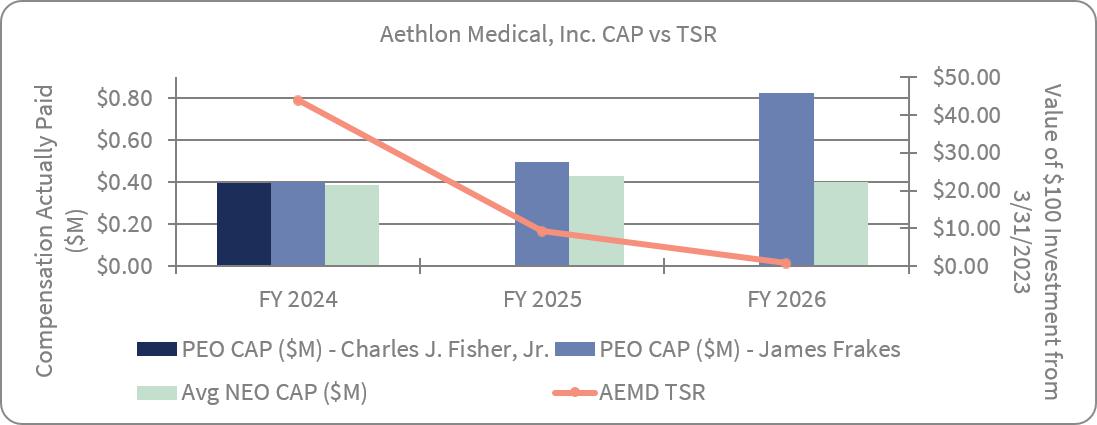
Compensation Actually Paid and Net Loss
Because the Company is a pre-commercial stage company, we had no revenue during the periods presented. Consequently, we do not use net income (loss) as a performance measure in our executive compensation program. Moreover, as a pre-commercial stage company with no revenue, we do not believe there is any meaningful relationship between our net loss and compensation actually paid to our NEOs during the periods presented.
The chart compares Compensation Actually Paid (“CAP”) to named executive officers and net income for fiscal years 2024 through 2026. Bars represent CAP amounts for Charles J. Fisher, Jr., James Frakes, and the average non-PEO named executive officers, measured on the left axis in millions of dollars. A line represents net income, measured on the right axis in millions of dollars. The chart shows CAP generally increased over the periods presented, while net income remained negative, declining in fiscal 2025 before improving in fiscal 2026.
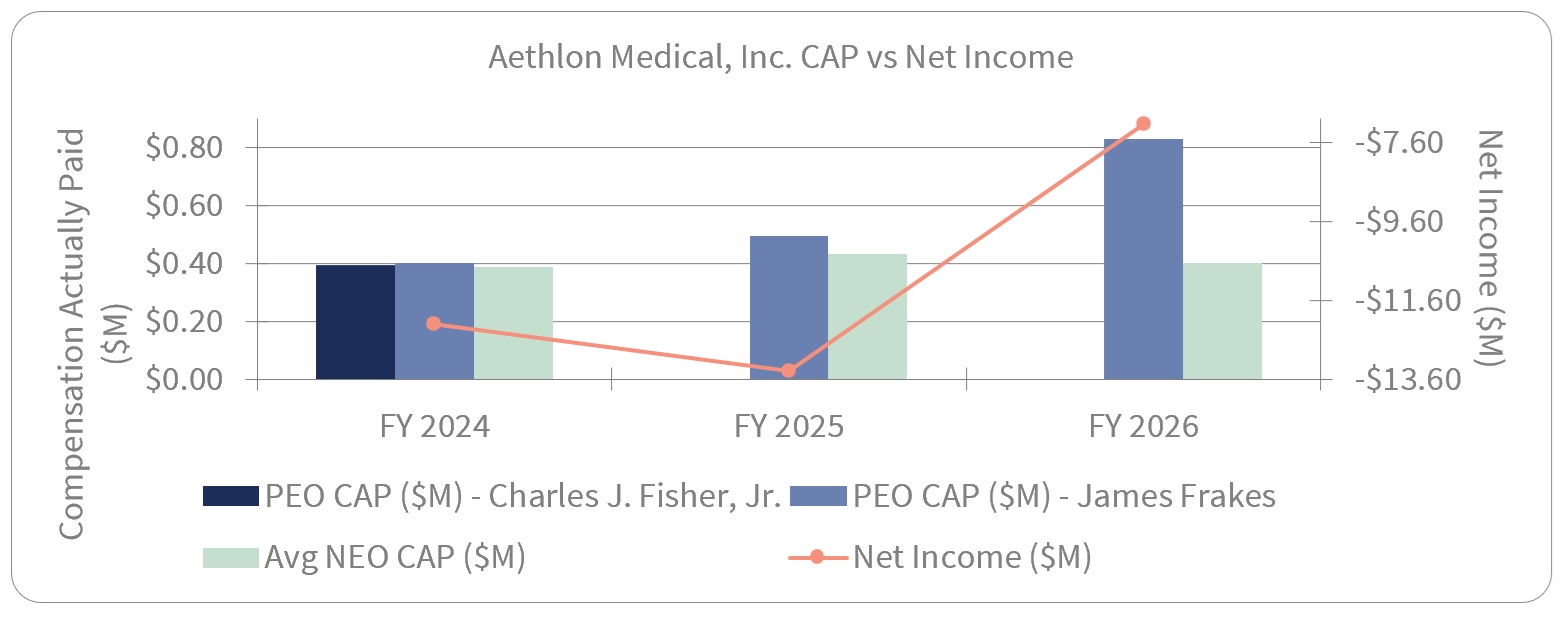
All information provided above under the “Item 402(v) Pay Versus Performance” heading will not be deemed to be incorporated by reference into any filing of the Company under the Securities Act of 1933, as amended, or the Securities Exchange Act of 1934, as amended, whether made before or after the date hereof and irrespective of any general incorporation language in any such filing, except to the extent the Company specifically incorporates such information by reference.
| 77 |
ITEM 13. CERTAIN RELATIONSHIPS AND RELATED TRANSACTIONS AND DIRECTOR INDEPENDENCE
There have been no transactions since April 1, 2025, and there are no currently proposed transactions, in which we were or are to be a participant and the amount involved exceeds the lesser of $120,000 or one percent of the average of our total assets at year-end for the last two completed fiscal years, and in which any related person had or will have a direct or indirect material interest. Our Audit Committee considers and approves or disapproves any related party transaction as defined under SEC Regulation Item 404, to the extent required by SEC regulations.
Employment Arrangements
We currently have written employment agreements with our executive officers. For information about our employment agreements with our named executive officers, refer to “Executive and Director Compensation — Employment Contracts.”
Equity Awards Granted to Executive Officers and Directors
We have granted stock options and RSUs to our executive officers and directors. For information about our grants of stock option awards and RSUs to our named executive officers and our directors, refer to “Executive and Director Compensation — Outstanding Equity Awards at 2026 Fiscal Year-End,” “Executive and Director Compensation — Director Compensation for 2026 Fiscal Year” and “Executive and Director Compensation — Non-Employee Director Compensation Policy.”
Indemnification Agreements
We have entered into and intend to continue to enter into indemnification agreements with each of our directors and our officers. The indemnification agreements, our Articles of Incorporation, as amended, and our Amended and Restated Bylaws require us to indemnify our directors and officers to the fullest extent permitted by Nevada law.
Policies and Procedures for Transactions with Related Persons
We maintain a written policy that our executive officers, directors, nominees for election as a director, beneficial owners of more than 5% of any class of our common stock and any members of the immediate family or affiliate of any of the foregoing persons are not permitted to enter into a related person transaction with us without the approval or ratification of the Audit Committee. Any request for us to enter into a transaction with an executive officer, director, nominee for election as a director, beneficial owner of more than 5% of any class of our common stock, or any member of the immediate family or affiliate of any of the foregoing persons, in which the amount involved exceeds $120,000 and such person would have a direct or indirect interest, must be presented to the Audit Committee for review, consideration and approval. In approving or rejecting any such proposal, the Audit Committee is to consider the material facts of the transaction, including whether the transaction is on terms no less favorable than terms generally available to an unaffiliated third party under the same or similar circumstances and the extent of the related person’s interest in the transaction.
| 78 |
ITEM 14. PRINCIPAL ACCOUNTANT FEES AND SERVICES
The following table presents fees for professional services billed by Haskell & White during the fiscal years ended March 31, 2026 and 2025:
| Fiscal Year 2026 | Fiscal Year 2025 | |||||||
| Audit Fees(1) | $ | 235,500 | $ | 237,300 | ||||
| Tax Fees(2) | 20,450 | 17,500 | ||||||
| Total Fees | $ | 255,950 | $ | 254,800 | ||||
| (1) | Audit fees include fees for professional services rendered in connection with the audit of our annual financial statements for fiscal years 2026 and 2025 and for reviews of our quarterly financial statements and those services normally provided in connection with statutory or regulatory filings or engagements including comfort letters, consents and other services related to SEC matters. | |
| (2) | Tax Fees include the aggregate fees billed during fiscal year 2026 for professional services for preparation of income tax returns. |
Policy on Audit Committee Pre-approval of Audit and Permissible Non-audit Services of Independent Auditor
Our Audit Committee is responsible for pre-approving all audit, audit-related, tax and other permitted non-audit services to be performed for us by our independent auditor. The Audit Committee approved all of the services for which Haskell & White LLP billed us as set forth in the above table.
| 79 |
PART IV
ITEM 15. EXHIBITS AND FINANCIAL STATEMENT SCHEDULES
The following documents are filed as part of this Annual Report:
(a)(1) Financial Statements.
The response to this portion of Item 15 is set forth under Part II, Item 8 above.
(a)(2) Financial Statement Schedules.
All schedules have been omitted because they are not required or because the required information is given in the Financial Statements or Notes thereto set forth under Item 8 above.
(a)(3) Exhibits required by Item 601 of Regulation S-K.
| 80 |
| 81 |
| 82 |
| Incorporated by Reference | ||||||||||||
|
Exhibit Number |
Exhibit Description | Form | SEC File No. | Exhibit No. |
Date | Filed Herewith | ||||||
| 24.1 | Power of Attorney (see signature page) | X | ||||||||||
| 31.1 | Certification of the Principal Executive Officer and Principal Financial Officer pursuant to Rule 13a-14(a) or 15d-14(a) of the Securities Exchange Act of 1934 | X | ||||||||||
| 32.1* | Certification of the Principal Executive Officer and Principal Financial Officer pursuant to Rule 13a-14(b) or 15d-14(b) of the Exchange Act and 18 U.S.C. Section 1350 | X | ||||||||||
| 97.1 | Incentive Compensation Recoupment Policy | 10-K | 001-37487 | 97.1 | June 26, 2025 | |||||||
| 101.INS | Inline XBRL Instance Document (the instance document does not appear in the Interactive Data File because its XBRL tags are embedded within the Inline XBRL document) | X | ||||||||||
| 101.SCH | Inline XBRL Taxonomy Extension Schema Document | X | ||||||||||
| 101.CAL | Inline XBRL Taxonomy Extension Calculation Linkbase Document | X | ||||||||||
| 101.DEF | Inline XBRL Taxonomy Extension Definition Linkbase Document | X | ||||||||||
| 101.LAB | Inline XBRL Taxonomy Extension Label Linkbase Document | X | ||||||||||
| 101.PRE | Inline XBRL Taxonomy Extension Presentation Linkbase Document | X | ||||||||||
| 104 | Cover Page Interactive Data File (formatted in IXBRL, and included in exhibit 101) | X | ||||||||||
__________________
| ++ | Indicates management contract or compensatory plan. | |
| * | The information in Exhibit 32.1 shall not be deemed “filed” for purposes of Section 18 of the Exchange Act, or otherwise subject to the liabilities of that section, nor shall it be deemed incorporated by reference in any filing under the Securities Act or the Exchange Act (including this Annual Report), unless the Registrant specifically incorporates the foregoing information into those documents by reference. |
ITEM 16. FORM 10-K SUMMARY
None.
| 83 |
SIGNATURES
Pursuant to the requirements of Section 13 or 15(d) of the Securities Exchange Act of 1934, as amended, the registrant has duly caused this report to be signed on its behalf by the undersigned, thereunto duly authorized, on the 10th day of June, 2026.
| By: | /s/ JAMES B. FRAKES | ||
|
JAMES B. FRAKES CHIEF EXECUTIVE OFFICER CHIEF FINANCIAL OFFICER. |
POWER OF ATTORNEY
KNOW ALL PERSONS BY THESE PRESENTS, that each person whose signature appears below constitutes and appoints James B. Frakes his or her true and lawful attorney-in-fact and agent, with full power of substitution, for him or her and in his or her name, place and stead, in any and all capacities, to sign any and all amendments to this Annual Report on Form 10-K, and to file the same, with all exhibits thereto, and other documents in connection therewith, with the Securities and Exchange Commission, granting unto said attorney-in-fact and agent full power and authority to do and perform each and every act and thing requisite and necessary to be done in connection therewith, as fully to all intents and purposes as he or she might or could do in person, hereby ratifying and confirming all that said attorney-in-fact and agent or his substitutes or substitute, may lawfully do or cause to be done by virtue hereof.
Pursuant to the requirements of the Securities Exchange Act of 1934, as amended, this report has been signed below by the following persons on behalf of the registrant and in the capacities and on the dates indicated.
| Signature | Title | Date | ||
| /s/ JAMES B. FRAKES | Chief Executive Officer and Chief Financial Officer, | June 10, 2026 | ||
| James B. Frakes | Principal Executive Officer, Principal Financial and Accounting Officer and Director | |||
| /s/ EDWARD G. BROENNIMAN | Chairman and Director | June 10, 2026 | ||
| Edward G. Broenniman | ||||
| /s/ CHETAN S. SHAH | Director | June 10, 2026 | ||
| Chetan S. Shah, M.D. | ||||
| /s/ ANGELA ROSSETTI | Director | June 10, 2026 | ||
| Angela Rossetti | ||||
| /s/ NICOLAS GIKAKIS | Director | June 10, 2026 | ||
| Nicolas Gikakis | ||||
| 84 |
| Page | |
| Consolidated Financial Statements | |
| Report of Independent Registered Public Accounting Firm (Haskell & White LLP, Irvine, CA PCAOB ID No |
F-2 |
| Consolidated Balance Sheets as of March 31, 2026 and 2025 | F-3 |
| Consolidated Statements of Operations and Comprehensive Loss for the Years Ended March 31, 2026 and 2025 | F-4 |
| Consolidated Statements of Equity for the Years Ended March 31, 2026 and 2025 | F-5 |
| Consolidated Statements of Cash Flows for the Years Ended March 31, 2026 and 2025 | F-6 |
| Notes to Consolidated Financial Statements | F-7 |
| F-1 |
REPORT OF INDEPENDENT REGISTERED PUBLIC ACCOUNTING FIRM
To the Board of Directors and Stockholders
Aethlon Medical, Inc.
Opinion on the Consolidated Financial Statements
We have audited the accompanying consolidated balance sheets of Aethlon Medical, Inc. (the “Company”) as of March 31, 2025 and 2026, and the related consolidated statements of operations and comprehensive loss, equity, and cash flows for the year each of the years in the two-year period ended March 31, 2026, and the related notes (collectively referred to as the “consolidated financial statements”). In our opinion, the consolidated financial statements present fairly, in all material respects, the consolidated financial position of the Company as of March 31, 2026 and 2025, and the consolidated results of its operations and its cash flows for each year in the two-year period ended March 31, 2026, in conformity with accounting principles generally accepted in the United States of America.
Substantial Doubt About the Company’s Ability to Continue as a Going Concern
The accompanying consolidated financial statements have been prepared assuming that the Company will continue as a going concern. As discussed in Note 1 to the consolidated financial statements, the Company has recurring losses from operations, an accumulated deficit, expects to incur losses for the foreseeable future and requires additional working capital to achieve its operating plans. These conditions raise substantial doubt about the Company’s ability to continue as a going concern. Management’s plans in regard to these matters are also described in Note 1 to the consolidated financial statements. The consolidated financial statements do not include any adjustments to reflect the possible future effects on the recoverability and classification of assets or the amounts and classification of liabilities that may result from the outcome of this uncertainty.
Basis for Opinion
These consolidated financial statements are the responsibility of the Company’s management. Our responsibility is to express an opinion on the Company’s consolidated financial statements based on our audits. We are a public accounting firm registered with the Public Company Accounting Oversight Board (United States) (“PCAOB”) and are required to be independent with respect to the Company in accordance with the U.S. federal securities laws and the applicable rules and regulations of the Securities and Exchange Commission and the PCAOB.
We conducted our audits in accordance with the standards of the PCAOB. Those standards require that we plan and perform the audits to obtain reasonable assurance about whether the consolidated financial statements are free of material misstatement, whether due to error or fraud. The Company is not required to have, nor were we engaged to perform, an audit of its internal control over financial reporting. As part of our audits, we are required to obtain an understanding of internal control over financial reporting, but not for the purpose of expressing an opinion on the effectiveness of the Company’s internal control over financial reporting. Accordingly, we express no such opinion.
Our audits included performing procedures to assess the risks of material misstatement of the consolidated financial statements, whether due to error or fraud, and performing procedures that respond to those risks. Such procedures included examining, on a test basis, evidence regarding the amounts and disclosures in the consolidated financial statements. Our audits also included evaluating the accounting principles used and significant estimates made by management, as well as evaluating the overall presentation of the consolidated financial statements. We believe that our audits provide a reasonable basis for our opinion.
Critical Audit Matters
Critical audit matters are matters arising from the current period audit of the consolidated financial statements that were communicated or required to be communicated to the audit committee and that: (1) relate to accounts or disclosures that are material to the consolidated financial statements and (2) involved our especially challenging, subjective, or complex judgments. We determined that there are no critical audit matters.
/s/ Haskell & White LLP
We have served as the Company’s auditor since 2024.
June 10, 2026
| F-2 |
AETHLON MEDICAL, INC. AND SUBSIDIARY
CONSOLIDATED BALANCE SHEETS
| March 31, | ||||||||
| 2026 | 2025 | |||||||
| ASSETS | ||||||||
| CURRENT ASSETS | ||||||||
| Cash and cash equivalents | $ | $ | ||||||
| Deferred offering costs | ||||||||
| Prepaid expenses and other current assets | ||||||||
| TOTAL CURRENT ASSETS | ||||||||
| Property and equipment, net | ||||||||
| Operating lease right-of-use asset, net | ||||||||
| Patents, net | ||||||||
| Restricted cash | ||||||||
| Deposits | ||||||||
| TOTAL ASSETS | $ | $ | ||||||
| LIABILITIES AND STOCKHOLDERS’ EQUITY | ||||||||
| CURRENT LIABILITIES | ||||||||
| Accounts payable | $ | $ | ||||||
| Due to related parties | ||||||||
| Operating lease liability, current portion | ||||||||
| Other current liabilities | ||||||||
| TOTAL CURRENT LIABILITIES | ||||||||
| Operating lease liability, less current portion | ||||||||
| TOTAL LIABILITIES | ||||||||
| COMMITMENTS AND CONTINGENCIES (Note 8) | ||||||||
| STOCKHOLDERS’ EQUITY | ||||||||
| Common stock, $ par value, shares authorized at March 31, 2026 and shares authorized at March 31, 2025; issued and outstanding at March 31, 2026 and shares issued and outstanding at March 31, 2025 | ||||||||
| Additional paid-in capital | ||||||||
| Accumulated other comprehensive loss | ( | ) | ( | ) | ||||
| Accumulated deficit | ( | ) | ( | ) | ||||
| TOTAL STOCKHOLDERS’ EQUITY | ||||||||
| TOTAL LIABILITIES AND STOCKHOLDERS’ EQUITY | $ | $ | ||||||
See accompanying notes to the consolidated financial statements.
| F-3 |
AETHLON MEDICAL, INC. AND SUBSIDIARY
CONSOLIDATED STATEMENTS OF OPERATIONS AND COMPREHENSIVE LOSS
| Years Ended March 31, | ||||||||
| 2026 | 2025 | |||||||
| OPERATING COSTS AND EXPENSES | ||||||||
| Professional fees | $ | $ | ||||||
| Payroll and related expenses | ||||||||
| General and administrative | ||||||||
| Total operating expenses | ||||||||
| OPERATING LOSS | ( | ) | ( | ) | ||||
| OTHER INCOME (EXPENSE), NET | ||||||||
| Interest income | ||||||||
| Other income | ||||||||
| Interest expense | ( | ) | ( | ) | ||||
| Other expense | ( | ) | ||||||
| Total other income (expense), net | ( | ) | ||||||
| NET LOSS ATTRIBUTABLE TO COMMON STOCKHOLDERS | ( | ) | ( | ) | ||||
| Basic and diluted net loss per share attributable to common stockholders | $ | ) | $ | ) | ||||
| Weighted average number of common shares outstanding - basic and diluted | ||||||||
| NET LOSS ATTRIBUTABLE TO COMMON STOCKHOLDERS | ( | ) | ( | ) | ||||
| OTHER COMPREHENSIVE LOSS | ( | ) | ( | ) | ||||
| COMPREHENSIVE LOSS | $ | ( | ) | $ | ( | ) | ||
See accompanying notes to the consolidated financial statements.
| F-4 |
AETHLON MEDICAL, INC. AND SUBSIDIARY
CONSOLIDATED STATEMENTS OF EQUITY
FOR THE YEARS ENDED MARCH 31, 2026 AND 2025
| COMMON STOCK | ADDITIONAL PAID IN | ACCUMULATED | ACCUMULATED COMPREHENSIVE | TOTAL | ||||||||||||||||||||
| SHARES | AMOUNT | CAPITAL | DEFICIT | LOSS | EQUITY | |||||||||||||||||||
| BALANCE - MARCH 31, 2024 | $ | $ | $ | ( | ) | $ | ( | ) | $ | |||||||||||||||
| Proceeds from Issuances of common stock for public offering | ||||||||||||||||||||||||
| Issuance of common stock upon Class A and Class B warrant exercises, net | ||||||||||||||||||||||||
| Issuance of common shares upon vesting of restricted stock units and net stock option exercises | ( | ) | ( | ) | ||||||||||||||||||||
| Stock-based compensation expense | – | |||||||||||||||||||||||
| Warrant Inducement | ||||||||||||||||||||||||
| Net loss | – | ( | ) | ( | ) | |||||||||||||||||||
| Other comprehensive loss | – | ( | ) | ( | ) | |||||||||||||||||||
| BALANCE – MARCH 31, 2025 | $ | $ | $ | ( | ) | $ | ( | ) | $ | |||||||||||||||
| Issuances of common stock for public offering, net | ||||||||||||||||||||||||
| Issuances of pre-funded warrants and warrants to institutional investors (including exercise of existing warrants), net of offering costs | ||||||||||||||||||||||||
| Exercise of pre-funded warrants | ( | ) | ||||||||||||||||||||||
| Issuance of common shares upon vesting of restricted stock units and net stock option exercises | ( | ) | ( | ) | ||||||||||||||||||||
| Stock-based compensation expense | – | |||||||||||||||||||||||
| Rounding for reverse split | – | – | – | – | – | |||||||||||||||||||
| Net loss | – | ( | ) | ( | ) | |||||||||||||||||||
| Other comprehensive loss | – | ( | ) | ( | ) | |||||||||||||||||||
| BALANCE – MARCH 31, 2026 | $ | $ | $ | ( | ) | $ | ( | ) | $ | |||||||||||||||
See accompanying notes to the consolidated financial statements.
| F-5 |
AETHLON MEDICAL, INC. AND SUBSIDIARY
CONSOLIDATED STATEMENTS OF CASH FLOWS
FOR THE YEARS ENDED MARCH 31, 2026 AND 2025
| Years Ended March 31, | ||||||||
| 2026 | 2025 | |||||||
| Cash flows from operating activities: | ||||||||
| Net loss | $ | ( | ) | $ | ( | ) | ||
| Adjustments to reconcile net loss to net cash used in operating activities: | ||||||||
| Depreciation and amortization | ||||||||
| Stock-based compensation | ||||||||
| Non-cash lease expense | ||||||||
| Warrant Inducement Expense | ||||||||
| Changes in operating assets and liabilities: | ||||||||
| Prepaid expenses and other current assets | ||||||||
| Accounts payable and other current liabilities | ( | ) | ( | ) | ||||
| Due to related parties | ( | ) | ||||||
| Net cash used in operating activities | ( | ) | ( | ) | ||||
| Cash flows from investing activities: | ||||||||
| Purchases of property and equipment | ( | ) | ||||||
| Cash used in investing activities | ( | ) | ||||||
| Cash flows from financing activities: | ||||||||
| Tax withholding payments or tax equivalent payments for net share settlement of restricted stock units | ( | ) | ( | ) | ||||
| Gross proceeds from the issuance of common stock and pre-funded warrants | ||||||||
| Payments for offering costs related to equity issuance | ( | ) | ( | ) | ||||
| Proceeds from exercise of warrants – standard terms | ||||||||
| Proceeds from exercise of warrants – induced terms | ||||||||
| Commission paid related to warrant inducement | ( | ) | ||||||
| Legal fees paid related to warrant inducement | ( | ) | ||||||
| Payments for deferred offering costs related to future equity issuance | ( | ) | ||||||
| Net cash provided by financing activities | ||||||||
| Effect of Exchange Rate on Changes on Cash | ( | ) | ||||||
| Net (decrease) increase in cash and cash equivalents and restricted cash | ( | ) | ||||||
| Cash and cash equivalents restricted cash at beginning of year | ||||||||
| Cash and cash equivalents and restricted cash at end of year | $ | $ | ||||||
| Supplemental information of non-cash investing and financing activities: | ||||||||
| Issuance of shares under vested restricted stock units, net stock option exercises and unvested share issuance for services | $ | $ | ||||||
| Disposal of fully depreciated property | $ | $ | ||||||
| Warrant modification costs | $ | $ | ||||||
| Deferred offering costs not yet paid | $ | $ | ||||||
| Reconciliation of cash, cash equivalents and restricted cash to the consolidated balance sheets: | ||||||||
| Cash and cash equivalents | $ | $ | ||||||
| Restricted cash | ||||||||
| Cash and restricted cash | $ | $ | ||||||
See accompanying notes to the consolidated financial statements.
| F-6 |
Aethlon Medical, Inc. and Subsidiary
Notes to Consolidated Financial Statements
1. ORGANIZATION, LIQUIDITY AND SUMMARY OF SIGNIFICANT ACCOUNTING POLICIES
ORGANIZATION
Aethlon Medical, Inc. (“Aethlon,” the “Company,” “we” or “us”) is a medical therapeutic company focused on developing the Hemopurifier® (HP), a clinical-stage immunotherapeutic device designed to address unmet needs in oncology, life-threatening infectious diseases, organ transplantation and other disease states in which extracellular vesicles (EVs) contribute to disease progression. The Hemopurifier utilizes a proprietary lectin-based technology to bind and remove enveloped viruses and EVs from biological fluids. EVs have been associated with immune suppression, metastasis, and resistance to therapy in cancer, as well as progression of severe infectious diseases. In pre-clinical studies, the Hemopurifier has also demonstrated the ability to bind disease-associated extracellular vesicles (“EVs”) and a panel of enveloped viruses. The Hemopurifier has been evaluated in human studies, involving 173 treatment sessions in 44 patients with either viral infections or cancer. The device has been well tolerated with an adverse event profile that is consistent with extracorporeal therapy. In certain human studies designed to evaluate viral clearance from biological fluids, findings demonstrated the removal of enveloped viruses. The U.S. Food and Drug Administration (“FDA”) has granted the Hemopurifier “Breakthrough Device” designation for two independent indications:
| · | the treatment of individuals with advanced or metastatic cancer who are unresponsive to or intolerant of standard of care therapy, and with cancer types in which extracellular vesicles have been shown to contribute to disease progression and | |
| · | the treatment of life-threatening viruses for which no approved therapies exist. |
Oncology
The Company is evaluating the Hemopurifier as a potential treatment of patients with advanced and metastatic cancer through its ability to bind to and remove extracellular vesicles (“EVs”) particles that may promote tumor growth and metastasis. In October 2022, we formed a wholly-owned subsidiary in Australia to support oncology-related clinical research and pursue regulatory approval and potential regulatory and commercialization opportunities for the Hemopurifier.
The Company previously completed an in vitro binding study of utilizing cancer patient samples, to evaluate the Hemopurifier’s ability to remove EVs from plasma. Results from this translational study provided pre-clinical evidence supporting the design of our oncology clinical trial involving patients with solid tumors who have stable or progressive disease during anti-PD-1 monotherapy treatment, such as Keytruda® (pembrolizumab) or Opdivo® (nivolumab).
The Company is currently conducting a safety, feasibility and dose-finding clinical trial in Australia evaluating the Hemopurifier in patients with solid tumors who have stable or progressive disease during anti-PD-1 monotherapy treatment. The trial is designed to enroll approximately 9 to 18 participants. The primary endpoint of the trial is safety, while exploratory analyses will be conducted to explore the number of HP treatments required to produce sustained reductions of EVs as well as improve anti-tumor T cell activity.
| F-7 |
Three clinical sites in Australia— Royal Adelaide Hospital in Adelaide, and Pindara Private Hospital on the Gold Coast and GenesisCare North Shore Hospital in Sydney— are currently open for patient enrollment. During fiscal year 2026, we completed enrollment and treatment of the first cohort of three participants, each of whom received a single 4-hour Hemopurifier treatment. Following review of the first cohort data, independent Data Safety Monitoring Board (DSMB) reported no safety concerns and recommended progression to the second cohort. Following the DSMB review of the first cohort, enrollment commenced in the second cohort, in which participants received two Hemopurifier treatments during a one-week treatment period. In March 2026, the Company completed the second cohort and the DSMB subsequently approved advancement to the third cohort of the study. To date, no serious adverse events (“SAEs”) or dose-limiting toxicities ((“DLTs”) related to the Hemopurifier have been reported.
The Company previously pursued approval of a similar oncology clinical trial in India and received formal approval from the Central Drugs Standard Control Organization (“CDSCO”) on July 7, 2025. Following evaluation of anticipated site activation timelines and trial execution requirements, the Company elected to not proceed with the India trial in order to conserve resources and focus efforts on the Australian oncology clinical trial.
Life-Threatening Viral Infections
The Company believes the Hemopurifier may be applicable in the treatment of life-threatening viral infections involving highly glycosylated, or carbohydrate coated, viruses for which no approved therapies exist. In small-scale or early feasibility human studies conducted under FDA and international regulatory frameworks, the Hemopurifier has been used to treat individuals infected with Ebola, human immunodeficiency virus, or HIV, and hepatitis-C and SARS-CoV-2.
In vitro studies have demonstrated the ability of the Hemopurifier to capture multiple enveloped viruses, including Ebola, Marburg virus, Zika, Lassa, MERS-CoV, Cytomegalovirus, Epstein-Barr, Herpes simplex, Chikungunya, Dengue, West Nile, H1N1 swine flu, H5N1 bird flu, and the reconstructed 1918 Spanish flu virus. In several cases, these studies were conducted in collaboration with leading government or non-government research institutes.
While we terminated our U.S. and India-based COVID-19 studies due to low ICU patient volume and shifting priorities, these programs demonstrated provided clinical experience with the Hemopurifier in critically ill patients. We continue to maintain an open IDE for viral indications, preserving the ability to evaluate the Hemopurifier in response to future outbreaks or emergent pathogens.
The Company has sufficient inventory of Hemopurifiers to support our ongoing oncology trial in Australia as well as any near-term expansion of that study. While we have received FDA approval to begin manufacturing at our San Diego facility under our IDE supplement, we are still awaiting FDA approval of a separate supplement to qualify an additional supplier of a key Hemopurifier component. We continue to work with the FDA on this process.
Pre-Clinical Exploration of Additional Clinical Uses for the Hemopurifier
The Aethlon R&D laboratory continues to explore potential new indications for the Hemopurifier. We have published in the peer-reviewed journal Transplant Immunology the ability of the device to remove extracellular vesicles and their microRNA cargo from acellular perfusates of discarded kidneys that had undergone normothermic machine perfusion.
On May 12, 2025, the results of our pre-clinical ex vivo study entitled “Ex Vivo Removal of CD41 positive platelet microparticles from Plasma by a Medical Device containing a Galanthus nivalis agglutinin (GNA) affinity resin” were published in the pre-print vehicle bioRxiv.
Platelet-derived extracellular vesicles (PD-EVs) are the most numerous EV population in the body and are released by platelets in response to a variety of stimuli. The cargo contained within these EVs have been noted to take part in damage to blood vessels, activation of immune cells and spread of tumor cells. Excessive levels of PD-EVs have been implicated in a myriad of diseases including cancer, lupus, systemic sclerosis, multiple sclerosis, Alzheimer’s disease, sepsis, acute COVID-19 and Long COVID.
| F-8 |
In this study, donated healthy human plasma was circulated through the Hemopurifier (HP) to simulate a clinical HP session. The study demonstrated approximately 98.5% removal of platelet-derived EVs at a timepoint equivalent to a four-hour HP treatment. We believe the results support the ongoing Australian oncology clinical trial and may support investigation of the Hemopurifier in additional disease indications.
In November 2025, we publicly released a separate pre-clinical preprint entitled “Increased mannosylation of extracellular vesicles in Long COVID plasma provides a potential therapeutic target for Galanthus nivalis agglutinin (GNA) affinity resin,” describing exploratory ex vivo laboratory research conducted in collaboration with the University of California, San Francisco Long COVID Clinic examining extracellular vesicle characteristics in plasma samples from individuals with Long COVID. The findings described in these preprints have not been peer reviewed and are based on laboratory analyses rather than clinical studies. These activities are intended to inform potential future research directions and evaluate the broader applicability of the Hemopurifier platform and may not be indicative of clinical outcomes.
Successful clinical development and regulatory approvals will be required before the Hemopurifier may be marketed in the United States or foreign jurisdictions. Some of our patents may expire before regulatory approval is obtained; however, the Company believes that its existing patent portfolio and more recently issued patents and patent applications will continue to support protection of the proprietary nature of our Hemopurifier treatment technology.
The Company continues to monitor the impact of inflation, global economic conditions, geopolitical conflicts, capital market volatility and other macroeconomic factors on its business, operations, clinical development programs and future access to capital. The extent to which these factors may affect the Company’s business, financial condition and results of operations remains uncertain and will depend on future developments beyond the Company’s control.
LIQUIDITY AND GOING CONCERN
The Company has incurred losses since inception in
devoting substantially all of its efforts toward research and development and has an accumulated deficit of $
Management has evaluated whether there are conditions and events considered in the aggregate that raise substantial doubt about the Company’s ability to continue as a going concern within one year after the date that these financial statements are issued. While the Company continues to evaluate potential expense reduction opportunities, such opportunities may not materialize and patient recruitment may occur more rapidly than expected, resulting in increased operating expenses. Based on the Company’s current operating plan and existing cash and cash equivalents, management has concluded that substantial doubt exists regarding the Company’s ability to continue as a going concern for a period of at least one year from the date these financial statements are issued.
The Company’s ability to continue operating depends on its ability to obtain additional capital through equity financing, debt financing, strategic transactions or other funding sources. Although the Company plans to continue actively pursuing financing alternatives, there can be no assurance that such financing will be available on acceptable terms, or at all. The accompanying financial statements do not include any adjustments that might result from the outcome of this uncertainty.
| F-9 |
PRINCIPLES OF CONSOLIDATION
The accompanying consolidated financial statements include the accounts of Aethlon Medical, Inc. and its wholly owned subsidiary, Aethlon Medical Australia Pty Ltd. Operations in our Australian subsidiary is recorded in their functional currency. The results of operations for our Australian subsidiary are translated from functional currency into U.S. dollars. Expenses originally incurred in U.S. dollars are translated using the exchange rate on the transaction date. For expenses in the subsidiary’s functional currency, we use the average exchange rate for the period, as it is not practical to determine the exact rate for each transaction date. Assets and liabilities are translated using the period end exchange rates. The U.S dollar effects that arise from translating the net assets of are recorded in other comprehensive income (loss). All significant inter-company transactions and balances have been eliminated in consolidation. The consolidated financial statements contain all normal recurring accruals and adjustments that, in the opinion of management, are necessary to present fairly the consolidated financial statements as of and for the fiscal years ended March 31, 2026 and 2025, and the consolidated statement of cash flows for the fiscal years ended March 31, 2026 and 2025.
RISKS AND UNCERTAINTIES
We operate in an industry that is subject to intense competition, government regulation and rapid technological change. Our operations are subject to significant risk and uncertainties including financial, operational, technological, regulatory, and including the potential risk of business failure.
USE OF ESTIMATES
We prepare our consolidated financial statements in conformity with accounting principles generally accepted in the United States of America, or GAAP, which requires us to make a number of estimates and assumptions that affect the reported amounts of assets and liabilities and disclosure of contingent assets and liabilities at the date of the financial statements. Such estimates and assumptions also affect the reported amounts of expenses during the reporting period. On an ongoing basis, we evaluate estimates and assumptions based upon historical experience and various other factors and circumstances. We believe our estimates and assumptions are reasonable in the circumstances; however, actual results may differ materially from those estimates under different future conditions.
Estimates and assumptions that have a significant effect on the amounts reported in the consolidated financial statements include, but are not limited to, the valuation of stock-based compensation awards, the fair value of equity instruments issued in financing transactions, accrued expenses and the assessment of long-lived assets.
CASH AND CASH EQUIVALENTS
Accounting standards define “cash and cash equivalents” as any short-term, highly liquid investment that is both readily convertible to known amounts of cash and so near their maturity that they present insignificant risk of changes in value because of changes in interest rates. For the purpose of financial statement presentation, we consider all highly liquid investment instruments with original maturities of three months or less when purchased, or any investment redeemable without penalty or loss of interest to be cash equivalents. Cash is carried at cost, which approximates fair value, and cash equivalents are carried at fair value. The Company evaluates its financial assets for expected credit losses in accordance with ASC 326. Based on the nature of the Company’s cash equivalents, which primarily consist of highly rated money market funds and short-term U.S. Treasury securities, the Company did not record an allowance for expected credit losses as of March 31, 2026.
| F-10 |
As of March 31, 2026 and March 31, 2025 our cash and cash equivalents were comprised of the following instruments:
| For the year ended | ||||||||
| March 31, 2026 | March 31, 2025 | |||||||
| Cash in US bank checking account | $ | $ | ||||||
| Cash equivalents held in US Treasury bills | ||||||||
| Cash in Australian bank checking account (US dollars) | ||||||||
| Total cash and cash equivalents | $ | $ | ||||||
CONCENTRATIONS OF CREDIT RISKS
Cash is maintained at one US financial institution
in a checking account. Accounts at this institution are secured by the Federal Deposit Insurance Corporation up to $250,000. Our March
31, 2026 cash balances were approximately $
At March 31,
2026, we maintained cash equivalents of approximately $
Cash is maintained at one Australian financial institution in checking accounts. Accounts at this institution are secured by the Financial Claims Scheme for up to Australian $250,000. Our March 31, 2025 Australian cash balance was below that threshold.
RESTRICTED CASH
To comply with the terms of our laboratory, office,
and manufacturing space leases, we arranged for our former bank, First Republic Bank, to issue two standby letters of credit (L/Cs) totaling
$
PROPERTY AND EQUIPMENT
Property and equipment are stated at cost. Depreciation is computed using the straight-line method over the estimated useful lives of the related assets, which range from two to five years. Repairs and maintenance are charged to expense as incurred while improvements are capitalized. Upon the sale or retirement of property and equipment, the accounts are relieved of the cost and the related accumulated depreciation with any gain or loss included in the consolidated statements of operations.
| F-11 |
INCOME TAXES
Deferred tax assets and liabilities are recognized
for the future tax consequences attributable to the difference between the consolidated financial statements and their respective tax
basis. Deferred income taxes reflect the net tax effects of (a) temporary differences between the carrying amounts of assets and liabilities
for financial reporting purposes and the amounts reported for income tax purposes, and (b) tax credit carryforwards. We record a valuation
allowance for deferred tax assets when, based on our best estimate of taxable income (if any) in the foreseeable future, it is more likely
than not that some portion of the deferred tax assets may not be realized. Management has provided a full valuation allowance against
the Company’s net deferred tax asset. Tax positions taken or expected to be taken in tax returns are evaluated using a more-likely-than-not
recognition threshold. Tax positions deemed to not meet a more-likely-than-not threshold would be recorded as tax expense in the current
year. There were
LONG-LIVED ASSETS
Long-lived assets are reviewed for impairment whenever
events or changes in circumstances indicate that their carrying amounts may not be recoverable. If the cost basis of a long-lived asset
is greater than the projected future undiscounted net cash flows from such asset, an impairment loss is recognized. We believe
Basic loss per share is computed by dividing net loss available to common stockholders by the weighted average number of common shares outstanding during the period of computation. Diluted loss per share is computed similar to basic loss per share except that the denominator is increased to include the number of additional common shares that would have been outstanding if potential common shares had been issued, if such additional common shares were dilutive. Since we have had net losses for all periods presented, basic and diluted loss per share is the same, and additional potential common shares have been excluded as their effect would be antidilutive.
As of March 31, 2026 and 2025, a total of and potential common shares, consisting of shares underlying outstanding stock options, restricted stock units, or RSUs, shares held in abeyance and warrants were excluded as their inclusion would be antidilutive.
REVENUE RECOGNITION
We did not recognize revenue in fiscal years ended March 31, 2026 or March 31, 2025.
Employee stock options and rights to purchase shares under stock participation plans are accounted for under the fair value method. Accordingly, share-based compensation is measured when all granting activities have been completed, generally the grant date, based on the fair value of the award. The exercise price of options is generally equal to the market price of the Company’s common stock (defined as the closing price as quoted on the Nasdaq Capital Market or OTCBB on the date of grant). Compensation cost recognized by the Company includes (a) compensation cost for all equity incentive awards granted prior to April 1, 2006, but not yet vested, based on the grant-date fair value estimated in accordance with the original provisions of the then current accounting standards, and (b) compensation cost for all equity incentive awards granted subsequent to March 31, 2006, based on the grant-date fair value estimated in accordance with the provisions of subsequent accounting standards. We use a Binomial Lattice option pricing model for estimating fair value of options granted (see Note 4).
| F-12 |
The following table summarizes share-based compensation expenses relating to shares and options granted and the effect on loss per common share during the years ended March 31, 2026 and 2025:
| Fiscal Years Ended | ||||||||
| March 31, 2026 | March 31, 2025 | |||||||
| Vesting of Stock Options and Restricted Stock Units | $ | $ | ||||||
| Total Stock-Based Compensation Expense | $ | $ | ||||||
| Weighted average number of common shares outstanding – basic and diluted | ||||||||
| Basic and diluted loss per common share | $ | ) | $ | ) | ||||
We record share-based compensation expenses for awards of stock options and RSUs under ASC 718, Share-based compensation, or ASC 718. For awards to non-employees for periods prior to the adoption of ASU 2018-07, Compensation-Stock Compensation: Improvements to Non-employee Share-Based Payment Accounting, on April 1, 2019, the Company had applied ASC 505-50, Equity – Equity-based payments to non-employees, or ASC 505-50. ASC 718 establishes guidance for the recognition of expenses arising from the issuance of share-based compensation awards at their fair value at the grant date.
We recognize share-based compensation expense related to stock options and stock appreciation rights granted to employees, directors and consultants based on the estimated fair value of the awards on the date of grant. We estimate the grant date fair value, and the resulting share-based compensation expense, for stock options that only have service vesting requirements or performance-based vesting requirements without market conditions using the binomial lattice option-pricing model. The grant date fair value of the share-based awards with service vesting requirements is generally recognized on a straight-line basis over the requisite service period, which is generally the vesting period of the respective awards. Determining the appropriate amount to expense for performance-based awards based on the achievement of stated goals requires judgment. The estimate of expense is revised periodically based on the probability of achieving the required performance targets and adjustments are made as appropriate. The cumulative impact of any revisions is reflected in the period of change. If any applicable financial performance goals are not met, no compensation cost is recognized and any previously recognized compensation cost is reversed. For performance-based awards with market conditions, we determine the fair value of awards as of the grant date using a Monte Carlo simulation model.
We review share-based compensation on a quarterly basis for changes to the estimate of expected award forfeitures based on actual forfeiture experience. The effect of adjusting the forfeiture rate for all expense amortization after March 31, 2007 is recognized in the period the forfeiture estimate is changed. The effect of forfeiture adjustments for the fiscal year ended March 31, 2026 was insignificant.
PATENTS
Patents include both foreign and domestic patents. We capitalize the cost of patents, some of which were acquired, and amortize such costs over the shorter of the remaining legal life or their estimated economic life, upon issuance of the patent. The unamortized costs of patents are subject to our review for impairment under our long-lived asset policy above.
| F-13 |
STOCK PURCHASE WARRANTS
In the past we issued warrants for the purchase of shares of our common stock in connection with the issuance of common stock for cash. Warrants issued in connection with common stock for cash, if classified as equity, are considered issued in connection with equity transactions and the warrant fair value is recorded to additional paid-in-capital.
RESEARCH AND DEVELOPMENT EXPENSES
Our research and development costs are expensed as
incurred. We incurred approximately $
OFF-BALANCE SHEET ARRANGEMENTS
We have not entered into any off-balance sheet arrangements that have or are reasonably likely to have a current or future material effect on our consolidated financial statements.
SIGNIFICANT RECENT ACCOUNTING PRONOUNCEMENTS
In fiscal year 2025, the Company adopted Accounting Standards Update (ASU) No. 2023-07, Segment Reporting (Topic 280): Improvements to Reportable Segment Disclosures. This ASU requires public entities to disclose significant segment expense categories that are regularly provided to the chief operating decision maker (CODM) and included in the reported measure of segment profit or loss.
The Company operates as a reportable segment. The adoption of ASU 2023-07 did not have an impact on the Company’s consolidated financial statements but resulted in enhanced footnote disclosures regarding significant segment expenses, as reflected in Note 9 – Segment Reporting.
In November 2023, the FASB issued Accounting Standards Update 2023-09, Improvements to Income Taxes (Topic 740): Improvements to Income Tax Disclosures, which requires enhanced annual disclosures for specific categories in the rate reconciliation and income taxes paid disaggregated by federal, state, and foreign jurisdictions.
The Company adopted ASU 2023-09 effective April 1, 2025. Adoption of the standard did not impact the Company’s consolidated financial statements but resulted in enhanced income tax disclosures, as reflected in Note 7 – Income Taxes.
In March 2024, the Financial Accounting Standards Board (FASB) issued Accounting Standards Update No. 2024-02, Codification Improvements—Amendments to Remove References to the Concepts Statements (“ASU 2024-02”). The amendments remove references to FASB Concepts Statements from the Accounting Standards Codification and do not change existing accounting requirements. The guidance is effective for fiscal years beginning after December 15, 2024, including interim periods within those fiscal years. The Company does not expect the adoption of this guidance to have a material impact on its consolidated financial statements and related disclosures.
| F-14 |
In March 2024, the FASB issued Accounting Standards Update 2024-03, Income Statement—Reporting Comprehensive Income—Expense Disaggregation Disclosures (“ASU 2024-03”), which requires public business entities to provide enhanced annual and interim disclosures that disaggregate specified income statement expense categories. In January 2025, the FASB issued ASU 2025-01, which clarified the effective date of ASU 2024-03. The amendments are effective for annual reporting periods beginning after December 15, 2026, and interim reporting periods beginning after December 15, 2027. Early adoption is permitted. The Company is currently evaluating the impact the adoption of this guidance may have on its consolidated financial statements and related disclosures.
In December 2025, the FASB issued ASU 2025-10, Government Grants (Topic 832), which establishes guidance related to the recognition, measurement, presentation, and disclosure of government grants. ASU 2025-10 is effective for annual periods beginning after December 15, 2028, and interim periods within fiscal years beginning after December 15, 2029, with early adoption permitted. The Company is currently evaluating the impact this guidance may have on its consolidated financial statements and disclosures.
2. PROPERTY AND EQUIPMENT, NET
Property and equipment, net, consist of the following:
| March 31, 2026 | March 31, 2025 | |||||||
| Furniture and office equipment, at cost | $ | $ | ||||||
| Add: additions | ||||||||
| Less: disposals | ( | ) | ( | ) | ||||
| Leasehold improvements | ||||||||
| Gross property and equipment | ||||||||
| Less: accumulated depreciation | ( | ) | ( | ) | ||||
| Fixed assets, net | $ | $ | ||||||
Depreciation expense for the fiscal years ended March
31, 2026 and 2025 was $
3. PATENTS, NET
Patents, net consist of the following:
| March 31, 2026 | March 31, 2025 | |||||||
| Issued patents | $ | $ | ||||||
| Accumulated amortization | ( | ) | ( | ) | ||||
| Patents, net | $ | $ | ||||||
Amortization expense for our capitalized issued patents
for each of the fiscal years ended March 31, 2026 and 2025 was $
| F-15 |
4. EQUITY TRANSACTIONS
REVERSE STOCK SPLITS
Effective as of the close
of business on June 6, 2025, with trading on a post-split basis beginning on June 9, 2025, the Company effected a
Effective as of the close
of business on October 16, 2025, with trading on a post-split basis beginning on October 20, 2025, the Company effected a
On February 19, 2026, the Company’s stockholders approved an amendment to the Company’s Articles of Incorporation to increase the number of authorized shares of common stock from shares to shares.
All share and per share amounts presented in the accompanying consolidated financial statements and related notes have been retroactively adjusted to reflect both reverse stock splits for all periods presented.
ISSUANCES OF COMMON STOCK AND WARRANTS
Equity Transactions in the Fiscal Year Ended March 31, 2026.
December 2025 Private Placement and Warrant Inducement Agreement
On December 5, 2025, the Company and an institutional investor (the “Purchaser”)
entered into a securities purchase agreement (the “Securities Purchase Agreement”), pursuant to which the Company agreed to
issue to the Purchaser, in a private placement (the “PIPE Offering”), (i)
On January 22, 2026, the Company entered into an amendment to the Securities
Purchase Agreement and the Pre-Funded Warrants pursuant to which the Pre-Funded Warrants became immediately exercisable at an exercise
price of $
At the same time and as part of the PIPE Offering, the Company also entered
into a warrant inducement agreement (the “Inducement Agreement”) with the same Purchaser of certain outstanding common stock
purchase warrants. Under this agreement, the Purchaser’s existing warrants were modified, including exercise at a reduced price
of $
| F-16 |
The modification of the existing warrants and issuance of the Inducement
Warrants were accounted for as costs associated with a financing transaction. The new warrants became exercisable on February 19, 2026,
have an exercise price of $
The Company also issued warrants to buy
The securities issued in the PIPE Offering and Inducement Agreement were issued in a private placement exempt from registration under Section 4(a)(2) of the Securities Act and Regulation D promulgated thereunder.
The Company filed a Registration Statement on Form S-1 (File No. 333-292598) covering the resale of shares underlying the warrants issued in the PIPE Offering and Inducement Agreement which was declared effective on January 16, 2026. The Company is required to maintain the effectiveness of the registration statement as required under the Registration Rights Agreement and Inducement Agreement. The agreements include customary provisions for liquidated damages if the registration statements are not maintained on time.
Gross proceeds from the PIPE Offering were approximately $
Warrant Exercises
As described above, in connection with the Inducement Agreement, the holder
of common stock purchase warrants exercised shares of common stock for additional proceeds to the company of $
September 2025 Registered Direct Offering
On September 4, 2025, we entered into a Securities Purchase Agreement with
certain investors pursuant to which it agreed to sell (i) shares of common stock, (ii)
The offering closed on September 5, 2025, and we received gross proceeds
of approximately $
In connection with the offering, the Company and its officers and directors agreed to customary lock-up provisions restricting certain issuances or sales of securities for up to 90 days following the closing.
| F-17 |
April 2025 RSU Grants to Independent Directors
In April 2025, our Board of Directors approved, pursuant to the terms of the Director Compensation Policy, the grant of the annual RSUs under the Director Compensation Policy to each of the four non-employee directors of the Company then serving on the Board of Directors. The Director Compensation Policy provides for a grant of stock options or $50,000 worth of RSUs at the beginning of each fiscal year for current non-employee directors then serving on the Board of Directors, and for a grant of stock options or $75,000 worth of RSUs for a newly elected non-employee director, with each RSU priced at the average for the closing prices for the five days preceding and including the date of grant, or $2.80 per share for the RSUs granted in April 2025. As a result, in April 2025 the four eligible directors were each granted an RSU in the amount of shares under the Company’s 2020 Equity Incentive Plan, or the 2020 Plan.
Equity Transactions in the Fiscal Year Ended March 31, 2025.
March 2025 Warrant-Based Financing
On March 16, 2025, the
Company entered into an inducement offer to exercise existing Class A and Class B Warrants
(the “Agreement”) with a certain accredited and institutional holder (the “Holder”) of the Company’s outstanding
Class A and Class B Warrants issued on May 17, 2024 (the “Existing Warrants”).
The fair value of the new
warrants issued and the incremental fair value associated with the modification of the existing warrants totaled approximately $
The closing took place on
March 17, 2025. Gross proceeds to the Company from the exercise of the Existing Warrants was $
As a result of the Holder exercising the Existing Warrants, the Company issued an aggregate of shares of its common stock. The shares underlying the Existing Warrants have all been registered on Form S-1 registration statement (Registration Number 333-278188).
The Company agreed to file a resale registration statement registering the shares underlying the Replacement Warrants (“Resale Registration Statement”) within ninety (90) days of the date of the Agreement and to use commercially reasonable best efforts to cause the Resale Registration Statement to be effective on or prior to the 150th calendar day after the date of the Agreement.
| F-18 |
Subject to the terms of the Agreement, the Company will be required to pay certain liquidated damages if the shares underlying the New Warrants are not filed within the ninety (90) period, as more fully described in the Agreement.
The Company further agreed that until sixty (60) days after the closing date of the warrant exercise, it will not (other than in connection with limited enumerated exceptions) issue, enter into any agreement to issue or announce the issuance or proposed issuance of any shares of common stock or common stock equivalents or file any registration statement or any amendment or supplement (other than the registration statement registering the shares underlying the Replacement Warrants).
In connection with the transactions
contemplated in the Agreement, the Company agreed to pay its placement agent, Maxim Group, LLC (the “Agent”) the following
compensation, (i) a cash fee equal to 6.0% of the gross proceeds received by the Company in the transactions contemplated by the Agreement,
and (ii) legal fees and out-of-pocket expenses of $
May 2024 Public Offering
On May 17, 2024, the Company
closed a public offering pursuant to which it sold an aggregate of: (i) shares of common stock and accompanying Class
A warrants to purchase up to shares of common stock and Class B warrants to purchase up to shares
of common stock, at a combined public offering price of $ per share and accompanying warrants; and (ii) in lieu of common stock, pre-funded
warrants to purchase
All pre-funded warrants issued
in the offering were exercised in the quarter ended June 30, 2024. The Class A and Class B warrants
each have an exercise price of $
Maxim Group LLC (“Maxim”),
served as the exclusive placement agent in connection with the offering. We paid Maxim a cash fee of 6.5% of the aggregate gross proceeds
raised at the closing of the offering, and reimbursement of certain expenses and legal fees in the amount of $
The gross proceeds from the
offering, before deducting the placement agent’s fees and other offering expenses, were approximately $
The shares of Common Stock, the Class A and Class B warrants, the pre-funded warrants and the Placement Agent Warrants described above and the underlying shares of Common Stock were offered pursuant to a Registration Statement on Form S-1, as amended (File No. 333-278188) (the “Registration Statement”), which was declared effective by the Securities and Exchange Commission (the “SEC”) on May 15, 2024.
| F-19 |
RSU Grants to Non-Employee Directors
On April 17, 2024, the Compensation Committee of the Board, or Compensation Committee, approved, pursuant to the terms of the Company’s Amended and Restated Non-Employee Director Compensation Policy, or the Director Compensation Policy, the grant of the annual RSUs under the Director Compensation Policy to each of the four non-employee directors of the Company then serving on the Board of Directors of the Company, or Board. The Director Compensation Policy provides for a grant of stock options or $50,000 worth of RSUs at the beginning of each fiscal year for current non-employee directors then serving on the Board, and for a grant of stock options or $75,000 worth of RSUs for a newly elected non-employee director, with each RSU priced at the average for the closing prices for the five days preceding and including the date of grant, or $12.16 per share for the April 2024 RSU grants. As a result, in April 2024 the four eligible directors were each granted an RSU in the amount of shares under the 2020 Plan.
There were no vested RSUs outstanding as of March 31, 2025.
WARRANTS:
During the fiscal year ended March 31, 2026, warrant activity primarily related to warrants issued in connection with the Company’s September 2025 public offering and the Company’s December 2025 PIPE and warrant inducement transaction. During the twelve-months ended March 31, 2026, we issued warrants in connection with the September 2025 public offering and in connection with a December 2025 PIPE and warrant inducement transaction. In addition, warrants were exercised in connection with the December 2025 transaction and warrants expired unexercised during the year. As of March 31, 2026, a total of warrants were outstanding and exercisable at a weighted average exercise price of $ per share.
A summary of the aggregate warrant activity for the years ended March 31, 2026 and 2025 is presented below:
| Fiscal Year Ended March 31, | ||||||||||||||||
| 2026 | 2025 | |||||||||||||||
| Warrants | Weighted Average Exercise Price | Warrants | Weighted Average Exercise Price | |||||||||||||
| Outstanding, beginning of year | $ | $ | ||||||||||||||
| Granted | $ | $ | ||||||||||||||
| Exercised | ( | ) | $ | ( | ) | $ | ||||||||||
| Cancelled/Forfeited | ( | ) | $ | ( | ) | $ | ||||||||||
| Outstanding, end of year | $ | $ | ||||||||||||||
| Exercisable, end of year | $ | $ | ||||||||||||||
| Weighted average estimated fair value of warrants granted | $ | N/A | $ | N/A | ||||||||||||
| F-20 |
The detail of the warrants outstanding and exercisable as of March 31, 2026 is as follows:
| Warrants Outstanding | ||||||||||||
| Range of Exercise Prices | Number Outstanding | Weighted Average Remaining Life (Years) | Weighted Average Exercise Price | |||||||||
| $9.00 or Below | $ | |||||||||||
| $46.40 | $ | |||||||||||
The detail of the warrants outstanding and exercisable as of March 31, 2025 is as follows:
| Warrants Outstanding and Exercisable | ||||||||||||
| Range of Exercise Prices | Number Outstanding | Weighted Average Remaining Life (Years) | Weighted Average Exercise Price | |||||||||
| $46.4 or Below | $ | |||||||||||
STOCK-BASED COMPENSATION:
2020 EQUITY INCENTIVE PLAN
The 2020 Equity Incentive Plan (the “2020 Plan”) was approved by our stockholders in September 2020 and has subsequently been amended from time to time with stockholder approval to increase the number of shares available for issuance. The 2020 plan permits the issuance of stock options, restricted stock units (RSUs), stock bonuses, stock appreciation rights, and other equity awards to employees, directors and consultants. As of March 31, 2026, shares remained available for issuance under the 2020 Plan.
NON-EMPLOYEE DIRECTOR COMPENSATION POLICY
The Company maintains the Director Compensation Policy which provides for cash and equity compensation for persons serving as non-employee directors of the Company. Under this policy, each new non-employee director receives either stock options or a grant of RSUs upon appointment/election, as well as either an annual grant of stock options or of RSUs at the beginning of each fiscal year. The (i) stock options are subject to vesting and (ii) RSUs are subject to vesting and represent the right to be issued on a future date shares of our common stock upon vesting.
Please see above under the heading “Equity Transactions in the Fiscal Year Ended March 31, 2026—RSU Grants to Non-Employee Directors” for disclosure regarding equity awards under the Director Compensation Policy during the fiscal year ended March 31, 2026.
| F-21 |
STOCK OPTION ACTIVITY
During the fiscal years ended March 31, 2026 and March 31, 2025, we did not issue stock option grants.
Options outstanding that were vested as of March 31, 2026 and options that are expected to vest subsequent to March 31, 2026 are as follows:
| Number of Shares | Weighted Average Exercise Price | Weighted Average Remaining Contractual Term in Years | ||||||||||
| Vested | $ | |||||||||||
| Expected to vest | $ | – | ||||||||||
| Total | ||||||||||||
The following is a summary of the stock options outstanding at March 31, 2026 and 2025 and the changes during the years then ended:
| Fiscal Year Ended March 31, | ||||||||||||||||
| 2026 | 2025 | |||||||||||||||
| Options | Weighted Average Exercise Price | Options | Weighted Average Exercise Price | |||||||||||||
| Outstanding, beginning of year | $ | $ | ||||||||||||||
| Granted | $ | $ | ||||||||||||||
| Cancelled/Forfeited | $ | ( | ) | $ | ||||||||||||
| Outstanding, end of year | $ | $ | ||||||||||||||
| Exercisable, end of year | $ | $ | ||||||||||||||
| Weighted average estimated fair value of options granted | $ | N/A | $ | N/A | ||||||||||||
There were stock option grants during the fiscal years ended March 31, 2026 or March 31, 2025. There were RSUs granted during the fiscal year ended March 31, 2026. The weighted average grant date fair value of RSUs granted during the fiscal year ended March 31, 2026 was $. There were stock option exercises during the fiscal years ended March 31, 2026 and 2025.
| F-22 |
The table below summarizes nonvested stock options as of March 31, 2026 and changes during the year ended March 31, 2026.
| Shares | Weighted Average Grant Date Fair Value | |||||||
| Nonvested stock options at April 1, 2025 | $ | |||||||
| Vested | ( | ) | $ | |||||
| Forfeited | $ | |||||||
| Nonvested stock options at March 31, 2026 | ||||||||
The detail of the options outstanding and exercisable as of March 31, 2025 is as follows:
| Options Outstanding | Options Exercisable | |||||||||||||||||||
| Exercise Prices | Number Outstanding |
Weighted Average Remaining Life (Years) |
Weighted Average Exercise Price |
Number Outstanding |
Weighted Average Exercise Price |
|||||||||||||||
| $1024.00-1,128.00 | years | $ | $ | |||||||||||||||||
| $2,016.00 | years | $ | $ | |||||||||||||||||
| Total | ||||||||||||||||||||
We recorded stock-based compensation expense related to RSU issuances and to options granted totaling $ and $ for the fiscal years ended March 31, 2026 and 2025, respectively. These expenses were recorded as stock compensation included in payroll and related expenses in the accompanying consolidated statement of operations for the years ended March 31, 2026 and 2025.
The table below presents a summary of restricted stock unit activity as of March 31, 2026, and for the year then ended.
| Shares | ||||
| Nonvested RSUs at April 1, 2025 | ||||
| Granted | ||||
| Vested | ( | ) | ||
| Nonvested RSUs at March 31, 2026 | ||||
Our total stock-based compensation for fiscal years ended March 31, 2026 and 2025 included the following:
| Fiscal Year Ended | ||||||||
| March 31, 2026 | March 31, 2025 | |||||||
| Vesting of restricted stock units | $ | $ | ||||||
| Vesting of stock options | ||||||||
| Total Stock-Based Compensation | $ | $ | ||||||
| F-23 |
We review share-based compensation on a quarterly basis for changes to the estimate of expected award forfeitures based on actual forfeiture experience. The cumulative effect of adjusting the forfeiture rate for all expense amortization is recognized in the period the forfeiture estimate is changed. The effect of forfeiture adjustments for the fiscal year ended March 31, 2026 was insignificant.
On March 31, 2026, our outstanding stock options had no intrinsic value since the closing price on that date of $ per share was below the weighted average exercise price of our outstanding stock options.
At March 31, 2026, there was unrecognized compensation cost related to share-based payments.
5. RELATED PARTY TRANSACTIONS
DUE TO RELATED PARTIES
For the fiscal year ended
March 31, 2026 we accrued unpaid fees of $
We paid out accrued vacation
totaling approximately $
Amounts due to related parties were comprised of the following items:
| March 31, 2026 | March 31, 2025 | |||||||
| Accrued Board fees | $ | $ | ||||||
| Accrued vacation to all employees | ||||||||
| Accrued separation expenses | ||||||||
| Total due to related parties | $ | $ | ||||||
6. OTHER CURRENT LIABILITIES
Other current liabilities were comprised of the following items:
| March 31, 2026 | March 31, 2025 | |||||||
| D&O insurance premium financing (See Note 8) | $ | $ | ||||||
| Accrued professional fees | ||||||||
| Accrued G&A | ||||||||
| Accrued resale registration | ||||||||
| Total other current liabilities | $ | $ | ||||||
| F-24 |
7. INCOME TAXES
The following table summarizes the Company’s loss before income taxes by tax jurisdiction for the years ended March 31, 2026 and 2025.
| March 31, 2026 | March 31, 2025 | |||||||
| Domestic | $ | ( | ) | $ | ( | ) | ||
| Foreign | ( | ) | ( | ) | ||||
| Worldwide loss | $ | ( | ) | $ | ( | ) | ||
The Company conducts operations in the United States and Australia. Losses generated in the United States primarily relate to research and development and corporate activities. Losses generated in Australia primarily relate to research and development activities conducted through the Company’s Australian subsidiary. The Australian subsidiary participates in the Australian Research and Development Tax Incentive program, which provides refundable tax offsets for certain qualifying research and development expenditures. The Company accounts for these refundable tax offsets as reductions of research and development expense and, accordingly, they do not result in current income tax expense or benefit.
For the years ended March 31, 2026 and 2025, the Company recorded no income tax expense or benefit due to the full valuation allowance maintained against its net deferred tax assets.
At March 31, 2026 and 2025, the Company’s deferred tax assets consisted primarily of net operating loss carryforwards, research and development tax credit carryforwards, capitalized research and development costs under Internal Revenue Code Section 174, and stock-based compensation deductions. Net operating loss carryforwards represented approximately 80% of the Company’s gross deferred tax assets at March 31, 2026. Due to uncertainty regarding the realization of these deferred tax assets, the Company has recorded a full valuation allowance against its net deferred tax assets.
Significant components of the Company’s deferred tax assets at March 31, 2026 and 2025 are as follows:
| YEAR ENDED MARCH 31, | ||||||||
| 2026 | 2025 | |||||||
| Deferred tax assets: | ||||||||
| Net operating loss carryforwards(1) | $ | $ | ||||||
| Capitalized research and development costs | ||||||||
| Research and development tax credits | ||||||||
| Stock compensation | ||||||||
| Gross deferred tax assets | ||||||||
| Total deferred tax liabilities | ||||||||
| Net deferred tax assets | ||||||||
| Valuation allowance for deferred tax assets | ( | ) | ( | ) | ||||
| Net deferred tax assets | $ | $ | ||||||
______________
| (1) |
| F-25 |
At March 31, 2026, the Company had federal, state
and foreign net operating loss carryforwards of approximately $
The following table reconciles the U.S. federal statutory income tax rate to the Company’s effective income tax rate for the year ended March 31, 2026.
| Amount | Rate | |||||||
| Rate Federal statutory income tax benefit | $ | ( | ) | |||||
| State taxes, net of federal benefit | ( | ) | ||||||
| Federal return-to-provision adjustments | ( | ) | ||||||
| State return-to-provision adjustments | ( | ) | ||||||
| Expiration of net operating loss carryforwards | ( | ) | ||||||
| Non-deductible items | ( | ) | ||||||
| Change in valuation allowance | ( | ) | ||||||
| Effective income tax rate | $ | |||||||
The state tax benefit represents the effect of state income taxes, net of the related federal tax benefit. Return-to-provision adjustments primarily relate to differences between estimates included in the prior year’s income tax provision and amounts reported on subsequently filed income tax returns. The expiration of net operating loss carryforwards relates to deferred tax assets associated with tax attributes that expired during the year. The change in valuation allowance reflects the increase in the valuation allowance required to fully offset deferred tax assets generated during the year.
ASC 740, “Income Taxes”, clarifies the accounting for uncertainty in income taxes recognized in an entity’s financial statements, and prescribes recognition thresholds and measurement attributes for financial statement disclosure of tax positions taken or expected to be taken on a tax return. Under ASC 740, the impact of an uncertain income tax position on the income tax return must be recognized at the largest amount that is more-likely-than-not to be sustained upon audit by the relevant taxing authority. An uncertain income tax position will not be recognized if it has less than a 50% likelihood of being sustained. Additionally, ASC 740 provides guidance on derecognition, classification, interest and penalties, accounting in interim periods, disclosure and transition. Our practice is to recognize interest and/or penalties related to income tax matters in income tax expense. During the years ended March 31, 2026 and 2025, we did not recognize any interest or penalties relating to tax matters.
At and for the years ended March 31, 2026 and
2025, management does not believe the Company has any uncertain tax positions. Accordingly, there are
Our tax returns remain open for examination by the applicable authorities, generally 3 years for federal and 4 years for state. We are currently not under examination by any taxing authorities.
| F-26 |
8. COMMITMENTS AND CONTINGENCIES
CONTRACTUAL OBLIGATIONS AND COMMITMENTS
We had the following contractual obligations and commitments at year end March 31, 2026:
LEASE COMMITMENTS
Office, Lab and Manufacturing Space Leases
The office, lab and manufacturing leases are coterminous
with a remaining term of
As of March 31, 2026, we have right-of-use lease assets
of $
The following table presents a maturity analysis of expected undiscounted cash flows for operating leases on an annual basis for the next fiscal year. All of our leases conterminously expire during the fiscal year ending March 31, 2027.
| Fiscal Years Ended March 31, | ||||
| 2027 | ||||
| Total minimum lease payments | ||||
| Less amount representing imputed interest | ( | ) | ||
| Present value of minimum lease payments | $ | |||
Overall, our rent expense, which is included in general
and administrative expenses, approximated $
Premium Financing Agreement
In January 2026, the Company entered into a short-term
premium financing agreement with FIRST Insurance Funding, a division of Lake Forest Bank & Trust Company, N.A., to finance a portion
of its Directors & Officers (D&O) and other insurance premiums. The total amount financed under the agreement was approximately
$
| F-27 |
As collateral for the financing, the Company granted the lender a first priority security interest in the financed insurance policies, including all unearned premiums, dividends, credits, and certain loss payments. In the event of default, cancellation, or early termination of the policies, the lender has the right to collect any unearned premiums and apply them against the remaining loan balance.
This arrangement is classified as a short-term liability within other liabilities on the balance sheet (See Note 6) and is recorded net of any prepaid portions of the insurance policies.
LEGAL MATTERS
From time to time, claims are made against us in the ordinary course of business, which could result in litigation. Claims and associated litigation are subject to inherent uncertainties and unfavorable outcomes could occur, such as monetary damages, fines, penalties or injunctions prohibiting us from selling one or more products or engaging in other activities.
The occurrence of an unfavorable outcome in any specific period could have a material adverse effect on our results of operations for that period or future periods. We are not presently a party to any pending or threatened legal proceedings.
9. SEGMENT REPORTING
The Company operates as a operating and reportable segment, which reflects the manner in which the Chief Operating Decision Maker (CODM), the Company’s Chief Executive Officer, manages the business and allocates resources. The Company is a development-stage medical technology company focused on advancing a clinical-stage therapeutic device, with key operational decisions based on cash availability, development milestones, and return on investment associated with future manufacturing and commercialization opportunities.
Although the Company has no commercial revenue, the CODM regularly reviews certain expense categories and cash flow metrics to assess progress and allocate resources. The primary internal measure of performance used by the CODM is cash used in operating activities, rather than traditional profit or loss measures.
In accordance with ASU 2023-07, which the Company adopted for the year ended March 31, 2025, the following significant expense categories and internal performance measures were reviewed by the CODM during the fiscal year ended March 31, 2026 and March 31, 2025:
| Category | Year Ended March 31, 2026 | Year Ended March 31, 2025 | ||||||
| Research and development1 | $ | $ | ||||||
| General and administrative2 | $ | $ | ||||||
| Cash used in operating activities3 | $ | $ | ||||||
| 1 | |
| 2 | |
| 3 |
| F-28 |
The Company does not allocate assets to operating segments, nor does the CODM evaluate performance using a segment profit or loss measure. There were no changes in the internal reports provided to or reviewed by the CODM during the periods presented.
Entity-Wide Information:
| · | The Company did not recognize revenue during the fiscal year ended March 31, 2026. | |
| · | All long-lived assets are located in the United States. | |
| · | All of the clinical trial activity is conducted through the Company’s wholly owned subsidiary based in Australia. |
10. SUBSEQUENT EVENTS
ATM Sales
Subsequent to March 31, 2026, the Company sold an aggregate of 800,111 shares of common stock under its ATM facility, resulting in gross proceeds of approximately $1,904,000. Net proceeds, after sales commissions of approximately $48,000 and SEC, settlement and delivery fees of approximately $5,900, were approximately $1,851,000. The Company has not reflected additional offering-related costs, including legal and accounting fees, in the net proceeds amount, as such costs will be recorded as a reduction of additional paid-in capital upon final determination. The Company intends to use the proceeds for working capital and general corporate purposes, including clinical development activities and research and development. On June 4, 2026, the Company filed Amendment No. 1 to its prospectus supplement relating to its at-the-market offering program. The amendment updated the amount of securities eligible for sale pursuant to General Instruction I.B.6 of Form S-3. Following the filing of the amendment, the Company may offer and sell shares of its common stock having an aggregate offering price of up to approximately $542,716 pursuant to its at-the-market offering program.
Australian Oncology Clinical Trial
On June 4, 2026, we completed treatment of the first participant in Cohort 3 of the Company’s Australian oncology trial at Pindara Private Hospital on the Gold Coast of Australia. The participant received three Hemopurifier treatments over a one-week period, each treatment lasting four hours. The participant tolerated the procedures without reported complications. The participant will now undergo a seven-day safety follow-up period during which the participant will be monitored for dose limiting toxicities (“DLTs”) and device-related serious adverse events (SAEs) occurs. Two additional patients must be enrolled and treated to complete this Cohort 3.
RSU Grants
On April 17, 2026, the Board of Directors approved annual restricted stock unit (“RSU”) awards to each of the Company’s four non-employee directors pursuant to the Company’s Director Compensation Policy and the Company’s 2020 Equity Incentive Plan. The awards had an aggregate grant date value of approximately $200,000 and covered an aggregate of 87,260 shares of common stock. The awards vest in four equal quarterly installments through March 31, 2027, subject to continued service on the applicable vesting dates.
| F-29 |